YZi Labs Backs TermMax to Advance On-Chain Bond Market Infrastructure
Singapore, Singapore, August 27th, 2026, Chainwire TermMax, a fixed-rate lending protocol built by Term Structure Labs, announced on August 26 that it has received a strategic investment from YZi Labs. Terms were not dis...
Archive context
Older archive item. Useful for background and entity history, but not a fresh market-moving signal.

Singapore, Singapore, August 27th, 2026, Chainwire
TermMax, a fixed-rate lending protocol built by Term Structure Labs, announced on August 26 that it has received a strategic investment from YZi Labs. Terms were not disclosed.
TermMax was selected for YZi Labs’ EASY Residency Season 3 and has raised more than $8 million to date. Its earlier backers include Cumberland DRW — which led the 2023 seed round — HashKey Capital, Decima Fund, Longling Capital and MZ Web3 Fund.
The protocol has been live on mainnet since April 2025 and now runs across 10 EVM-compatible chains, with 60 fixed-rate markets, 40 strategy vaults, tens of millions of dollars in total value locked and more than 1.5 million registered wallets. Keyrock, Hardcore Labs, Edge Capital and Origami serve as Curators, managing strategy vaults on the protocol. The $TMX token completed its TGE on August 25.
The investor’s own public position points to the gap this investment is meant to fill. In an August 14 post describing what it wants to see built, YZi Labs wrote that tokenized blue-chip equities have reached meaningful volume, but that the financial application layer around them — credit, collateral management, risk transfer and structured products — remains underdeveloped, and that options and other risk-transfer products in particular remain conspicuously absent.
YZi Labs placed this investment precisely where that gap sits.
“When I left banking, there were a few hundred billion dollars of assets sitting on-chain without a single directly observable interest rate curve between them. In traditional markets, that would be unheard of. That is what made me decide to build this infrastructure on-chain.” – Jerry Li, Co-founder and CEO, TermMax.
Tokenized equities are the fastest-growing asset class on-chain, now at $2.48 billion, with holder count up 165% in 30 days.
TermMax integrated Ondo Global Markets in January 2026 to launch the first fixed-rate borrowing market to accept tokenized U.S. equities as collateral, then added Binance’s bStock. In August it went live on Robinhood Chain, where QQQ, SPY and NVDA can be posted against USDG.
But financing is only half of what tokenized equities need. Nearly all of this year’s tokenized-equity infrastructure has gone into perpetual futures, and almost none into options.
TermMax Alpha is where that changes: physical delivery options, with no liquidation before expiry. The conversion price is fixed when the position is opened, and the position is settled by physical delivery at expiry. A directionally correct position therefore cannot be knocked out by a few minutes of volatile trading in thin liquidity — the failure mode that makes perpetuals unsuitable at the illiquid end of tokenized equities.
This no-liquidation design rests on a choice running through the whole protocol: when liquidation does happen, it settles by physical delivery, with collateral delivered directly to the lender rather than sold into the market. The usual assumption — that collateral can be sold at fair value on demand — holds for ETH and fails for a tokenized equity with a few million dollars of depth.
On the institutional side, TermPrime completed its first live trade on Canton Network at the end of June and has since grown its counterparty network to nine institutions.
TermMax runs an early validator node on Canton, and TermPrime is ready to support lending business for institutions there through open markets.
TermMax holds a DeFiSafety Process Quality Review score of 93%, matching Aave V3.
“What we set out to do is not to teach traditional institutions DeFi. It is to let DeFi grow into something professional enough to genuinely serve finance.” – Jerry Li, Co-founder and CEO, TermMax.
What TermMax wants to be is not another lending protocol, but the on-chain interest rate curve itself.
About TermMax
TermMax is a fixed-rate, fixed-term borrowing and lending marketplace built by Term Structure Labs, live on mainnet since April 2025 and deployed across 10 EVM-compatible chains, where it runs 60 fixed-rate markets and 40 strategy vaults. The protocol splits debt into three tradable tokens: FT (principal), XT (interest and option value) and GT (an ERC-721 receipt for leveraged positions). Professional Curators set target APR ranges across isolated markets and manage strategy vaults, and liquidations settle by physical delivery of collateral. Co-founder and CEO Jerry Li has 25 years in global financial markets and served as Managing Director at Deutsche Bank, running fixed income and FX for Greater China.
Website: https://ts.finance/
About YZi Labs
YZi Labs manages over $10 billion in assets globally. Our investment philosophy emphasizes impact first — we believe that meaningful returns will naturally follow. We invest in ventures at every stage, prioritizing those with solid fundamentals in Web3, AI, and biotech. YZi Labs’ portfolio covers over 300 projects from over 25 countries across six continents. Some notable portfolios include Trust Wallet, CoinMarketCap, Polygon, Injective, Ethena, SafePal Wallet, Better Payment Network, Aster, XAI, and more. More than 65 of YZi Labs’ portfolio companies have gone through our incubation program, EASY Residency. For more information, follow YZi Labs on X (@yzilabs).
ContactTermMax Marketing Team
[email protected]
Why this matters
Aave is showing up inside the Institutional Adoption theme, so this story is worth tracking for follow-through rather than treating it as a one-off headline.
Original source
Read on Brave New CoinRelated market context
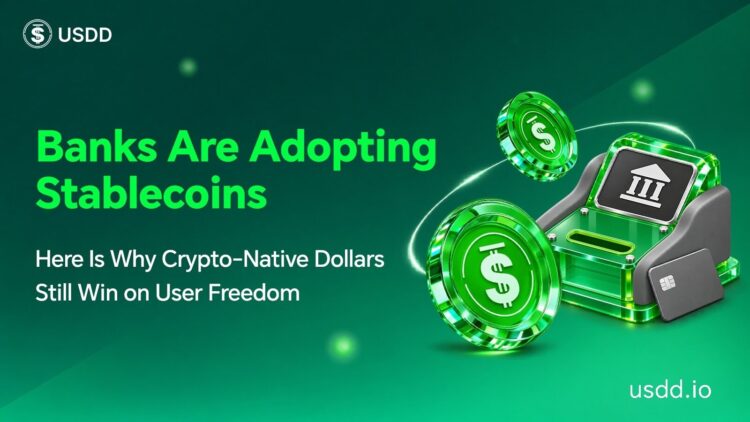
As traditional giants rush into digital dollars, USDD’s Yvonne Chia explains why 24/7 access, self-custody, and transparent yield give decentralized stablecoins an edge banks can’t replicate. 20 November – Road Town, Totorla, British Virgin Islands – Decentralized stablecoin protocol USDD is accelerating its multichain utility across TRON, Ethereum, and BNB Chain—combining automated sUSDD yield via its Smart Allocator with GasFree zero-TRX transfers—as traditional financial giants race to build competing stablecoin rails. In a recent industry interview with instant exchange partner ChangeNOW, USDD Head of Communications Yvonne Chia outlined why self-custody, 24/7 settlement, and transparent onchain reserves give decentralized digital dollars a structural advantage over bank-issued alternatives. 1. Permissionless Access vs. Gatekept Accounts For billions of people globally, opening and maintaining a traditional bank account still involves paperwork, minimum balance requirements, geographic restrictions, and approval delays. Even when banks integrate stablecoin rails behind the scenes, those services remain gated behind legacy compliance walls and intermediary control. Crypto-native stablecoins flip that model on its head. As Yvonne Chia highlighted during the interview: “Compare this to a stablecoin like USDD, where all you need is a phone, a working internet connection, you can immediately start a wallet and you have access to your funds right away.” With USDD, users can access and manage their digital dollars directly through their own wallets, without depending on traditional financial intermediaries. This represents a fundamental shift in financial access: users are no longer limited to the services, operating hours, or account structures of a single institution. Instead, they have the freedom to hold, manage, and transfer their assets on their own terms. Self-custody also gives users greater autonomy over their financial decisions. They can choose which wallets to use, where to transfer their assets, and which supported decentralized applications to interact with, without needing to route every transaction through a centralized financial institution. With USDD, users’ digital dollars can move with them across an open blockchain ecosystem, rather than remaining tied to a particular bank or service provider. 2. 24/7 Global Settlement vs. “Banking Hours” Legacy payment networks still operate on decades-old schedules: weekend cutoffs, bank holidays, and multi-day cross-border settlement delays accompanied by hefty wire fees. Blockchain networks never close. Whether it is a Sunday night or a public holiday, USDD moves globally without depending on traditional banking operating hours or settlement windows. “We are able to have transfers 24/7 and we’re not limited to any traditional banking hours. So I think that in some ways, stablecoins are not just becoming banks, but exceeding what traditional banks can offer to users.” To make everyday transfers even smoother than fintech apps, USDD introduced GasFree integration on TRON, allowing users on supported wallets to pay network fees directly in USDD without needing to hold TRX. This removes another practical barrier to stablecoin adoption: having to acquire and maintain a separate gas token just to transfer digital dollars. With GasFree, eligible users can pay approximately 0.5 USDD per transaction, compared with around 1.5 USDT for a standard USDT transfer under the referenced fee conditions. These improvements matter because the usefulness of a stablecoin is not determined by its peg alone. Low-cost transfers, straightforward wallet experiences, and around-the-clock availability are what make digital dollars practical for everyday payments and global value transfers. 3. Passing Yield Back to Users vs. Bank Spreads Perhaps the sharpest contrast between banks and decentralized stablecoins lies in how yield is distributed. In traditional banking, institutions take customer deposits, deploy them into yield-generating markets, and retain a significant portion of the returns. Everyday depositors may receive relatively low interest rates, while higher-yielding products often come with eligibility requirements, minimum deposits, or fixed maturity periods. Stablecoins introduce another way to participate in digital-dollar opportunities. Rather than keeping capital entirely within a traditional deposit account, users can access onchain yield opportunities through decentralized protocols and transparent investment mechanisms. USDD was built to return that value directly to holders. Through USDD Earn, users can deposit USDD to receive sUSDD, earning automated, competitive yield powered by our Smart Allocator system, with no fixed lock-up periods restricting access to their capital. For users, the distinction is important: USDD Earn provides access to a productive stablecoin while maintaining flexibility, rather than requiring users to commit their capital to a conventional fixed-term product. 4. Onchain Verification vs. Institutional Trust Traditional banks ask customers to trust closed-door balance sheets and periodic regulatory filings—until a crisis proves otherwise. USDD takes a different approach through its “Don’t trust, verify” ethos, emphasizing publicly accessible onchain information and independent verification. Onchain Transparency: Smart contract addresses, collateral reserves, and Smart Allocator deployments are publicly viewable, allowing users to examine relevant information directly on the blockchain. Structured Disclosures: Quarterly Treasury Reports provide additional information about reserve positions, financial performance, and operational developments. Independent Security Reviews: USDD undergoes third-party security audits to assess its smart contracts and identify potential vulnerabilities. Transparency does not eliminate financial or technical risks, but it changes how users can evaluate them. Instead of relying exclusively on an institution’s assurances, users have access to information that can be independently examined and verified. 5. Beyond a Single Network: An Open, Multichain Financial Ecosystem Financial freedom is not just about holding digital dollars. It is also about being able to use them wherever opportunities and applications exist. A stablecoin confined to a single network or limited use case cannot fully realize the potential of open blockchain finance. Following its January 2025 protocol upgrade, USDD expanded natively from TRON onto Ethereum and BNB Chain, extending its reach across multiple blockchain ecosystems. This multichain presence allows USDD to connect with different communities, liquidity environments, and decentralized applications. Its sUSDD product has also expanded into DeFi integrations, including Pendle and Morpho, giving users additional ways to access yield strategies across supported ecosystems. The bigger picture is an interconnected financial ecosystem in which users can move between holding, transferring, exchanging, and deploying their stablecoins according to their own needs. These are not isolated functions. Together, they make stablecoins more useful as everyday financial infrastructure. The Future: Interconnected, Open, and Multichain Banks will undoubtedly continue using stablecoin rails to modernize their back-end settlement. However, true financial freedom comes from open networks where assets flow freely across protocols without intermediaries. For USDD, the opportunity goes beyond offering a dollar-pegged asset. It is about making digital dollars accessible, transferable, and productive across an interconnected financial ecosystem. From self-custody and 24/7 transfers to flexible yield opportunities and multichain DeFi access, these capabilities give users more ways to put their money to work. Banks may be bringing stablecoins into traditional finance. Crypto-native protocols are showing what stablecoins can make possible beyond it.
As traditional giants rush into digital dollars, USDD’s Yvonne Chia explains why 24/7 access, self-custody, and transparent yield...

Robinhood’s Steve Quirk takes tokenization and prediction markets to Bloomberg’s ETF stage
Robinhood's expansion into tokenization and prediction markets could redefine trading norms, challenging traditional exchanges and...

Binance hack laundering accelerates as $149M in Bitcoin passes through coinjoins, Elliptic says
The accelerated laundering of stolen funds via coinjoins highlights ongoing challenges in tracking and recovering illicit cryptocu...
Coinbase Institutional: US dollar was the lone gainer as Bitcoin and Ethereum led monthly losses
Crypto market volatility highlights investor preference for stability, with institutions consolidating into perceived safer assets...

Bitcoin, Ethereum, XRP, and Solana slide as $90 billion exits crypto market
The crypto market's volatility highlights the fragility of leveraged positions and suggests a cooling institutional interest amid...

BTCS warns SEC its $54 million Aave loan could face liquidation
BTCS's situation highlights the risks of DeFi leverage for public companies, emphasizing the need for transparency and risk manage...