BRICS De-Dollarization Push, China, and Crypto Threaten US Dollar’s Dominance: Analyst
Fitch Solutions’ global head of country risk has named the rising adoption of cryptocurrencies, the de-dollarization efforts by the BRICS countries, and China’s rising “economic might” as key factors that erode the U.S....
Archive context
Older archive item. Useful for background and entity history, but not a fresh market-moving signal.

Fitch Solutions’ global head of country risk has named the rising adoption of cryptocurrencies, the de-dollarization efforts by the BRICS countries, and China’s rising “economic might” as key factors that erode the U.S. dollar’s dominance over time. He cautioned that China will “exert more influence in global financial institutions and trade.”
Analyst Explains Why U.S. Dollar’s Dominance Is at RiskFitch Solutions’ global head of country risk, Cedric Chehab, explained why the U.S. dollar’s dominance is declining in an interview with CNBC on Sunday. Fitch Solutions provides financial information services; it is a division of Fitch Group that includes Fitch Ratings, a global leader in credit ratings and research.
The analyst explained that “Any reduction in the status of the U.S. dollar is going to be a slow erosion rather than a paradigm shift,” adding:
We’re gonna see that dollar dominance erode over time.
Chehab named three key reasons why the USD dominance is eroding. The first concerns China. He detailed: “China is the largest trade partner of most economies, and as its economic might continues to rise, that means that it’ll exert more influence in global financial institutions and trade, etc.”
Secondly, he explained that several economies want to diversify. Russia, for example, has been trying to delink itself from the U.S.-led financial sector, he described, noting that the sanctions imposed by Western countries have accelerated the efforts. Chehab also mentioned the BRICS bloc and ASEAN countries making similar efforts to reduce their reliance on the U.S. dollar. BRICS consists of Brazil, Russia, India, China, and South Africa. They are reportedly working to create a new type of currency that will reduce their reliance on the U.S. dollar. ASEAN nations comprise Brunei, Cambodia, Indonesia, Laos, Malaysia, Myanmar, the Philippines, Singapore, Thailand, and Vietnam.
The Fitch Solutions analyst also pointed to central bank digital currencies (CBDCs) and cryptocurrencies as the third reason. Noting that they are “less talked about,” he cautioned:
We’ll essentially see, perhaps, less use of general currencies. That will impact the U.S. dollar.
Do you agree with the Fitch Solutions analyst? Let us know in the comments section below.
Why this matters
This cryptocurrency story adds another data point to the current market tape and is useful when read alongside nearby source coverage.
Original source
Read on Bitcoin NewsRelated market context

Ripple Brings RLUSD to Cross River Bank as Garlinghouse Backs Evernorth’s XRP Strategy
Announced on October 15, the Cross River partnership integrates Ripple USD (RLUSD) into the bank’s proprietary Core Operating Syst...

Circle Says 59 Cents of Each Revenue Dollar Went to USDC Partners and Transaction Costs
Circle said it paid about $819 million of its roughly $1.4 billion in first-half 2026 revenue to USDC distribution partners and tr...

Crypto Analyst Lark Davis: The Bitcoin Bull Run has Begun
Bitcoin Magazine Crypto Analyst Lark Davis: The Bitcoin Bull Run has Begun Bitcoin has been trading sideways in the $80Ks, but Lar...

Circle Targets 40 New Markets As USDC Push Moves Beyond Crypto Trading
TL;DR: Circle plans to expand USDC infrastructure into approximately 40 developing and emerging markets. The company is targeting...
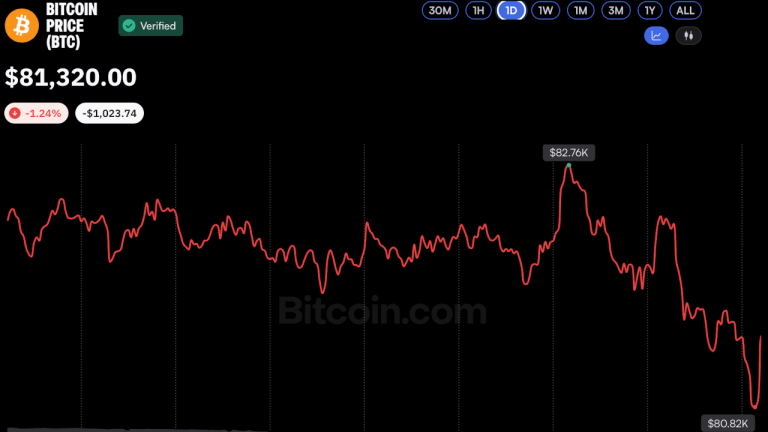
Bitcoin Price Hovers Near $81K as Analysts See Potential Market Bottom
Bitcoin slipped below $81,000 on Oct. 16 amid heightened market volatility, but analysts remained cautiously optimistic, suggestin...

Trade futures without the wallet-hopping: Unified Wallet is now available in the EEA
TL;DR Unified Wallet is now available to EEA clients on Kraken Pro It combines your spot, margin, and futures balances into one sh...