BRICS Leaders Set to Discuss Common Currency to Challenge US Dollar Dominance in Upcoming Summit
The BRICS nations are set to discuss the feasibility of a common currency at the upcoming leaders’ summit. “It’s a matter we must discuss and discuss properly,” a South African minister stressed, noting that a growing nu...
Archive context
Older archive item. Useful for background and entity history, but not a fresh market-moving signal.
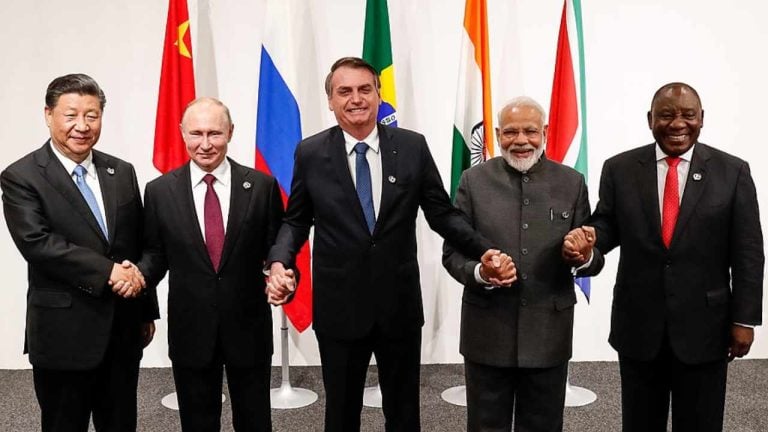
The BRICS nations are set to discuss the feasibility of a common currency at the upcoming leaders’ summit. “It’s a matter we must discuss and discuss properly,” a South African minister stressed, noting that a growing number of countries are saying: “Why can’t we trade in our own currencies? Why are we committed to trading through the dollar?”
BRICS Currency to Be Discussed at Upcoming Leaders’ SummitThe BRICS countries are planning to discuss the feasibility of introducing a common currency at their upcoming leaders’ summit, which will be hosted by South Africa on Aug. 22 in Johannesburg.
While noting that she does not like “preempting BRICS leaders’ discussions,” South African Minister of International Relations and Cooperation Naledi Pandor commented on BRICS currency discussions in an interview with Bloomberg Tuesday. She stressed:
It’s a matter we must discuss and discuss properly.
“I don’t think we should always assume the idea will work because economics is very difficult and you have to have regard to all countries, especially in a situation of low growth when you are emerging from crises,” she continued.
The BRICS nations, which comprise Brazil, Russia, India, China, and South Africa, have been ramping up their de-dollarization efforts, and a common BRICS currency is expected to help member countries shift away from the reliance on the USD. A Russian official recently said he expects an agreement on a BRICS currency this year. Nineteen countries have either applied to join the BRICS economic bloc or have expressed interest in joining, including Saudi Arabia and Iran.
The South African minister explained that the BRICS nations and a growing number of countries are saying:
Why can’t we trade in our own currencies? Why are we committed to trading through the dollar?
Nonetheless, she cautioned: “South Africa has an internationally traded currency. However, we hold a lot of debt in dollars so you know we have to approach this discussion responsibly.”
Multiple people expect a common BRICS currency to erode the U.S. dollar’s dominance. A former White House economist said if the BRICS nations used only their common currency for international trade, “they would remove an impediment that now thwarts their efforts to escape dollar hegemony.” However, some believe that a BRICS currency poses little to no threat the to USD, including Bank of America and Dave Ramsey.
Do you think a BRICS currency will displace the U.S. dollar as the world’s reserve currency? Let us know in the comments section below.
Why this matters
This cryptocurrency story adds another data point to the current market tape and is useful when read alongside nearby source coverage.
Original source
Read on Bitcoin NewsRelated market context
US Hoovers up Bitcoin While the World Runs on Its Digital Dollars: Report
Bitcoin Magazine US Hoovers up Bitcoin While the World Runs on Its Digital Dollars: Report America is accumulating bitcoin while e...

Circle Targets 40 New Markets As USDC Push Moves Beyond Crypto Trading
TL;DR: Circle plans to expand USDC infrastructure into approximately 40 developing and emerging markets. The company is targeting...
Circle Says 59 Cents of Each Revenue Dollar Went to USDC Partners and Transaction Costs
Circle said it paid about $819 million of its roughly $1.4 billion in first-half 2026 revenue to USDC distribution partners and tr...
XRP spot volume surpasses Bitcoin and Ethereum on South Korea’s Upbit
XRP's dominance on Upbit highlights the potential impact of local regulatory shifts on global crypto liquidity and market dynamics...

Aave V4 opens dollar-euro borrowing on Circle’s Arc network
Aave V4's new feature could enhance euro liquidity in DeFi, testing risk management and potentially influencing stablecoin market...
Binance Eyes Hong Kong, South Korea, Taiwan, Brazil Stocks in Global Push
Binance is exploring ways to give users exposure to leading stocks in markets including Hong Kong, South Korea, Taiwan, and Brazil...