Canton Coin Is a ‘Digital Commodity,’ SEC Staff Say in Letter Covering Network Rewards
Minting Canton Coin (CC) as network rewards without registering it under the securities laws won’t draw an SEC staff enforcement recommendation, as long as validators and app providers do it the way Digital Asset describ...
Watchlist
Published in the last two hours. A tracked entity is involved.

Minting Canton Coin (CC) as network rewards without registering it under the securities laws won’t draw an SEC staff enforcement recommendation, as long as validators and app providers do it the way Digital Asset described. Staff wrote in the letter that the token fits the “digital commodity” category in the SEC’s March 2026 crypto interpretation.
Deputy Chief Counsel Jonathan A. Ingram of the Division of Corporation Finance signed the no-action letter on Nov. 3, answering an Oct. 30 request from Digital Asset’s counsel, Jeffrey T. Dinwoodie. It covers programmatic minting by three groups (Super Validators, Validators and application providers) and names two registration provisions: Section 5 of the Securities Act and Section 12(g) of the Exchange Act.
Get Unchained’s crypto news in your inbox with the free Unchained Daily newsletter.
What the Staff Agreed ToStaff said in the letter that they relied on Digital Asset’s representations, singling out two: that CC “derives its value from the programmatic operation of the Canton Network, as well as supply and demand dynamics, rather than from the expectation of profits from the essential managerial efforts of others” and that Canton has no “central party,” as the interpretation defines that term.
The letter is a staff position, not a Commission action. It says “any different facts or conditions might require the Division to reach different conclusions,” and that it “does not express any legal conclusion on the issues presented.” The letter does not address trading of CC on secondary markets.
Dinwoodie’s request also asked staff to confirm that CC is therefore not itself a security. The reply states the digital-commodity view without that clause. The SEC’s March interpretation, Release 33-11412, says a digital commodity itself, “as described in this release, is not a security”; such an asset can still be sold under an investment contract, and that contract is a security. Canton’s Nov. 4 press release described the relief as confirming that CC “is a digital commodity and not a security.”
The Facts Staff Relied OnAccording to the request, Canton was functional when it launched in June 2024, and CC had no ICO, pre-mine or pre-launch sale; every coin has been minted by the protocol. CC pays no passive yield and carries no claim on income or assets, the request says, and Digital Asset “has not undertaken, and does not undertake, to support, stabilize or otherwise influence the price of Canton Coin.” As of Sept. 30, Digital Asset ran two of the 13 Super Validator nodes; the node operators vote on governance, and changes need approval from at least two-thirds of them.
“This decision provides important clarity around how a public blockchain can incentivize participation while operating within established regulatory frameworks,” Yuval Rooz, CEO of Digital Asset, said in the release.
Miles Jennings, head of policy and general counsel at a16z Frontier, wrote on X that the SEC’s taxonomy and follow-up FAQs “have now created a clear pathway out of securities laws” and that “network tokens are digital commodities.” The firm, then called a16z crypto, headed Digital Asset’s $355 million raise in June.
CC traded near $0.098 at 18:34 UTC on Nov. 4, according to CoinGecko data pulled by Unchained, about where it was on Oct. 31 and Nov. 1, after a dip to roughly $0.093 late on Nov. 2.
On Nov. 2, the day before the letter, Corporation Finance staff said in new crypto FAQ answers that unaffiliated participants in a network’s broad-based governance system generally aren’t a controlling group. Consensys has separately lined up Canton as the next network for its service linking banks’ private ledgers.
Related Listen: Is Canton ‘Permissionless’? Why Crypto Is Fighting Over What the Word Means
{"@context":"http:\/\/schema.org\/","@id":"https:\/\/unchainedcrypto.com\/canton-coin-is-a-digital-commodity-sec-staff-say-in-letter-covering-network-rewards\/#arve-youtube-fxarsrnufpg","@type":"VideoObject","embedURL":"https:\/\/www.youtube-nocookie.com\/embed\/FxaRSRnufpg?feature=oembed&iv_load_policy=3&modestbranding=1&rel=0&autohide=1&playsinline=1&autoplay=0"}
The post Canton Coin Is a ‘Digital Commodity,’ SEC Staff Say in Letter Covering Network Rewards appeared first on Unchained.
Why this matters
SEC is showing up inside the Regulation theme, so this story is worth tracking for follow-through rather than treating it as a one-off headline.
Original source
Read on UnchainedRelated market context

Canton Coin Gets SEC Nod as Wall Street Tokenization Heats Up
SEC staff said they view Canton Coin as a digital commodity and won’t recommend enforcement over how it’s minted, a week after DTC...

Six Days After Launch, Morgan Stanley Says It Is Using DTCC’s Tokenization Service
Morgan Stanley is using the DTCC Tokenization Service (DTS) to put U.S. equities and Treasuries into token form, the bank said in...
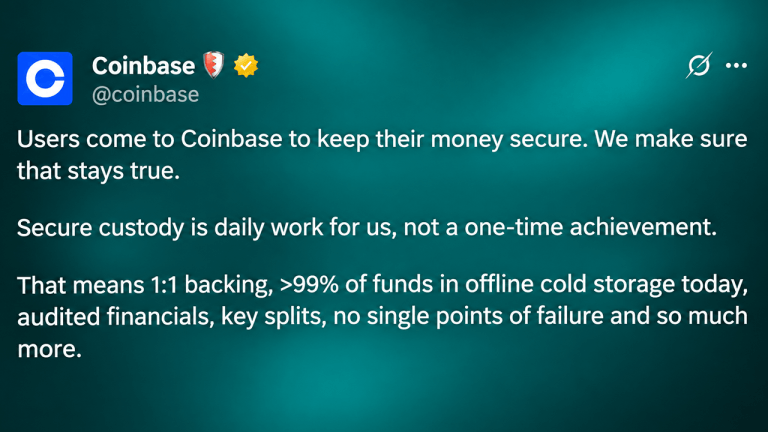
Coinbase Says 99% of Customer Assets in Cold Storage After $6.3B Binance Hack
Coinbase says more than 99% of customer assets are held in offline cold storage following Binance’s $6.34 billion hack on Oct. 29,...
Coinbase says 99% of customer assets are in cold storage following Binance’s $6.3B hack
Coinbase's robust cold storage strategy highlights the critical need for enhanced security measures in the crypto industry to prev...

Second Circuit Won’t Pause New York, Connecticut Actions Against Kalshi and Coinbase
Kalshi will not get federal court protection from New York and Connecticut regulators, and Coinbase will not get it from Connectic...
Coinbase says 99% of customer assets sit in cold storage after Binance’s $6.3 billion breach
Coinbase says 99% of customer assets are in cold storage and it wasn't affected by the $6.3 billion Binance hack.