CFTC Advisory Sets Expectations For Tokenized Collateral At Clearinghouses
The CFTC’s Division of Clearing and Risk has issued a staff advisory on how registered derivatives clearing organizations should handle tokenized collateral, including tokenized U.S. Treasuries used as margin. The adviso...
Archive context
Older archive item. Useful for background and entity history, but not a fresh market-moving signal.

The CFTC’s Division of Clearing and Risk has issued a staff advisory on how registered derivatives clearing organizations should handle tokenized collateral, including tokenized U.S. Treasuries used as margin.
The advisory is a narrow but important signal. It does not approve tokenized collateral for every market. It does not mean all clearinghouses can suddenly accept any on-chain asset. It sets risk-management expectations for registered DCOs dealing with a specific emerging market structure.
That makes the document useful for understanding how regulators are approaching tokenized assets inside core financial plumbing.
For more details, visit the official Cftc platform.
TL;DR- The CFTC issued staff guidance for DCOs handling tokenized collateral.
- The advisory covers risk controls around tokenized U.S. Treasuries used as margin.
- It is not a broad approval of all tokenized assets across all markets.
Derivatives clearing organizations sit deep inside financial market infrastructure.
They help manage counterparty risk, margin, settlement, and default processes for derivatives markets. Most retail crypto traders do not think about DCOs, but institutions care about them because clearing determines how risk is controlled after trades are made.
If tokenized collateral enters this part of the market, the stakes are high.
Collateral needs to be valued accurately. It needs to be liquid enough under stress. It needs strong custody arrangements. It needs legal clarity. It needs operational resilience.
The CFTC advisory speaks to those requirements.
Tokenized Treasuries Are Moving Closer To Market InfrastructureTokenized U.S. Treasuries have become one of the strongest RWA categories.
They are familiar, relatively liquid, yield-bearing, and easier for institutions to understand than many crypto-native assets. Using them as margin could make sense in some settings, but only if the risks are managed properly.
That is where regulators become cautious.
A tokenized Treasury may represent a traditional asset, but it still introduces digital-asset risks. There can be wallet risk, smart contract risk, transfer restrictions, issuer risk, oracle risk, redemption timing, and technology failure.
A clearinghouse cannot treat the tokenized wrapper as irrelevant.
Liquidity And Valuation Are CentralThe advisory highlights the kinds of questions DCOs need to answer.
How is the asset valued daily? What happens if liquidity dries up? Can the collateral be liquidated quickly during stress? Who controls custody? What legal rights does the clearinghouse have? Are there operational dependencies on a blockchain, custodian, or issuer?
Those questions are not theoretical.
Collateral is supposed to protect the system during bad conditions. If tokenized collateral only works during calm markets, it is not good enough for clearing.
Not A Free Pass For RWACrypto markets may be tempted to read the advisory as regulatory approval for tokenized assets.
That would be too broad.
The document is about expectations for registered DCOs. It does not bless every RWA protocol, every tokenized fund, or every tokenized Treasury product. It also does not remove the need for clearinghouses to satisfy existing regulations.
The more measured view is that tokenized collateral is now serious enough to require detailed supervisory expectations.
That is still meaningful.
The Institutional SignalThe advisory shows tokenization is moving from concept to infrastructure.
Regulators are no longer only asking whether tokenized assets are interesting. They are asking how they behave inside regulated market systems. That is a much more advanced conversation.
For crypto, that is a sign of maturity.
The next phase of RWA adoption will depend less on splashy launches and more on whether tokenized assets can survive legal, operational, custody, and liquidity scrutiny.
The CFTC’s advisory is part of that test.
This article draws on the CFTC Division of Clearing and Risk staff advisory on tokenized collateral for registered derivatives clearing organizations.
This article was written by the News Desk and edited by Samuel Rae.
Why this matters
CFTC is showing up inside the Regulation theme, so this story is worth tracking for follow-through rather than treating it as a one-off headline.
Original source
Read on NewsBTCRelated market context

Binance bStocks Hits $1 Billion As Tokenized Stock Trading Accelerates
TL;DR: Binance says its bStocks tokenized-equity offering has surpassed $1 billion in assets under management, four months after l...
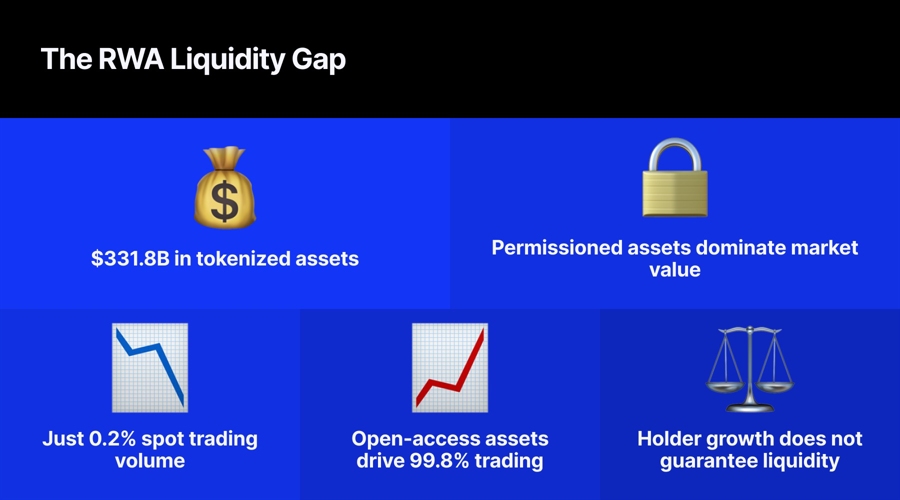
More Holders, Little Trading: The RWA Liquidity Problem Is Worse Than You Think
Let me ask you something straight. Does real-world asset trading on crypto exchanges feel like a genuine revolution, or does it fe...

Fidelity Sees A Stronger Solana Network, With Concentration Risks Still In View
TL;DR: Fidelity’s technology research team says Solana has operated for more than two years without a major mainnet outage, while...

Pantera Leads $10 Million Fission Funding Round To Solve Tokenized Fund Liquidity Problem
TL;DR: Tokenization infrastructure firm Fission has raised $10 million in a funding round led by Pantera Capital. It wants to make...

Morgan Stanley Builds Crypto Lab to Test Stablecoins, Tokenization and DeFi at Scale
Key Takeaways: Morgan Stanley has opened a Digital Asset Lab dedicated to blockchain technologies. The test is to be applied to th...

CFTC advances crypto regulation plan after CLARITY Act defeat in Senate
The CFTC's proactive regulation efforts may stabilize crypto markets, but ongoing legislative uncertainty could hinder comprehensi...