Chinese Central Bank Says It Will Prioritize Stabilizing Currency After Yuan Plunges to 14-Year Low Versus USD
Moments after the Chinese yuan’s onshore exchange rate versus the U.S. dollar slumped to 7.2458 per dollar, the Peoples Bank of China responded by stating that it will prioritize stabilizing the currency. Similar to othe...
Archive context
Older archive item. Useful for background and entity history, but not a fresh market-moving signal.
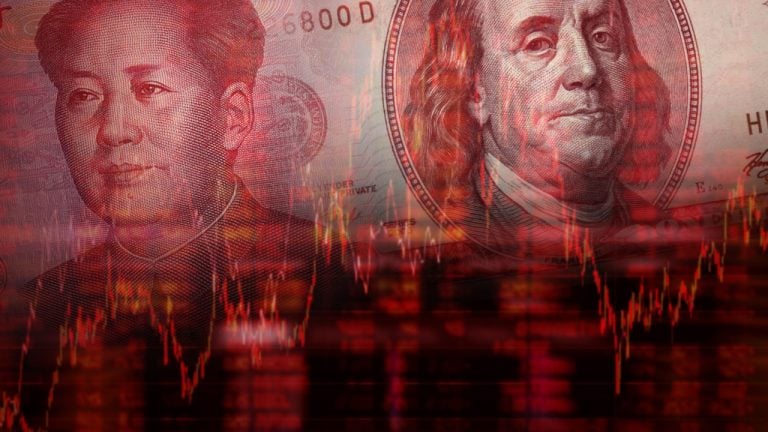
Moments after the Chinese yuan’s onshore exchange rate versus the U.S. dollar slumped to 7.2458 per dollar, the Peoples Bank of China responded by stating that it will prioritize stabilizing the currency. Similar to other currencies that have been depreciating against the dollar, the yuan has now lost 12% versus the greenback so far this year.
Central Bank Warns Currency Speculators
The Chinese yuan’s onshore exchange rate against the greenback recently plunged to 7.2458 for every dollar, the lowest since January 2008. The yuan’s latest slump came just days after the exchange rate between the two currencies breached the 1:7 mark. Since then — September 15, 2022 — the yuan has now depreciated by over 3%.
Overall, the Chinese yuan has lost over 12% against the U.S. dollar since the start of the year. According to a Reuters report, the Chinese yuan, just like other global currencies, has struggled against the dollar ever since the U.S. Federal Reserve began marginally increasing interest rates.
The interest rate hikes are a tool being used by the U.S. Federal Reserve to tame the country’s inflation rate which peaked at 9.1% in June 2022.
However, following the yuan’s slump to its lowest exchange rate in more than 14 years, the People’s Bank of China (PBOC) has reportedly said it will now prioritize stabilizing the yuan.
In addition to reassuring the markets, the PBOC also warned of repercussions likely to be faced by those betting against the yuan. The PBOC reportedly said:
Do not bet on one-way appreciation or depreciation of the yuan, as losses will definitely be incurred in the long term.
Instead of betting against the currency, the central bank urged players in the currency markets to “voluntarily safeguard the stability of the market, and be firm when they need to iron out big rallies or declines in the exchange rate.”
As per a Bloomberg report, the Chinese central bank’s warning is aimed at corporates that are accused of placing speculative bets against the yuan. The warning is also directed at financial institutions reportedly violating the country’s policies.
Before the yuan’s September 28 fall, the POBC reportedly signaled its intention to “dampen speculative demand” by imposing a risk reserve requirement ratio (RRRR) of 20% on financial institutions purchasing foreign exchange via currency forwards. A report in the South China Morning Post, which quotes analysts from Goldman Sachs, suggested that the PBOC hoped raising the RRRR would slow down the yuan’s depreciation ahead of The Chinese Communist Party’s 20th Congress.
Meanwhile, Grant Wilson, a senior adviser at macro advisory and data analytics firm Exante Data, insisted in a recent op-ed that Chinese monetary authorities may have already resorted to secretly helping the yuan. However, since the intervention is by stealth, it only shows up “on the balance sheet of China’s state banks as net foreign currency assets, rather than in the PBOC’s official reserves.”
Wilson argued that Chinese authorities are intervening in this way because this will limit the yuan’s appreciation while supporting exports. The fear of being labeled a currency manipulator is another reason why Chinese monetary authorities may have chosen to intervene secretly.
“The stability of official reserves ensures that China does not meet one of three criteria used by the U.S. Treasury to label a country a currency manipulator,” explained Wilson.
What are your thoughts on this story? Let us know what you think in the comments section below.
Why this matters
This cryptocurrency story adds another data point to the current market tape and is useful when read alongside nearby source coverage.
Original source
Read on Bitcoin NewsRelated market context

Netanyahu Floats Blockchain as a Sanctions Workaround; Israel’s Central Bank Objects
Israeli Prime Minister Benjamin Netanyahu said in a Channel 10 interview on Friday, Oct. 23, that Israel has to get ready for poss...

How Solana Supports Fast Crypto Payments in Digital Gaming
Picture a SOL holder on a quiet evening, watching the token tick sideways on a chart that hasn’t done much all week. Rather than r...

Bank Lobby Presses OCC For Clarity On Stablecoin Rewards After Final Rule
A final stablecoin rule has not ended the argument over rewards. The Bank Policy Institute used its October 24 newsletter to renew...

Strategy’s Weekly STRC Buyback Climbs to $205 Million While Its Bitcoin Stack Stays Put
Strategy spent $204.9 million repurchasing 2,068,459 shares of its STRC preferred stock between Oct. 19 and Oct. 25 and bought no...

Quant Crypto Soars 18% as QNT Charges Toward $250
Quant crypto is back in the spotlight after QNT climbed to $216, gaining 18.7% in 24 hours. The move puts the blockchain interoper...

BNB New Layer 1 Puts CZ’s Ecosystem Strategy in Focus as ASTER Builds Its Own Chain
Changpeng Zhao’s vision for a multi-chain crypto ecosystem is coming into sharper focus as BNB Chain develops a new Layer 1 blockc...