Crypto lobbies launch a last-minute TV campaign against banks to pass the CLARITY Act
The crypto industry is launching a seven-figure national advertising campaign to rescue the CLARITY Act ahead of a crucial Senate vote next week. The Senate is scheduled to vote Sept. 15 on whether to invoke cloture on a...
Archive context
Older archive item. Useful for background and entity history, but not a fresh market-moving signal.
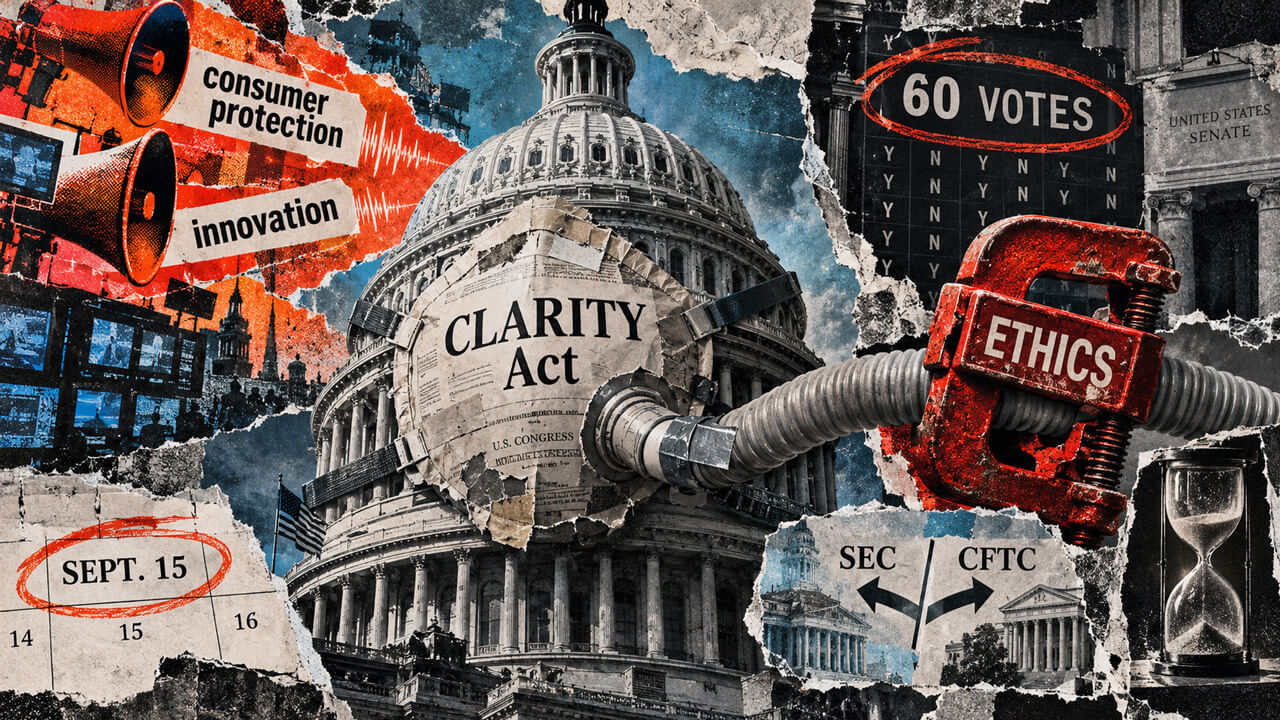
The crypto industry is launching a seven-figure national advertising campaign to rescue the CLARITY Act ahead of a crucial Senate vote next week.
The Senate is scheduled to vote Sept. 15 on whether to invoke cloture on a motion to proceed to the Digital Asset Market Clarity Act, a procedural hurdle requiring 60 votes.
The measure would establish federal rules for digital-asset markets and divide oversight between the Securities and Exchange Commission (SEC) and the Commodity Futures Trading Commission (CFTC). The vote would only open debate, leaving lawmakers to clear additional procedural steps before final passage.
Yet with a week remaining, senators involved in the negotiations are reportedly signaling that the votes may not be there.
Crypto turns up the pressure as the votes slip awayWith negotiations struggling to produce a breakthrough, crypto's political network is moving to make opposition to CLARITY more costly for lawmakers and the banking industry.
The Cedar Innovation Foundation, a 501(c)(4) nonprofit linked to the Fairshake super PAC network, is launching a seven-figure cable advertising campaign across three spots aimed at building support for the bill. Two emphasize consumer protection and endorsements from outside the crypto industry, while a third attacks banks that have resisted parts of the legislation.
The bank-focused advertisement accuses the industry of enjoying a profit “feeding frenzy” while trying to block competition, accompanied by images of pigs eating from troughs.
Banks, particularly smaller lenders, have spent months pushing lawmakers to tighten provisions governing stablecoin rewards, arguing that crypto platforms could use yield-like incentives to pull deposits away from the banking system.
Those objections have complicated negotiations, even as crypto companies have pressed Congress to complete legislation debated for years.
The other advertisements seek to broaden the CLARITY Act's appeal beyond the industry's regulatory agenda. One highlights support from major law-enforcement groups and says AARP backs provisions designed to combat crypto scams targeting older Americans. AARP's support is narrower than a full endorsement of the legislation, covering a provision aimed at crypto ATM fraud.
The campaign follows another potential obstacle that eased last week.
The National Sheriffs' Association dropped its opposition to CLARITY and shifted to a neutral position after months of warning that the legislation could weaken efforts to prosecute illicit crypto activity. Other law-enforcement groups have backed the measure.
Related Reading Trump to meet Coinbase, Ripple and crypto leaders as CLARITY Act odds collapse to 10% Trump ethics fight becomes the bill's choke pointClearing those industry disputes has done little to resolve the political issue now threatening the bill's survival: how far Congress should go in restricting a sitting president and his family from profiting from digital assets.
Republican Sens. Mike Rounds and Thom Tillis reportedly said the bill's prospects have deteriorated as Democrats and the White House remain divided over ethics restrictions governing President Donald Trump and his family's crypto interests.
Two Democratic aides told Semafor that the party has made little progress on its demand for an ethics provision covering Trump and his family. Rounds described the outlook as bleak, while Tillis said the legislation would fail without greater willingness from the White House to bridge the divide.
However, the White House disputes that characterization.
A spokesperson said Trump wants Congress to pass the CLARITY Act and argued that the administration has “worked tirelessly” on the legislation while agreeing to what it called the most comprehensive ethics provision in history.
The disagreement leaves senators approaching the vote with both sides claiming concessions have been made but no clear indication that enough Democrats are prepared to provide the votes needed for cloture.
The bill also faces a more basic political problem.
Republican Sen. Roger Marshall said he has heard virtually nothing about the legislation from constituents back home, suggesting that the industry's intense Washington campaign has yet to make market structure a significant voter issue for at least some senators.
A failed vote could close an already shrinking windowThe difficulty of assembling 60 votes has become more consequential as Congress runs out of opportunities to finish the legislation before the current session ends.
The House has canceled planned voting weeks later in September, making it increasingly likely that even a successful Senate process would push final action beyond the November midterm elections. Any Senate changes would also need House approval before the legislation could reach Trump's desk.
Sen. Cynthia Lummis, one of Congress' most prominent crypto advocates, has sought to turn that compressed calendar into pressure on wavering lawmakers.
“Next week, my colleagues have a choice,” Lummis said, framing the vote as one between protecting American crypto innovation and allowing China to gain ground in digital finance.
She has also emphasized provisions intended to protect customers when crypto companies fail.
The current proposal would require covered intermediaries to segregate customer assets and would treat qualifying holdings as customer property in bankruptcy, addressing problems exposed by failures such as FTX and Celsius.
Those protections would still depend on factors including how assets are held and the contractual relationship between customers and platforms.
Lummis has warned that failure this year could leave Congress without another realistic opportunity to enact market-structure legislation until 2030, potentially costing the US years of investment, jobs and tax revenue.
That timeline is a political forecast and not a statutory restriction. But with the House calendar already slipping beyond the midterms and the Senate still struggling to muster enough support to begin debate, the Sept. 15 vote is increasingly shaping up as a test of whether crypto's growing political influence can translate into the legislation the industry has spent the past year pursuing.
The post Crypto lobbies launch a last-minute TV campaign against banks to pass the CLARITY Act appeared first on CryptoSlate.
Why this matters
SEC is showing up inside the Regulation theme, so this story is worth tracking for follow-through rather than treating it as a one-off headline.
Original source
Read on CryptoSlateRelated market context

French Hill says SEC and CFTC crypto rules are no substitute for the CLARITY Act
The lack of a permanent legislative framework for crypto regulation may lead to ongoing market instability and fragmented complian...

SEC and CFTC Crypto Rules 'Fall Short' of Clarity, Says Rep. French Hill
The House Financial Services chairman credited the SEC and CFTC for stepping in after the Clarity Act's collapse but said only "pe...

House Finance panel chair says regulator actions on crypto ‘fall short’ of CLARITY bill
Representative French Hill hopes lawmakers could pass a cryptocurrency market structure bill before the next session of Congress i...
US government moves $470 million in seized crypto to Coinbase wallets, raising Bitcoin sale questions
The US government moved about $470 million in seized crypto to likely Coinbase Prime addresses, according to Arkham, reviving ques...
CFTC Chair Says New Crypto Rulemaking Will Prevent Another FTX-Style Collapse
Bitcoin Magazine CFTC Chair Says New Crypto Rulemaking Will Prevent Another FTX-Style Collapse Pro-crypto regulator Mike Selig has...

Cardano Brings Compliance Rules On-Chain With CIP-0113 Launch
TL;DR: Cardano’s CIP-0113 programmable token standard is now live on mainnet. It gives issuers the ability to build controls such...