Crypto PACs spend big on Ohio Senate race
Fairshake, a Super PAC often supported by the crypto industry, transferred over $24 million to its affiliate Defend American Jobs in September. Defend American Jobs spent about $24 million in the Ohio Senate race in Sept...
Archive context
Older archive item. Useful for background and entity history, but not a fresh market-moving signal.

Fairshake, a Super PAC often supported by the crypto industry, transferred over $24 million to its affiliate Defend American Jobs in September.
Defend American Jobs spent about $24 million in the Ohio Senate race in September.
Approximately $18.6 milion was spent supporting Jon Husted, the Republican incumbent for the Senate race.
An additional $5.7 million was spent opposing Sherrod Brown, the Democratic candidate for the Senate seat.
Defend American Jobs spent about $24 million in the Ohio Senate race in September.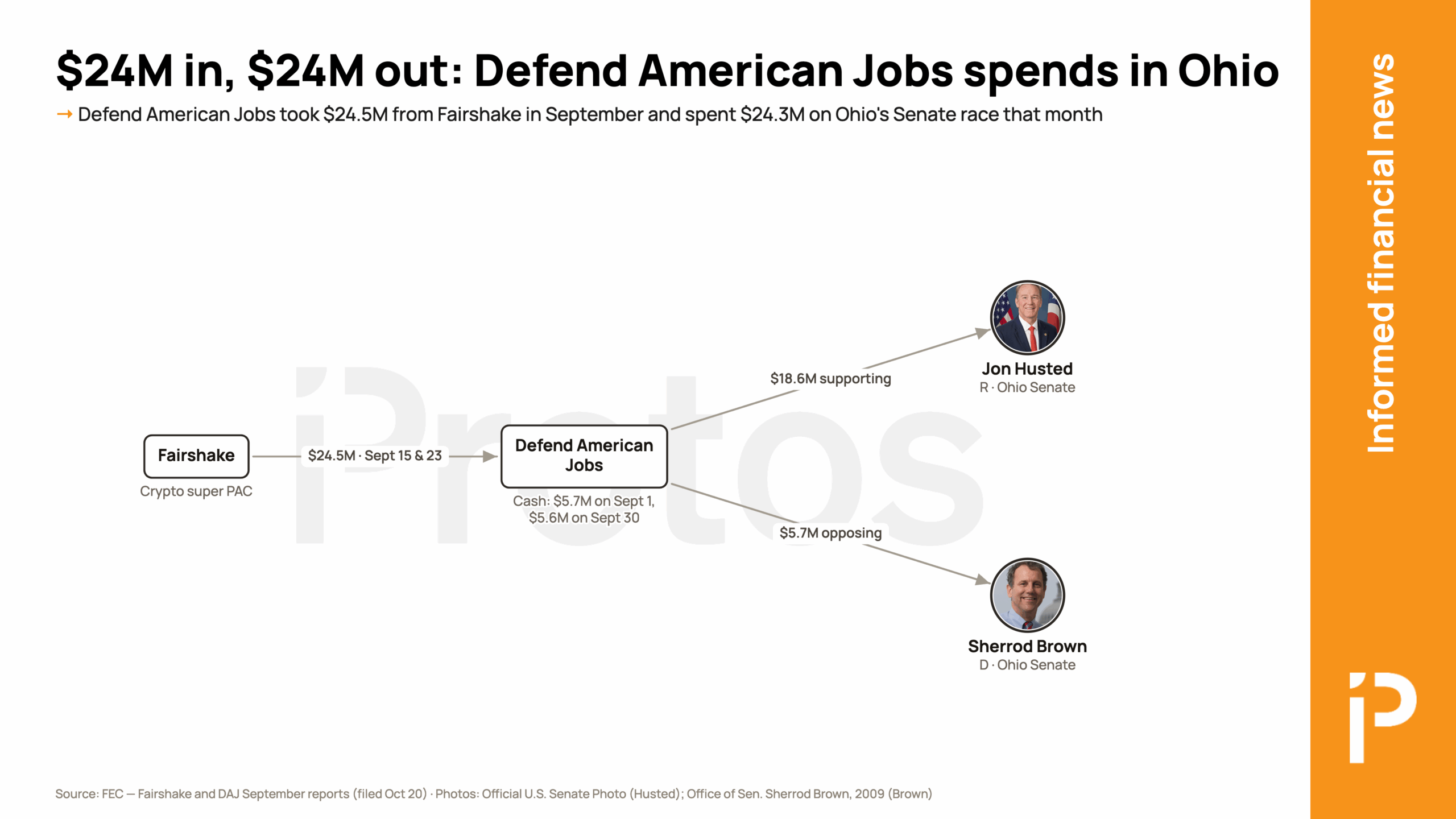
Defend American Jobs has continued spending in October, with more funds opposing Brown, supporting Husted, and adding in opposition to Dan Osborn, the independent in the Nebraska Senate race.
Brown has opposed the crypto industry before, describing crypto as “speculative products run by reckless companies — we know that’s true — that put Americans’ hard-earned money at risk, not surprising from an industry that was created to skirt the rules.”
The Clarity Act would create strong rules for cryptocurrency, protect consumers, and strengthen America’s leadership in digital assets.
We need to get it done. pic.twitter.com/RWoTH4YCsa
Husted was a vocal supporter of the Clarity Act.
In total, Defend American Jobs has spent more than $46 million in the Ohio Senate race this cycle, already beating the $40 million it spent supporting Bernie Moreno in 2024.
Defend American Jobs has been joined in its crypto industry spending by the Digital Freedom Fund.
The Digital Freedom Fund, which has most of its support coming from the Winklevoss Capital Fund, has spent an additional $5.9 million in the Ohio Senate race, supporting Husted and opposing Brown.
Got a tip? Send us an email securely via Protos Leaks. For more informed news and investigations, follow us on X, Bluesky, and Google News, or subscribe to our YouTube channel.
The post Crypto PACs spend big on Ohio Senate race appeared first on Protos.
Why this matters
This maps to the Regulation hub, so it can help confirm whether that theme is gaining breadth across the crypto news cycle.
Original source
Read on ProtosRelated market context
As traditional giants rush into digital dollars, USDD’s Yvonne Chia explains why 24/7 access, self-custody, and transparent yield give decentralized stablecoins an edge banks can’t replicate. 20 November – Road Town, Totorla, British Virgin Islands – Decentralized stablecoin protocol USDD is accelerating its multichain utility across TRON, Ethereum, and BNB Chain—combining automated sUSDD yield via its Smart Allocator with GasFree zero-TRX transfers—as traditional financial giants race to build competing stablecoin rails. In a recent industry interview with instant exchange partner ChangeNOW, USDD Head of Communications Yvonne Chia outlined why self-custody, 24/7 settlement, and transparent onchain reserves give decentralized digital dollars a structural advantage over bank-issued alternatives. 1. Permissionless Access vs. Gatekept Accounts For billions of people globally, opening and maintaining a traditional bank account still involves paperwork, minimum balance requirements, geographic restrictions, and approval delays. Even when banks integrate stablecoin rails behind the scenes, those services remain gated behind legacy compliance walls and intermediary control. Crypto-native stablecoins flip that model on its head. As Yvonne Chia highlighted during the interview: “Compare this to a stablecoin like USDD, where all you need is a phone, a working internet connection, you can immediately start a wallet and you have access to your funds right away.” With USDD, users can access and manage their digital dollars directly through their own wallets, without depending on traditional financial intermediaries. This represents a fundamental shift in financial access: users are no longer limited to the services, operating hours, or account structures of a single institution. Instead, they have the freedom to hold, manage, and transfer their assets on their own terms. Self-custody also gives users greater autonomy over their financial decisions. They can choose which wallets to use, where to transfer their assets, and which supported decentralized applications to interact with, without needing to route every transaction through a centralized financial institution. With USDD, users’ digital dollars can move with them across an open blockchain ecosystem, rather than remaining tied to a particular bank or service provider. 2. 24/7 Global Settlement vs. “Banking Hours” Legacy payment networks still operate on decades-old schedules: weekend cutoffs, bank holidays, and multi-day cross-border settlement delays accompanied by hefty wire fees. Blockchain networks never close. Whether it is a Sunday night or a public holiday, USDD moves globally without depending on traditional banking operating hours or settlement windows. “We are able to have transfers 24/7 and we’re not limited to any traditional banking hours. So I think that in some ways, stablecoins are not just becoming banks, but exceeding what traditional banks can offer to users.” To make everyday transfers even smoother than fintech apps, USDD introduced GasFree integration on TRON, allowing users on supported wallets to pay network fees directly in USDD without needing to hold TRX. This removes another practical barrier to stablecoin adoption: having to acquire and maintain a separate gas token just to transfer digital dollars. With GasFree, eligible users can pay approximately 0.5 USDD per transaction, compared with around 1.5 USDT for a standard USDT transfer under the referenced fee conditions. These improvements matter because the usefulness of a stablecoin is not determined by its peg alone. Low-cost transfers, straightforward wallet experiences, and around-the-clock availability are what make digital dollars practical for everyday payments and global value transfers. 3. Passing Yield Back to Users vs. Bank Spreads Perhaps the sharpest contrast between banks and decentralized stablecoins lies in how yield is distributed. In traditional banking, institutions take customer deposits, deploy them into yield-generating markets, and retain a significant portion of the returns. Everyday depositors may receive relatively low interest rates, while higher-yielding products often come with eligibility requirements, minimum deposits, or fixed maturity periods. Stablecoins introduce another way to participate in digital-dollar opportunities. Rather than keeping capital entirely within a traditional deposit account, users can access onchain yield opportunities through decentralized protocols and transparent investment mechanisms. USDD was built to return that value directly to holders. Through USDD Earn, users can deposit USDD to receive sUSDD, earning automated, competitive yield powered by our Smart Allocator system, with no fixed lock-up periods restricting access to their capital. For users, the distinction is important: USDD Earn provides access to a productive stablecoin while maintaining flexibility, rather than requiring users to commit their capital to a conventional fixed-term product. 4. Onchain Verification vs. Institutional Trust Traditional banks ask customers to trust closed-door balance sheets and periodic regulatory filings—until a crisis proves otherwise. USDD takes a different approach through its “Don’t trust, verify” ethos, emphasizing publicly accessible onchain information and independent verification. Onchain Transparency: Smart contract addresses, collateral reserves, and Smart Allocator deployments are publicly viewable, allowing users to examine relevant information directly on the blockchain. Structured Disclosures: Quarterly Treasury Reports provide additional information about reserve positions, financial performance, and operational developments. Independent Security Reviews: USDD undergoes third-party security audits to assess its smart contracts and identify potential vulnerabilities. Transparency does not eliminate financial or technical risks, but it changes how users can evaluate them. Instead of relying exclusively on an institution’s assurances, users have access to information that can be independently examined and verified. 5. Beyond a Single Network: An Open, Multichain Financial Ecosystem Financial freedom is not just about holding digital dollars. It is also about being able to use them wherever opportunities and applications exist. A stablecoin confined to a single network or limited use case cannot fully realize the potential of open blockchain finance. Following its January 2025 protocol upgrade, USDD expanded natively from TRON onto Ethereum and BNB Chain, extending its reach across multiple blockchain ecosystems. This multichain presence allows USDD to connect with different communities, liquidity environments, and decentralized applications. Its sUSDD product has also expanded into DeFi integrations, including Pendle and Morpho, giving users additional ways to access yield strategies across supported ecosystems. The bigger picture is an interconnected financial ecosystem in which users can move between holding, transferring, exchanging, and deploying their stablecoins according to their own needs. These are not isolated functions. Together, they make stablecoins more useful as everyday financial infrastructure. The Future: Interconnected, Open, and Multichain Banks will undoubtedly continue using stablecoin rails to modernize their back-end settlement. However, true financial freedom comes from open networks where assets flow freely across protocols without intermediaries. For USDD, the opportunity goes beyond offering a dollar-pegged asset. It is about making digital dollars accessible, transferable, and productive across an interconnected financial ecosystem. From self-custody and 24/7 transfers to flexible yield opportunities and multichain DeFi access, these capabilities give users more ways to put their money to work. Banks may be bringing stablecoins into traditional finance. Crypto-native protocols are showing what stablecoins can make possible beyond it.
As traditional giants rush into digital dollars, USDD’s Yvonne Chia explains why 24/7 access, self-custody, and transparent yield...

Thai cyber police raid Chiang Mai exchange shop tied to 2.7 million USDT wallet
The raid highlights vulnerabilities in Thailand's crypto market, emphasizing the need for stricter regulations to combat transnati...

Washington Politics Are Crushing Crypto Industry Ambitions, Warns Bitwise CIO
Matt Hougan, CIO of Bitwise, a multibillion-dollar crypto and onchain finance investment firm, believes that crypto will be unable...
SEC Freezes Assets in $560 Million Crypto Trading Ponzi Scheme
Bitcoin Magazine SEC Freezes Assets in $560 Million Crypto Trading Ponzi Scheme The Securities and Exchange Commission has frozen...
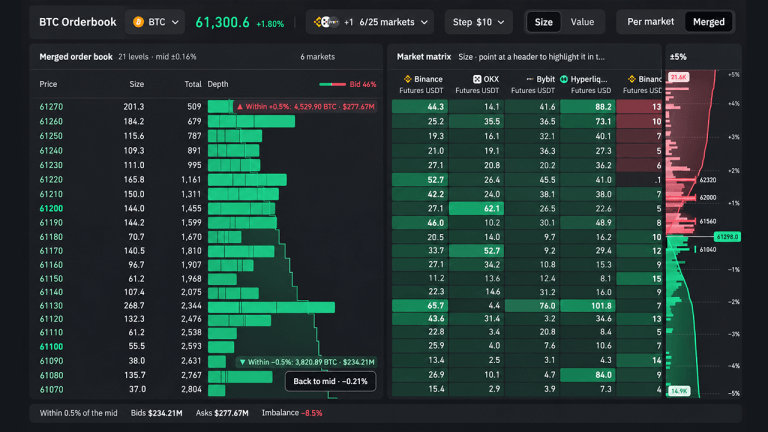
Bitcoin’s $236 Million Buy Wall: Real Demand or an Illusion?
Bitcoin’s order books reveal where buyers and sellers intend to trade, but the millions of dollars displayed on exchange screens t...

Bitcoin spot ETFs bleed $669 million as outflow streak stretches to four days
The sustained outflows from Bitcoin spot ETFs highlight growing investor caution and could signal broader market volatility and se...