Dutch crypto exchange collapses exposing customer balances’ true value amid multi-million-euro hole
Dutch crypto exchange Knaken's operating company and its affiliated payments foundation entered court-controlled bankruptcy on July 16 after the Rotterdam District Court found that the exchange could not repay customers...
Archive context
Older archive item. Useful for background and entity history, but not a fresh market-moving signal.
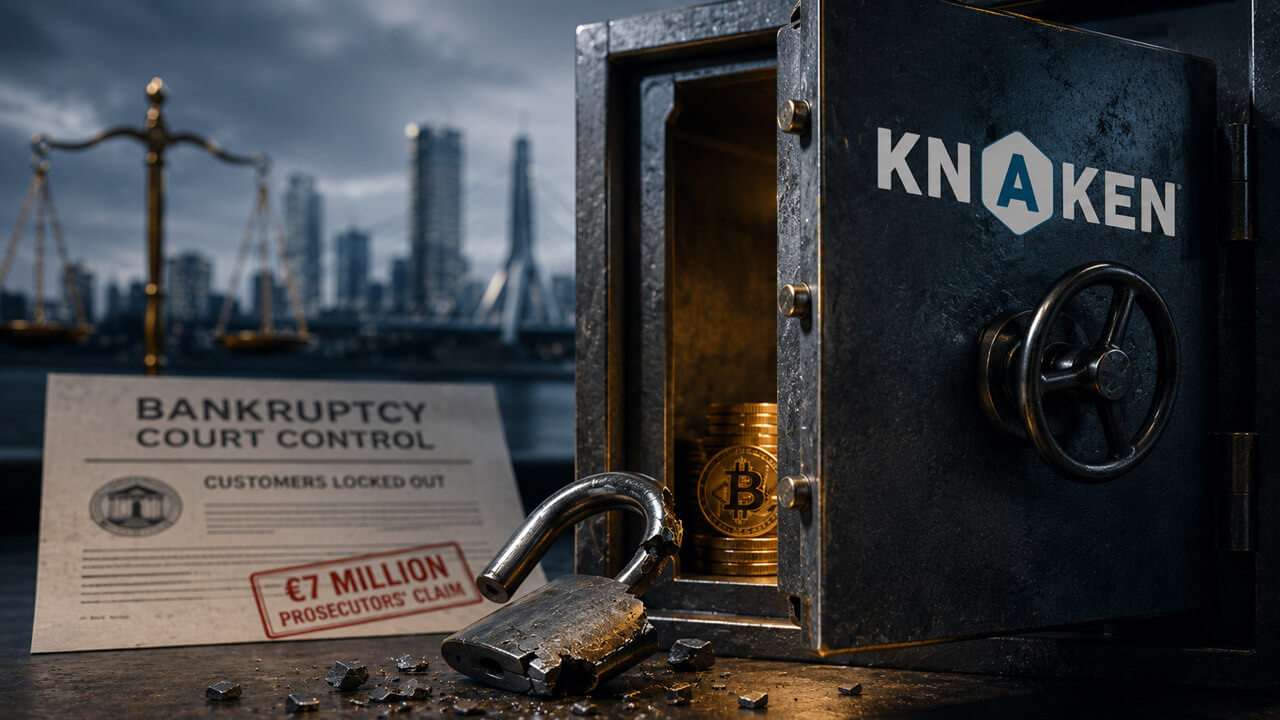
Dutch crypto exchange Knaken's operating company and its affiliated payments foundation entered court-controlled bankruptcy on July 16 after the Rotterdam District Court found that the exchange could not repay customers in full.
The court said customers were locked out, payments had stopped, and a substantial coverage deficit had not been disclosed.
The Dutch Public Prosecution Service told the court that about €7 million was missing from customer balances. The order confirms that management will not control the wind-down. Trustee C.F.W.A. Hamm now has authority over both Knaken Cryptohandel B.V. and Stichting Knaken Payments.
Related Reading Millions of EU crypto users face exchange cutoff as MiCA deadline hits in days Around three in four of the crypto companies registered across Europe are expected to lose their license this summer in the most aggressive thinning the industry has probably ever seen. Jun 14, 2026 · Andjela Radmilac Court control replaces Knaken’s payout planKnaken argued that bankruptcy was unnecessary. It said criminal asset seizures, the service shutdown, and its custody structure already protected customers, and proposed an independent verification process followed by its own distribution protocol. The court rejected that route and put an outside trustee in charge.
The public-interest petition took an unusual route. Prosecutors stepped in after blocked accounts and poor disclosure left customers unable to determine where they stood or to file a meaningful bankruptcy petition. Court control gave them a process outside the exchange’s own books and proposed payout system.
The Dutch bankruptcy trustee works for the collective body of creditors under a supervising judge. The trustee inventories assets and claims, examines records and possible irregularities, protects and liquidates the estate, and proposes distributions according to claim priority, as set out in Dutch judiciary guidance and the Bankruptcy Act.
For Knaken, that mandate supports reconciling platform ledgers with wallets, access controls, bank accounts, and other property across the company and the foundation. It also establishes which entity owes each customer and whether property described as a customer asset was actually held outside the exchange's own estate. The appointment provides independent verification, but it neither fills the deficit nor determines a recovery percentage on its own.
The Fiscal Intelligence and Investigation Service, known as the FIOD, was examining possible criminal conduct and carried out searches on June 29, according to prosecutors. Investigators seized digital data carriers and company assets, and no arrests had been made as of the June 30 statement.
Separate teams handled the civil petition and criminal investigation, and neither the investigation nor the seizures amount to a finding of guilt. The legal treatment of seized property and its coordination with the bankruptcy estates remain to be clarified through the two processes.
Custody protection depends on assets being thereThe bankruptcy of Stichting Knaken Payments makes the custody structure central to customer recovery. A separate foundation creates legal distance between an operating company and client property, but does not prove that sufficient assets were held, correctly recorded, or available for return when the platform failed.
The Dutch Authority for the Financial Markets says Dutch law has no automatic statutory segregation regime for custodied crypto comparable to the protections for securities held by banks and investment firms. Crypto providers therefore often use a separate entity, usually a foundation, to create legal separation.
Effective protection still requires the provider to hold client crypto and client funds, keep accurate position records, use separate client and proprietary wallets, maintain appropriate recovery-key controls, confine the foundation's activities to client custody interests, and operate a workable return procedure.
Related Reading MiCA’s July 1 deadline is Europe’s first crypto user-migration test – OKX interview MiCA can force unlicensed exchanges out of Europe on paper. OKX Europe’s CEO says the real test is whether offshore apps are still one tap away. Jul 1, 2026 · Gino MatosNeither the court nor prosecutors have disclosed which Knaken assets remain, where they are held, whether the platform ledger matches the foundation's records, or whether each balance was legally and operationally separated. Because both entities are bankrupt, the trustee must first establish those facts before an account entry can be connected to identifiable property or an accepted claim.
Knaken had not obtained the required AFM authorization, according to prosecutors. The Markets in Crypto-Assets Regulation, or MiCA, is now the benchmark for the safeguards that an authorized custody provider should operate under.
MiCA Article 70 requires authorized providers holding client crypto or access means to safeguard client ownership rights, especially in insolvency. Subject to institutional exceptions, eligible client funds must generally be placed in a separately identifiable account at a credit institution or central bank by the next business day.
MiCA Article 75 requires custody providers to maintain per-client position records, a custody policy, and return procedures. Client holdings must be legally and operationally separate from the provider's own holdings so that properly custodied crypto remains beyond the reach of the provider's creditors in the event of insolvency. The regulation's official text describes preventive custody controls, not a mechanism for replacing assets that are no longer there.
The European Securities and Markets Authority, or ESMA, told unauthorized providers in June to stop onboarding clients, restrict remaining activity to an orderly exit, safeguard client interests, and explain how assets would be handled.
The operational risk has appeared in other MiCA exits: recent CryptoSlate reporting described AscendEX warning that some withdrawals might not be processed. Knaken is in a distinct and more advanced legal position because a court has found a coverage deficit and imposed bankruptcy control.
Related Reading AscendEX shuts down after MiCA miss and warns some withdrawals may not be processed Automated payouts are paused after a failed liquidity deal, leaving customers without assurances on timing or amounts. Jul 10, 2026 · Liam 'Akiba' WrightDe Nederlandsche Bank says crypto-assets and crypto service providers fall outside the Dutch investor compensation scheme, while its deposit-guarantee guidance excludes crypto such as Bitcoin. Any treatment of cash actually held at a bank would depend on account ownership and structure, which have not been established for Knaken.
What customers should watch nextThe first decisive signal will be a reconciled inventory: crypto, cash, and other property that the trustee can control or recover, matched against the two entities' records. A displayed customer balance is evidence of what the platform said it owed, but recovery depends on whether corresponding property can be found and linked to a legal right.
The foundation may have held some assets for customers, while the operating company may owe other obligations. The bankruptcy process must determine whether identifiable client property is outside a general creditor pool, whether shortfalls become claims against either estate, and how accepted claims rank under Dutch insolvency rules.
Investigators may hold property or information relevant to the estate, but the court announcement does not establish what was seized, who owns it, or how it will be treated. Coordination between the trustee and criminal authorities will affect the evidence and assets available to the bankruptcy process without turning the insolvency case into a judgment on criminal liability.
Only after those questions are answered can the trustee produce a defensible estimate of what customers may receive and when.
For locked-out users, court control provides an independent way to distinguish an account balance from property that can actually be traced and returned. It replaces Knaken’s proposed payout process with supervised accounting and a collective claims procedure.
The post Dutch crypto exchange collapses exposing customer balances’ true value amid multi-million-euro hole appeared first on CryptoSlate.
Why this matters
OKX is showing up inside the Regulation theme, so this story is worth tracking for follow-through rather than treating it as a one-off headline.
Original source
Read on CryptoSlateRelated market context

Blockworks submits SEC comment letter on Regulation Crypto Assets
Blockworks filed an SEC comment letter on Regulation Crypto Assets, pushing for onchain disclosures and a new Qualified Onchain Di...
Crypto firms, Wall Street push SEC to revise Regulation Crypto Assets as comments close
As the SEC’s comment period on a cryptocurrency proposal draws to a close, digital asset firms and Wall Street institutions have t...

Anchorage Digital partners with Securitize to bring federally issued stablecoins to tokenized assets
This partnership enhances the integration of blockchain in traditional finance, potentially increasing institutional adoption of d...

AnchorWatch Opens Bitcoin Custody Service With Lloyd’s-Backed Insurance Option
TL;DR: AnchorWatch has opened its Nevada-chartered Bitcoin custody service, pairing a choice of key-control structures with option...
Bitcoin Could Outperform Most Assets, JPMorgan Says — But the Bank Still Won’t Recommend It
Bitcoin Magazine Bitcoin Could Outperform Most Assets, JPMorgan Says — But the Bank Still Won’t Recommend It JPMorganChase’s asset...

Deutsche Bank and JPMorgan build on Ethereum for institutional services
The integration of Ethereum by major banks could accelerate institutional adoption of blockchain, enhancing liquidity and asset to...