Fidelity says poorer people can access more IPOs
Fidelity, the largest stock brokerage in the US, has slashed IPO qualification minimums for its customers by at least 75% and up to 95% for certain offerings. This push to funnel poorer investors into public offerings fo...
Watchlist
Published in the last two hours. Multiple named entities are involved.

Fidelity, the largest stock brokerage in the US, has slashed IPO qualification minimums for its customers by at least 75% and up to 95% for certain offerings.
This push to funnel poorer investors into public offerings follows a September in which just five US IPOs raised a paltry $1.9 billion, the slowest US IPO month since March.
In fact, across all US IPOs this year, the equal-weighted average return since each offer price is negative.
Fidelity’s new minimum is just $25,000 from its former $100,000 or higher threshold, including its old $500,000 minimum to participate in certain non-KKR underwritten offerings.
The reduction arrives amid a broad push by brokerages to recruit smaller investors as US listings have slowed to a crawl, weeks before Anthropic’s planned November debut.
Fidelity’s new minimum is just $25,000 from its former $100,000 or higher threshold.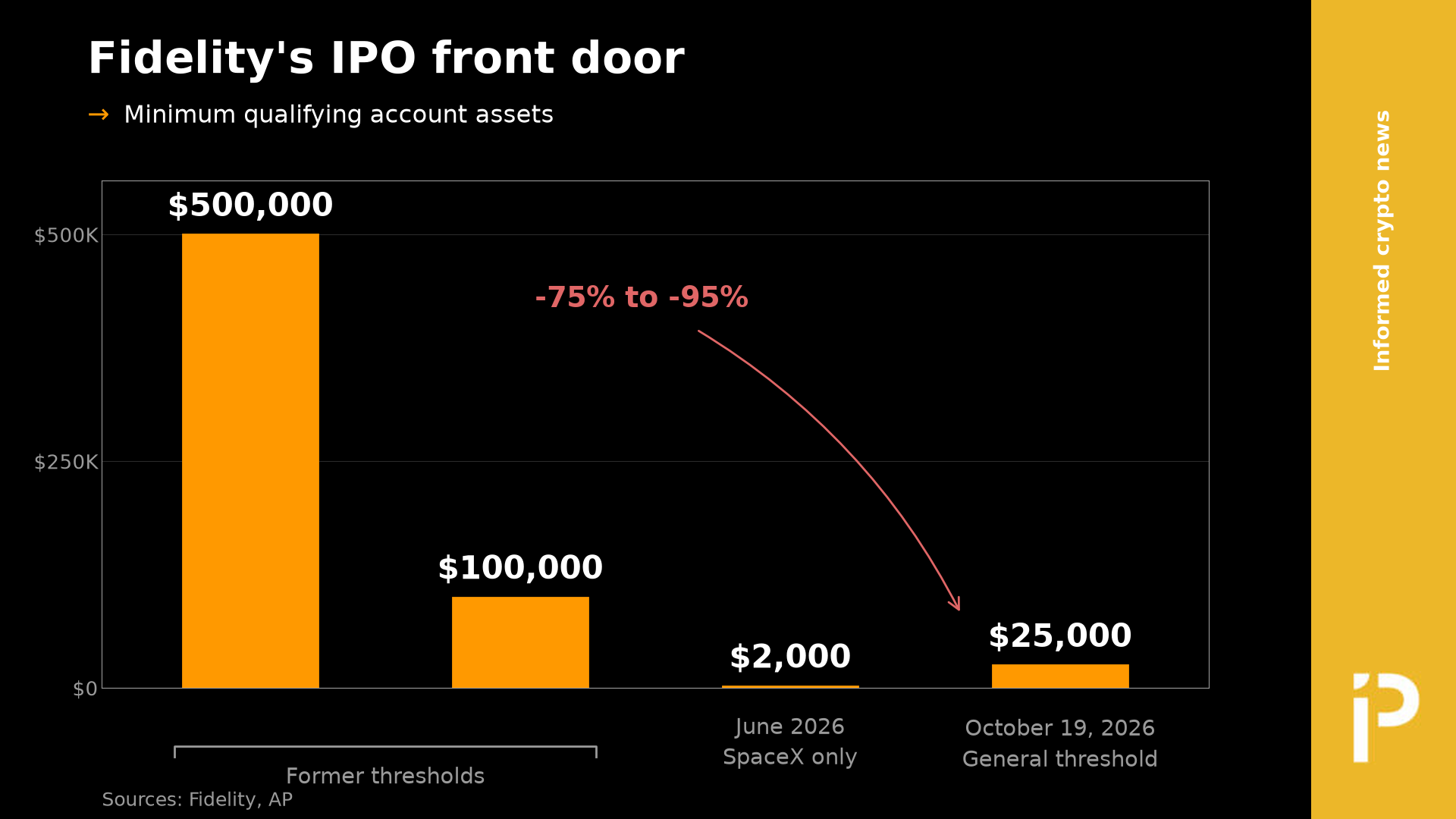
Read more: SpaceX IPO banks yell ‘buy’ as stock craters
Historically, Fidelity has used asset minimums to gate access to brand new, historically risky offerings as a way to limit unsophisticated speculation.
An LA Times columnist described IPO minimums as “protecting small retail clients from plunging into initial public stock offerings while the shares were still subject to IPO-related hype.”
Bloomberg described September as the slowest month since March for US listings. Smart-ring maker Oura, for example, postponed a listing that it hoped would have been worth up to $15.6 billion.
Buyers also refused the top of Oura’s IPO price request.
Nuclear group Holtec, along with SoftBank-backed SB Energy, also pulled back its IPO plans. Renaissance Capital analysts wrote that IPO activity has fallen short of expectations.
Fidelity says poorer people can buy more IPOsFidelity’s permanent, blanket reduction to $25,000 is actually its second reduction this year after counting its one-time SpaceX IPO eligibility reduction in June to $2,000.
We’re expanding access to the IPO market, so that more of our customers can participate. Starting today, October 19, we’re reducing the eligibility minimum to participate in IPOs, Follow Ons and Secondary offerings to $25,000 in retail assets (e.g., brokerage accounts, etc.).…
— Fidelity Investments (@Fidelity) October 19, 2026Read more: Circle IPO traders send wrong CRCL stock up 16,000%
The trend is clear. The finance industry is moving in a single direction: easier access and reduced minimums for poorer people to speculate on IPOs.
- Coinbase offered IPO access for the first time this year.
- Robinhood became an IPO underwriter for the first time, allowing it to obtain larger retail IPO allocations.
- E*Trade dramatically expanded its IPO center in 2026.
- Alpaca launched US IPO access via API in May, allowing fintech partners offer IPO participation to certain investors outside the US.
- Kraken and ByBit announced tokenized IPO access to customers for the first time in 2026 via xStocks, including to customers abroad.
The timing of Fidelity’s easement raised eyebrows on social media, with plenty of comments flagging Anthropic’s IPO as a possible subtext. The Claude maker could start marketing shares as soon as the week of November 9 at a valuation of up to $2 trillion.
Got a tip? Send us an email securely via Protos Leaks. For more informed news and investigations, follow us on X, Bluesky, and Google News, or subscribe to our YouTube channel.
The post Fidelity says poorer people can access more IPOs appeared first on Protos.
Why this matters
Fidelity is showing up inside the Institutional Adoption theme, so this story is worth tracking for follow-through rather than treating it as a one-off headline.
Original source
Read on ProtosRelated market context

Hyperliquid Policy Center Calls For Five Changes To SEC Crypto Rule
TL;DR: The Hyperliquid Policy Center supports the SEC’s proposed crypto framework but says five changes are needed to make the rul...

Coinbase and HTX face access restrictions under Kazakhstan court order
Kazakhstan's regulatory crackdown on unlicensed crypto exchanges could consolidate market power among licensed operators, limiting...

Ethereum Institutional taps former Coinbase research chief David Duong as Head of US
Duong's leadership could accelerate Ethereum's integration into traditional finance, potentially reshaping institutional engagemen...

Whale loses $469,000 in hours on Hyperliquid, yet re-enters with $16M ETH short bet
The unknown trader realized about $469,000 in losses before fees overnight, then added another 1,126 ETH of shorts. Read the full...

Deutsche Bank and JPMorgan build on Ethereum for institutional services
The integration of Ethereum by major banks could accelerate institutional adoption of blockchain, enhancing liquidity and asset to...

Stablecoin transfers quadruple to $891B as US banks expand adoption: Report
Coinbase reports growing adoption by banks and businesses, even as stablecoin market capitalization remains largely unchanged over...