Goldman Sachs and BNY Mellon Launch Tokenized Money Market Funds for Institutions
Key Takeaways: Goldman Sachs and BNY Mellon have launched tokenized money market funds for institutional clients. Initial participants include BlackRock, Fidelity, Federated Hermes, and the asset arms of both banks. The...
Archive context
Older archive item. Useful for background and entity history, but not a fresh market-moving signal.
Key Takeaways:
- Goldman Sachs and BNY Mellon have launched tokenized money market funds for institutional clients.
- Initial participants include BlackRock, Fidelity, Federated Hermes, and the asset arms of both banks.
- The platform allows real-time ownership tracking and may support future use in collateral management and settlement.
Goldman Sachs and Bank of New York Mellon have launched a system allowing institutional clients to access tokenized money market funds.
According to a CNBC report published on July 23, the offering targets the $7.1 trillion market, uses Goldman’s blockchain platform to record fund ownership, and is integrated with BNY’s custody services.
BlackRock and Fidelity Funds Already AvailableClients can invest in tokenized share classes of money market funds managed by BlackRock, Fidelity Investments, Federated Hermes, and the asset management divisions of both Goldman and BNY. The product is built for institutional users, including hedge funds, pension funds, and corporates.
BNY’s LiquidityDirect and @GoldmanSachs’ Digital Asset Platform have collaborated to launch tokenized money market funds (MMFs).
This significant initiative sets our clients on a path to access a new capability to increase the utility and potential transferability of MMFs in… pic.twitter.com/WJ1lv7m6T4
“We have created the ability for our clients to invest in tokenized money market share classes across a number of fund companies,” said Laide Majiyagbe, Global Head of Liquidity, Financing, and Collateral at BNY.
“The step of tokenizing is important, because today that will enable seamless and efficient transactions, without the frictions that happen in traditional markets,” said Majiyagbe.
Unlike stablecoins, which serve primarily as a medium of exchange, tokenized money market funds offer yield and may function as cash-equivalent holdings for large financial institutions.
According to Goldman and BNY, the funds could eventually be transferred between financial intermediaries without first converting to fiat currency.
Goldman Sachs and BNY Target $7.1 Billion MarketMathew McDermott, Global Head of Digital Assets at Goldman Sachs, said the structure supports future use in collateral and trade settlement. “The sheer scale of this market just offers a huge opportunity to create a lot more efficiency across the whole financial plumbing,” he said.
“That is what’s really powerful, because you’re creating utility in an instrument where it doesn’t exist today,” said McDermott.
The firms see this step as supporting real-time settlement and reducing operational frictions tied to traditional finance infrastructure. They also framed it as complementary to regulatory developments such as the recent GENIUS Act, which establishes a federal framework for stablecoins.
According to the report, U.S. money market funds hold about $7.1 trillion in assets, with roughly $2.5 trillion flowing into the space since the Federal Reserve began raising rates in 2022. Most are backed by short-term government or commercial debt.
The service is currently limited to institutional users and fund providers participating in the platform.
Institutional interest in programmable finance is growing, and assets like money market funds can be embedded into automated workflows across settlement, margining, and treasury operations. Such tokenized instruments could play a central role in modernizing how institutions manage liquidity and collateral across global markets.
Frequently Asked Questions (FAQs)What are the tax implications for institutions holding tokenized fund shares?While ownership structure remains similar to traditional funds, the digital nature may raise questions around jurisdiction, timing of income recognition, and reporting obligations.
Could tokenized funds allow 24/7 liquidity access?If integrated with global custodians and interoperable ledgers, institutions may eventually move capital between regions outside of standard market hours.
What legal structures govern these digital fund shares?Each share remains subject to existing securities regulation, but the ownership ledger is now maintained on a permissioned blockchain, allowing traceability without changing asset classification.
The post Goldman Sachs and BNY Mellon Launch Tokenized Money Market Funds for Institutions appeared first on Cryptonews.
Why this matters
This cryptocurrency story adds another data point to the current market tape and is useful when read alongside nearby source coverage.
Original source
Read on CryptonewsRelated market context
Bitcoin hedge funds face a liquidation trap when their collateral is split across markets
Here's a hypothetical situation: a hedge fund is making money, but one of its exchanges is about to liquidate its position anyway....
Franklin Templeton Explores SEC Relief for Tokenized Fund Trades
Franklin Templeton is exploring whether regulatory exemptions could allow tokenized money market funds and ETFs to trade through b...
Brazil’s BRL 22T CSD BR Moves Fund Records to XRP Ledger in Live Tokenization Push
Key Takeaways: CSD BR is leveraging the XRP Ledger to reflect real-time fund holdings. Over BRL 22 trillion in registered assets i...
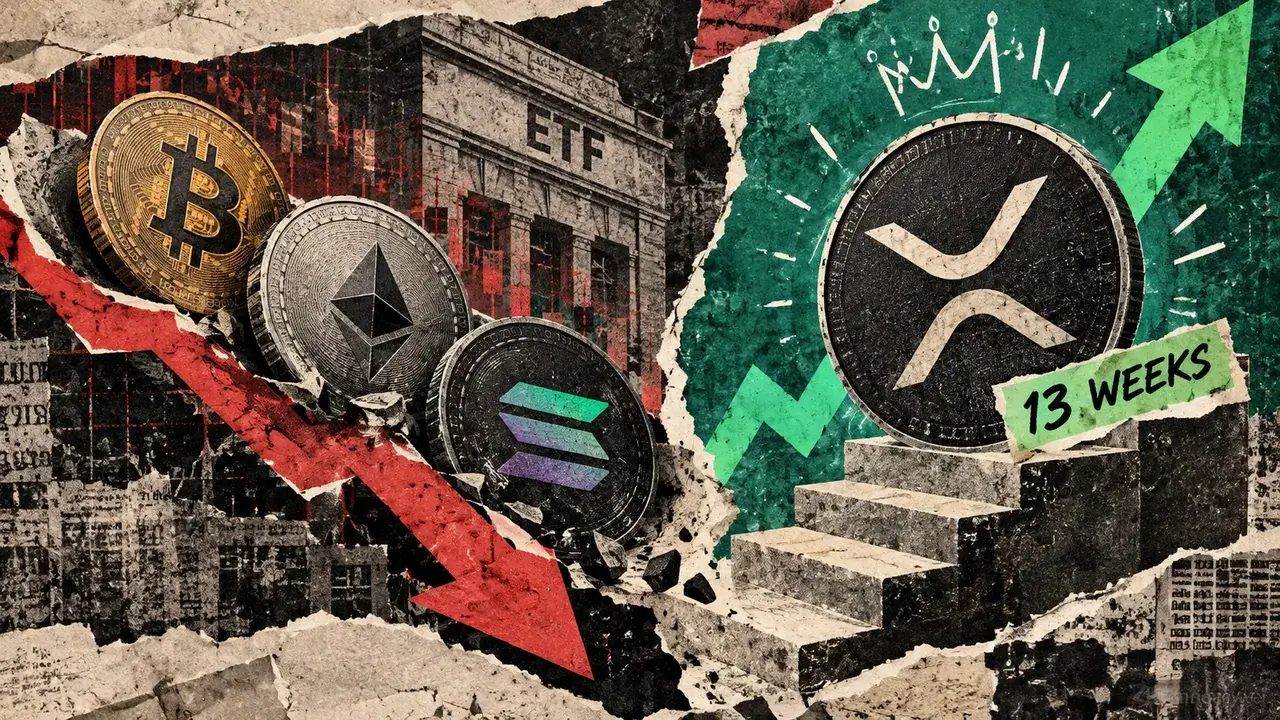
XRP ETFs extend a 13-week inflow streak as Bitcoin, Ethereum and Solana funds shed $1.25 billion
US-listed XRP ETFs extended their inflow streak to 13 weeks as Bitcoin, Ethereum and Solana funds suffered nearly $1.25 billion in...

Bitcoin holder loses 80 BTC worth $5.2 million after moving funds to reseller-bought Ledger
The incident underscores the critical importance of purchasing hardware wallets from official sources to ensure asset security. Th...
PeckShield Traces $3.89 Million in Ledger Theft Funds to Binance Deposits
The reported Tron deposits offer investigators an exchange-account lead, but intermediary wallets handling other clients’ money co...