IMF Bailout Could Be in UK’s Future, Says Strategist
Mizuho Securities’ head of global macro strategies has warned that an IMF bailout may be in the U.K.’s future. Moreover, a former chancellor of the exchequer cautioned that Britain is entering a long and severe recession...
Archive context
Older archive item. Useful for background and entity history, but not a fresh market-moving signal.

Mizuho Securities’ head of global macro strategies has warned that an IMF bailout may be in the U.K.’s future. Moreover, a former chancellor of the exchequer cautioned that Britain is entering a long and severe recession, emphasizing that it’s “the worst since 1990 and it may be the worst since before that.”
Peter Chatwell, head of global macro strategies at Mizuho Securities, shared his outlook for the U.K. economy in an interview on Bloomberg Television Monday.
He explained that Britain’s new prime minister, Liz Truss, has promised fiscal policy that the British government cannot afford. He also does not expect the Bank of England to be able to get inflation anywhere near its 2% mandate anytime soon.
“I’m thinking of two potential crises that this reminds me of,” the Mizuho strategist said. Noting that one of them is the European Exchange Rate Mechanism in 1992, he opined:
And then I’m thinking about the possibility of an IMF bailout, like in 1976.
Truss, a former British foreign minister, succeeded Boris Johnson and was appointed the new U.K. prime minister by Queen Elizabeth on Tuesday, beating former Chancellor of the Exchequer Rishi Sunak.
In September 1976, as the pound hit a record low, James Callaghan’s Labor government asked the IMF for a $3.9 billion loan, which was the largest amount ever requested from the IMF at that time.
Chatwell was not the only one seeing the possibility of an IMF bailout in the U.K.’s future. Deutsche Bank strategist Shreyas Gopal said Monday that “A balance of payments funding crisis may sound extreme, but it is not unprecedented,” elaborating:
A combination of aggressive fiscal spending, severe energy shock, and a slide in sterling ultimately resulted in the U.K. having recourse to an IMF loan in the mid 1970s.
“Today, the U.K. does retain some key lines of defense against a sudden stop, but we worry that the risks are rising nevertheless,” the strategist detailed.
Former Conservative Chancellor of the Exchequer Ken Clarke said Tuesday: “We are plainly likely to enter a long and perhaps quite severe recession. Certainly the worst since 1990 and it may be the worst since before that.”
Do you think the U.K. will need an IMF bailout? Let us know in the comments section below.
Why this matters
This cryptocurrency story adds another data point to the current market tape and is useful when read alongside nearby source coverage.
Original source
Read on Bitcoin NewsRelated market context

Brazil suffers worst selloff in decades on Lula win as Hyperliquid tokenized perp led price discovery
Lula's win prompts investor anxiety over Brazil's fiscal future, triggering significant market volatility and highlighting economi...

Ether ETFs Are Having Their Worst Month of 2026. Who Buys Once Bitmine Stops?
Ether’s (ETH) demand this year has largely come from two places: spot exchange-traded funds (ETFs) and Bitmine Immersion Technolog...

XRP whales now control 68.5% of supply, the highest share since November 2022
The increased concentration of XRP among whales raises concerns about market manipulation and challenges the token's decentralizat...
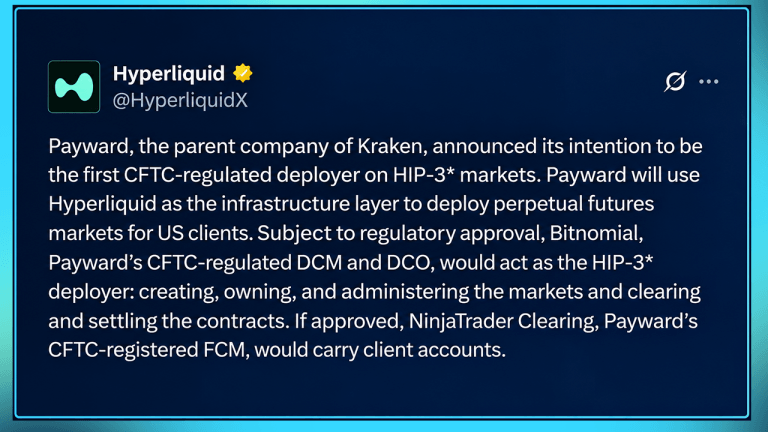
Kraken Parent Payward Eyes First CFTC-Regulated Hyperliquid Futures Market
Kraken parent Payward plans to become the first Commodity Futures Trading Commission (CFTC)-regulated operator to deploy perpetual...

Hyperliquid unveils HIP-3* to support regulated US perpetual futures through Payward
The introduction of regulated perpetual futures could enhance market accessibility and compliance, potentially boosting US crypto...

Kraken parent Payward to launch CFTC-regulated futures for US clients
The launch could boost Hyperliquid's market credibility and interest, but hinges on regulatory approval impacting future market dy...