Introducing Binance Oracle VRF: The Next Generation of Verifiable Randomness
Main Takeaways Binance Oracle VRF is a Verifiable Random Function (VRF) solution that enables blockchain developers to generate random numbers. Binance Oracle VRF can be used for an extensive selection of use cases, incl...
Archive context
Older archive item. Useful for background and entity history, but not a fresh market-moving signal.
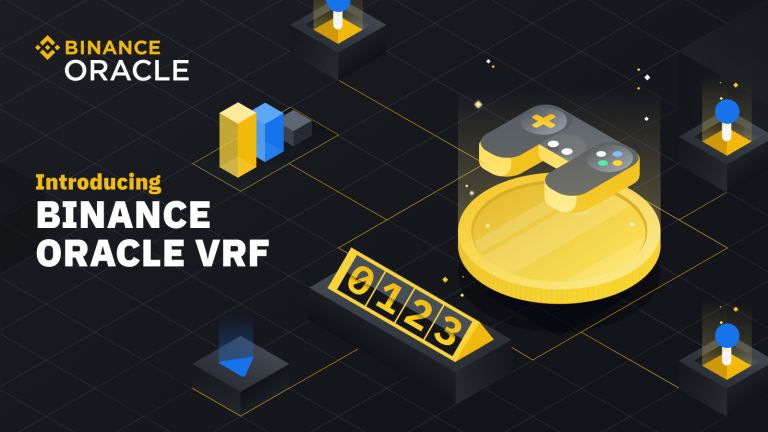
Main Takeaways
- Binance Oracle VRF is a Verifiable Random Function (VRF) solution that enables blockchain developers to generate random numbers.
- Binance Oracle VRF can be used for an extensive selection of use cases, including GameFi projects and other blockchain products built with smart contracts.
- Keep reading to learn more about how VRFs work, why blockchain applications need randomness, and how Binance Oracle VRF could benefit your project or business.
Powered by Binance Cloud and based on the latest Verifiable Random Function (VRF) standard, here’s everything you need to know about Binance Oracle VRF.
What Is a Verifiable Random Function (VRF)?
Verifiable Random Functions (VRF) are random number generators (RNG) whose outputs can be cryptographically proven as random. Here’s a quick summary of how it works.
- A series of inputs are passed into a VRF.
- The VRF computes the inputs and generates pseudorandom outputs.
- Anyone, at any time, can cryptographically verify that the output is random.
- All proof is published and verified on-chain before applications can use the output.
Why Do Blockchains Need Random Numbers?
There are various scenarios where blockchain applications require randomness. A few examples include:
- Building a blockchain-based game.
- Allocating tasks and resources.
- Picking samples for a consensus mechanism.
To illustrate, let’s examine how randomness can help a GameFi developer build a blockchain-based poker game.
The developer must convince its users that the poker game uses a fair and unbiased algorithm. For example, the deck of cards is shuffled randomly, and no party, including the developer, can manipulate the game.
Rather than using a black box algorithm that hides the game’s inner workings from its users, blockchain developers can effectively prove randomness by showing how their numbers are generated through a trustworthy oracle provider. This way, users can be sure that their game is fair and unbiased.
The Challenge of Generating Randomness
When generating randomness, a good output must fulfill four criteria: unbiased, unpredictable, verifiable, and instantly available.
Many blockchain developers find it challenging to produce on-chain randomness in their applications due to the deterministic nature of the blockchain. The on-chain generated randomness usually can’t satisfy the unpredictability.
On the other hand, purely relying on a simple off-chain oracle provider could force developers to compromise on availability or, even worse, security. In certain contexts, if a malicious provider feeds some predictable randomness, bad actors can exploit the situation to ensure they receive a favorable result. Imagine a loot-based game where players could try to open a treasure chest multiple times until they get an item they’re happy with. Or a card game where players could draw their hands numerous times until they get a good one.
What’s Under the Hood
VRF combines these two independent sources for seed generation. The randomness constructed by the off-chain provider with its private key is generated from the two parameters block-hash and preSeed. This ensures the unpredictability of the proof, as you cannot predict the block hash until the block is generated.
The proof provided off-chain ensures that the randomness is generated from block-hash and preSeed rather than something that a malicious provider could make up. That makes this randomness verifiable.
In simple terms, developers can generate random numbers fairly and securely.
Binance Oracle VRF
Let’s take a brief look at exactly what Binance Oracle VRF has to offer blockchain developers.
24/7 customer support
Developers have personalized, 24/7 access to a support team of experienced engineers. We understand every project is unique, and we work closely with developers to provide custom solutions that meet their specific requirements.
Powered by the Binance brand
As one of the world’s largest Web3 ecosystems, Binance provides a trusted brand known for its excellence and reputation in the crypto space. By using Binance Oracle VRF, developers can leverage the Binance brand’s power to enhance their projects’ credibility and attract more users.
Affordable without compromise
Our clients, startup or enterprise, get access to a Binance-grade product at a price lower than other solutions on the market.
Innovation shouldn’t come at a hefty price tag. Binance Oracle VRF’s competitive pricing structure is intentional by design. We keep costs low, so there are fewer barriers to entry for project teams with innovative ideas and use cases.
Secure, reliable, and compatible
Binance Oracle VRF is based on the latest VRF standard, which is compatible with a wide range of blockchain platforms, including Ethereum, BNB Chain, and more. Most importantly, we’ve rigorously tested and audited our system to ensure no individual or group can tamper with Binance Oracle VRF’s results.
Designed with accessibility in mind
Binance Oracle VRF’s seamless user experience allows easy VRF-to-smart contract integration. Our dashboard provides a simple yet intuitive interface to monitor requests, including the cost and status, as well as RNG results. With minimal setup, project teams can start generating cryptographically-verifiable outputs.
Integrate With Binance Oracle VRF Today
At Binance, we’re committed to providing the tools that developers need to build innovative and secure blockchain applications.
Start building with an industry-leading RNG solution, and experience the next generation of verifiable on-chain randomness. Try Binance Oracle VRF today →
Further Reading
This is a sponsored post. Learn how to reach our audience here. Read disclaimer below.
Why this matters
This cryptocurrency story adds another data point to the current market tape and is useful when read alongside nearby source coverage.
Original source
Read on Bitcoin NewsRelated market context
Binance Pool To Close November 10, Giving Bitcoin Miners Weeks To Move
TL;DR: Binance will discontinue its mining pool and related services at 07:00 UTC on November 10, 2026. Miners must redirect their...

Binance bStocks Hits $1 Billion As Tokenized Stock Trading Accelerates
TL;DR: Binance says its bStocks tokenized-equity offering has surpassed $1 billion in assets under management, four months after l...
Binance’s bStocks Lead Tokenized Stocks After Crossing $1 Billion
Binance’s tokenized U.S. equities product, bStocks, now holds more than $1 billion in assets under management, the exchange announ...
Binance Eyes Hong Kong, South Korea, Taiwan, Brazil Stocks in Global Push
Binance is exploring ways to give users exposure to leading stocks in markets including Hong Kong, South Korea, Taiwan, and Brazil...

Binance Pay Opens Crypto Payments at Millions of PayPay Merchants Across Japan
Key Takeaways: Binance Pay is now available for visitors to use at PayPay merchants in Japan. Crypto is immediately converted to J...

Nine companies, including Broadcom and UnitedHealth, block tokenized stock trading on OKXICE
The objections highlight potential challenges in tokenized stock adoption, impacting market dynamics and issuer control over digit...