New Ransomware Group Embargo Launders $34M in Crypto from US Hospital Attacks Since April
A new ransomware-as-a-service group called Embargo has laundered approximately $34.2 million in crypto since emerging in April 2024, primarily targeting US healthcare facilities through sophisticated attacks that demand...
Archive context
Older archive item. Useful for background and entity history, but not a fresh market-moving signal.

A new ransomware-as-a-service group called Embargo has laundered approximately $34.2 million in crypto since emerging in April 2024, primarily targeting US healthcare facilities through sophisticated attacks that demand ransoms up to $1.3 million.
TRM Labs research identifies the group as a potential rebrand of the defunct BlackCat operation, with notable victims including American Associated Pharmacies, Memorial Hospital and Manor in Georgia, and Weiser Memorial Hospital in Idaho.
Sophisticated RaaS Model Evades Detection Through Operational RestraintThe group operates under a ransomware-as-a-service model, providing affiliates with advanced tools while maintaining control over core infrastructure and payment negotiations.
TRM’s Graph Visualizer showing a small Embargo wallet cluster with incoming BlackCat (ALPHV) exposure. Source: TRMLabsUnlike prominent groups such as LockBit or Cl0p, Embargo avoids high-visibility tactics and overt branding, potentially helping it evade law enforcement detection while scaling operations across healthcare, business services, and manufacturing sectors.
TRM Labs identified multiple technical similarities linking Embargo to BlackCat, including shared use of the Rust programming language, nearly identical data leak site designs, and on-chain overlaps through shared wallet infrastructure.
Shared wallet cluster receiving Embargo and BlackCat funds. Source: TRMLabsHistorical BlackCat-linked addresses have funneled funds to wallet clusters associated with Embargo victims, reinforcing the assessment of potential operational continuity.
The discovery of Embargo coincides with a broader surge in sophisticated crypto-focused cybercrime operations.
July 2025 saw crypto hack losses jump 27.2% to $142 million through seventeen major security breaches, while the first half of 2025 recorded over $2.2 billion in losses across 344 incidents.
AI-Enhanced Operations Target Critical InfrastructureEmbargo uses advanced tactics enhanced by artificial intelligence and machine learning technologies to scale attacks and evade detection.
The group typically gains initial access through exploiting unpatched software vulnerabilities or sophisticated social engineering campaigns, including AI-generated phishing emails and drive-by downloads from malicious websites.
Once inside networks, Embargo deploys a two-part toolkit that disables security tools and removes recovery options before encrypting files.
The group uses double extortion tactics, encrypting files while exfiltrating sensitive data, then threatening to leak information or sell it on dark web markets if victims refuse payment.
The group’s data leak site publicly names individuals and releases sensitive information to pressure victims into paying ransoms.
Embargo directs victims to communicate through group-controlled infrastructure, allowing operators to retain control over negotiations while reducing exposure to law enforcement tracking.
Several incidents featured politically charged messages and ideological references, leading analysts to assess potential state alignment or linkage.
This combination of financial and ideological motivations complicates attribution efforts, as it follows broader trends of financially motivated actors engaging in politically themed campaigns.
Complex Money Laundering Networks Exploit Global ExchangesEmbargo launders ransom proceeds through sophisticated networks involving intermediary wallets, high-risk exchanges, and sanctioned platforms, including Cryptex.net.
Embargo deposits to Cryptnex.net Source: TRMLabsTRM Labs traced hundreds of deposits totaling approximately $13.5 million distributed across multiple virtual asset service providers worldwide.
Between May and August 2024, researchers observed approximately 17 deposits exceeding $1 million routed through the now-sanctioned Cryptex.net platform.
The group typically avoids heavy reliance on mixers or cross-chain bridges, instead layering transactions across multiple addresses before depositing directly into exchanges.
Approximately $18.8 million in victim funds remain dormant in unattributed wallets, likely representing deliberate evasion tactics to disrupt behavioral tracing patterns or delay movement until external conditions become more favorable.
These delays may also result from operational factors, including downstream laundering support needs or internal disputes among actors.
The complex laundering patterns coincide with other major crypto security incidents throughout 2025.
Indian exchange CoinDCX suffered a $44.2 million attack linked to North Korea’s Lazarus Group through compromised employee credentials.
Similarly, the GreedyBear attack group utilized 150 weaponized Firefox extensions and nearly 500 malicious executables to steal over $1 million.
July crypto hack losses surge 27% to $142 million with CoinDCX's $44 million insider breach and GMX's $42 million exploit leading victims.#July #CryptoHackhttps://t.co/4UCMKaxUvI
— Cryptonews.com (@cryptonews) August 1, 2025GMX lost $42 million through a re-entrancy vulnerability exploit but recovered $40.5 million through white-hat negotiations, keeping a $5 million bounty.
The protocol paused trading on Avalanche and disabled GLP minting pending user reimbursement procedures.
The post New Ransomware Group Embargo Launders $34M in Crypto from US Hospital Attacks Since April appeared first on Cryptonews.
Why this matters
This cryptocurrency story adds another data point to the current market tape and is useful when read alongside nearby source coverage.
Original source
Read on CryptonewsRelated market context

Ledger investigates wallet tampering tied to tens of millions in crypto thefts
The investigation highlights the critical need for enhanced security measures and trust in crypto hardware supply chains to preven...

Ledger investigates potential wallet tampering after reports of $86 million in crypto stolen
The hardware wallet maker said it is investigating devices sold by a Southeast Asian reseller as social posts swirl about crypto a...

U.S. Government Sends $1 Billion in Seized Bitfinex Bitcoin to Unlabeled Wallets
A wallet holding bitcoin stolen in the 2016 Bitfinex hack sent 12,267 BTC, worth about $1.01 billion, to new addresses on Thursday...

Stealing $1.5B in crypto is easy, cashing out is the trap
North Korean hackers stole around $1.5 billion from Bybit in February 2025. While the hack itself has been widely covered and anal...
OpenAI, Google and Meta battle for AI internet domains as crypto firms target .bitcoin and .wallet
OpenAI, Google, and Meta are competing for AI-related internet domains as cryptocurrency firms pursue their own digital naming rig...
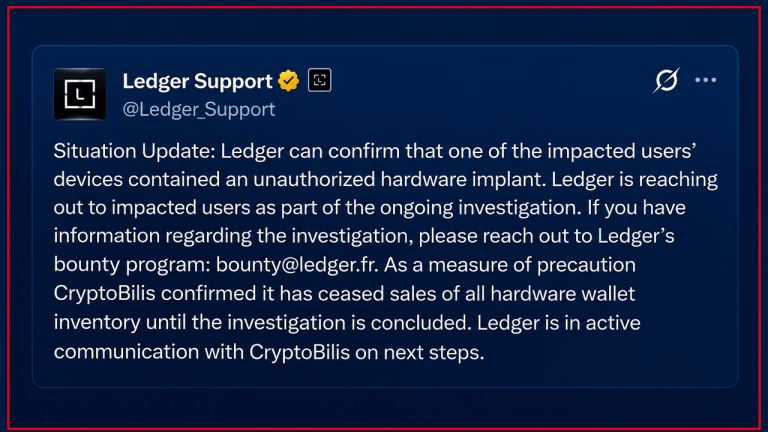
Ledger Confirms Hidden Hardware Implant in Affected User’s Wallet
Ledger confirmed Saturday, Oct. 10, 2026, that a hardware wallet belonging to one affected customer contained an unauthorized impl...