Russian ruble stablecoin: Exec lists 7 ‘Tether replica’ features
The concept of a Russian ruble stablecoin received special attention at a major local crypto event, the Blockchain Forum in Moscow, with key industry executives reflecting on some of the core features a ruble-backed stab...
Archive context
Older archive item. Useful for background and entity history, but not a fresh market-moving signal.
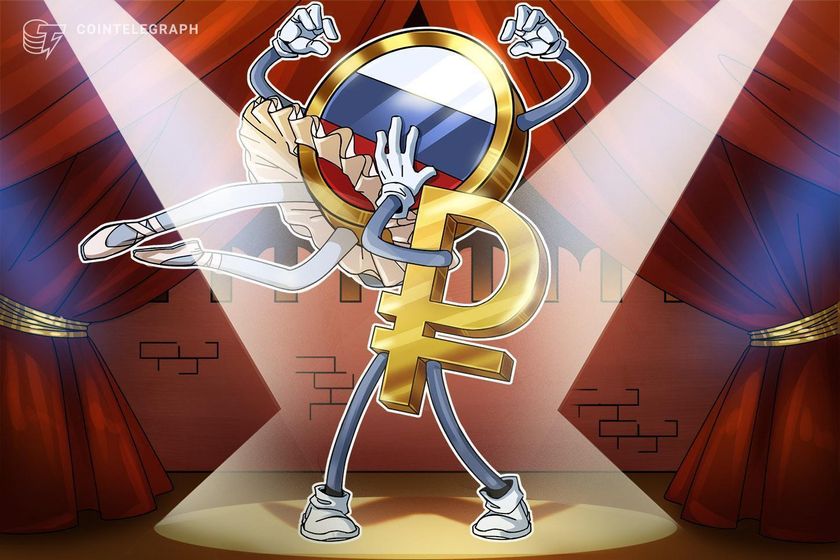
The concept of a Russian ruble stablecoin received special attention at a major local crypto event, the Blockchain Forum in Moscow, with key industry executives reflecting on some of the core features a ruble-backed stablecoin might require.
Sergey Mendeleev, founder of the digital settlement exchange Exved and inactive founder of the sanctioned Garantex exchange, put forward seven key criteria for a potential “replica of Tether” in a keynote at the Blockchain Forum on April 23.
Mendeleev said a potential ruble stablecoin must have untraceable transactions and allow transfers without Know Your Customer (KYC) checks.
However, because one of the criteria also requires the stablecoin to comply with Russian regulations, he expressed skepticism that such a product could emerge soon.
The DAI model praisedMendeleev proposed that a potential Russian “Tether replica” must be overcollateralized similarly to the Dai (DAI) stablecoin model, a decentralized algorithmic stablecoin that maintains its one-to-one peg with the US dollar using smart contracts.
“So, any person who buys it will understand that the contract is based on the assets that super-securitize it, not somewhere on some unknown accounts, but free to be checked by simple crypto methods,” he said.
Source: Cointelegraph
Another must-have feature should be excess liquidity on both centralized and decentralized exchanges, Mendeleev said, adding that users must be able to exchange the stablecoin at any time they need.
According to Mendeleev, a viable ruble-pegged stablecoin also needs to offer non-KYC transactions, so users are not required to pass their data to start using it.
“The Russian ruble stablecoin should have the opportunity where people use it without disclosing their data,” he stated.
Related: Russia’s central bank, finance ministry to launch crypto exchange
In the meantime, users should be able to earn interest on holding the stablecoin, Mendelev continued, adding that offering this feature is available via smart contracts.
Russia opts for centralizationMendeleev also suggested that a potential Russian version of Tether’s USDt (USDT) would need to feature untraceable and cheap transactions, while its smart contracts should not enable blocks or freezes.
The final criterion is that a potential ruble stablecoin would have to be regulated in accordance with the Russian legislation, which currently doesn’t look promising, according to Mendeleev.
Sergey Mendeleev at the Blockchain Forum in Moscow. Source: Bits.Media“Once we put these seven points together [...] then it would be a real alternative, which would help us at least compete with the solutions that are currently on the market,” he stated at the conference, adding:
“Unfortunately, from the point of view of regulation, we are currently going in the absolutely opposite direction [...] We are going in the direction of absolute centralization, not in the direction of liberalization of laws, but consolidation of prohibitions.”Possible solutionsWhile the regulatory side is not looking good, a potential Russian version of USDT is technically feasible, Mendeleev told Cointelegraph.
“Except for anonymous transactions, everything is easy to implement and has already been deployed by several projects, but it’s just not unified in one project yet,” he said.
The crypto advocate specifically referred to interesting opportunities by projects like the ruble-pegged A7A5 stablecoin, unblockable contracts at DAI, and others.
Related: Russian crypto exchange Mosca raided amid cash-to-crypto ban talks
Regulation is necessary but not enough, Mendeleev said, adding that the most difficult part is the trust of users who must see the ruble stablecoin as a viable alternative to major alternatives like USDT.
Recent reports suggest that the deputy head of Russia’s Finance Ministry’s financial policy department urged the government to develop ruble stablecoins.
Elsewhere, the Bank of Russia has continued to progress its central bank digital currency project, the digital ruble. According to Finance Minister Anton Siluanov, the digital ruble is scheduled to be rolled out for commercial banks in the second half of 2025.
Magazine: Bitcoin $100K hopes on ice, SBF’s mysterious prison move: Hodler’s Digest, April 20 – 26
Why this matters
This cryptocurrency story adds another data point to the current market tape and is useful when read alongside nearby source coverage.
Original source
Read on CointelegraphRelated market context

Anchorage Digital taps LayerZero for cross-chain stablecoin infrastructure
The potential partnership highlights the growing importance of interoperability and compliance in the evolving digital asset lands...
Russian Crypto Industry Could Be Operating Legally by Year-End: Central Bank
Bitcoin Magazine Russian Crypto Industry Could Be Operating Legally by Year-End: Central Bank Russia’s crypto industry may have al...

USDT on TRON Becomes Most Used Onchain Payment Option on CoinsBee as Stablecoin Spending Grows
CoinsBee payment data shows USDT on TRON recorded nearly twice as many payments as Bitcoin over the past 90 days, while its share...

Ripple Powers Absa Digital Asset Custody Launch for Africa’s $205B Crypto Market
Key Takeaways: Ripple brings its custody technology to Absa Digital Asset Custody, which Absa Corporate and Investment Banking lau...

Apple Pay Crypto Hiring Fuels New Stablecoin Speculation
Apple posted a U.S.-based Apple Pay Financial Product Strategy Lead role, listing a base-pay range of $149,700 to $280,000 and lis...

XRP News: Exchange Churn Surges, Binance Reserves Barely Move
Binance recorded average XRP inflows of 21,718,631 tokens per day last week, a figure 663% above the exchange’s quarterly baseline...