SEC Chairman Atkins: “Engineers Should Not Be Subject to Securities Laws”
Securities and Exchange Commission (SEC) Chairman Paul Atkins delivered a groundbreaking address on June 9, 2025, boldly declaring that “engineers should not be subject to securities laws” while championing the fundament...
Archive context
Older archive item. Useful for background and entity history, but not a fresh market-moving signal.
Securities and Exchange Commission (SEC) Chairman Paul Atkins delivered a groundbreaking address on June 9, 2025, boldly declaring that “engineers should not be subject to securities laws” while championing the fundamental right to self-custody digital assets.
Speaking at the SEC’s Crypto Task Force roundtable, “DeFi and the American Spirit,” Atkins described decentralized finance as embodying core American values of “economic liberty, private property rights, and innovation.”
The timing carries profound significance, coming after his June 3 Senate testimony, in which he condemned the SEC’s previous “regulation-by-enforcement” approach as having “inhibited innovation” and “invited fraud.”
Key points from Chairman Paul Atkins’ remarks today at “DeFi and the American Spirit,” SEC’s Crypto Task Force Roundtable on Decentralized Finance – a
— U.S. Securities and Exchange Commission (@SECGov) June 9, 2025 SEC’s Journey From Enforcement Crackdowns to Innovation ChampionsThe previous administration’s approach “discouraged Americans from participating in these market-based systems by asserting through lawsuits, speeches, regulation, and threatened regulatory action that participants and staking-as-a-service providers may be engaged in securities transactions,” Atkins explained.
This regulatory hostility peaked with enforcement actions targeting developers of self-custody software, treating code publication as potential brokerage activity.
The absurdity became clear through cases like Tornado Cash, in which developer Alexey Pertsev was arrested and convicted of money laundering. He received over five years in prison, but he was recently released.
Other developers, Roman Storm and Roman Semenov, faced similar charges, prompting Ethereum co-founder Vitalik Buterin to donate $170,000 to legal defense funds and the Ethereum Foundation to contribute $1.25 million, emphasizing that “writing code is not a crime.”
The EF is donating $1.25M to the legal defense of Alexey Pertsev.
Privacy is normal, and writing code is not a crime.
You can contribute to @alex_pertsev's defense here: https://t.co/shWFNoDJ9g https://t.co/ITvEiRkAGt
Atkins embraced judicial reasoning that holding developers liable for third-party misuse would be like suing a car manufacturer “for a third-party’s use of the car to commit a traffic violation or to rob a bank.”
He celebrated recent progress, particularly the Division of Corporation Finance’s clarification that voluntary participation in proof-of-work or proof-of-stake networks as miners, validators, or staking service providers falls outside the scope of federal securities law.
However, he emphasized that staff guidance “is not a duly promulgated rule with the force of law, so we cannot stop there.”
The SEC’s new approach is already working. The agency has dropped cases against major players, including Binance, Coinbase, and Ripple, which is a retreat from the previous administration’s aggressive stance.
Binance CEO Richard Teng calls SEC case dismissal a “huge win” and credits Trump for a crypto-friendly regulatory shift. #RichardTeng #Binancehttps://t.co/qZYIaMJCbX
— Cryptonews.com (@cryptonews) June 4, 2025This shift gained momentum with the January 21 launch of the Crypto Task Force, led by Commissioner Hester Peirce and supported by Commissioner Mark Uyeda. The task force is tasked with developing a comprehensive crypto regulatory framework.
Self-Custody as Financial Sovereignty and Innovation FrameworkAtkins’s passionate defense of self-custody rights positioned direct control over crypto assets as a “foundational American value that should not disappear when one logs onto the internet.”
JUST IN: SEC Chair Paul Atkins says the right to self custody crypto "is a foundational American value." pic.twitter.com/B7ghx7pUJ0
— Watcher.Guru (@WatcherGuru) June 9, 2025This principle gained urgency following spectacular failures of centralized platforms like FTX and Celsius, where billions in user funds were lost.
“While centralized platforms waivered and failed under recent stresses, many on-chain systems continued to operate as designed pursuant to open-source code,” he noted.
The chairman acknowledged legitimate concerns about user error in self-custody while supporting “greater flexibility to market participants to self-custody crypto assets, especially where intermediation imposes unnecessary transaction costs or restricts the ability to engage in staking and other on-chain activities.”
Atkins’ vision extends beyond individual rights to comprehensive market transformation.
He expressed excitement about “the use of on-chain software systems by issuers and intermediaries to eliminate economic frictions, increase capital efficiency, enable new types of financial products, and enhance liquidity.”
SEC Chair Paul Atkins said the agency is drafting an “innovation exemption” for DeFi, aiming to ease rules for launching on-chain products. SEC crypto lead Hester Peirce noted developers shouldn't be liable for code misuse, but centralized entities can't evade regulation by…
— Wu Blockchain (@WuBlockchain) June 10, 2025Most significantly, Atkins proposed an “innovation exemption” framework that would “expeditiously allow registrants and non-registrants to bring on-chain products and services to market” under specified conditions.
This conditional relief mechanism could “help fulfill President Trump’s vision to make America the ‘crypto capital of the planet’ by encouraging developers, entrepreneurs, and other firms that are willing to comply with certain conditions to innovate with on-chain technologies in the United States.”
The post SEC Chairman Atkins: “Engineers Should Not Be Subject to Securities Laws” appeared first on Cryptonews.
Why this matters
This cryptocurrency story adds another data point to the current market tape and is useful when read alongside nearby source coverage.
Original source
Read on CryptonewsRelated market context

CFTC Chairman Selig says he is disappointed in Congress over stalled crypto bill
The stalled crypto bill highlights regulatory uncertainty, potentially stifling innovation and market growth while increasing comp...

Stealing $1.5B in crypto is easy, cashing out is the trap
North Korean hackers stole around $1.5 billion from Bybit in February 2025. While the hack itself has been widely covered and anal...

Kalshi brings election betting odds to CBS News as most Americans object
The integration of election betting odds into mainstream media may challenge traditional polling credibility and face public resis...
Bitfinex Securities launches tokenized fund offerings using Tether’s Hadron
Bitfinex Securities' tokenized fund offerings could enhance digital asset market accessibility and diversification, impacting glob...
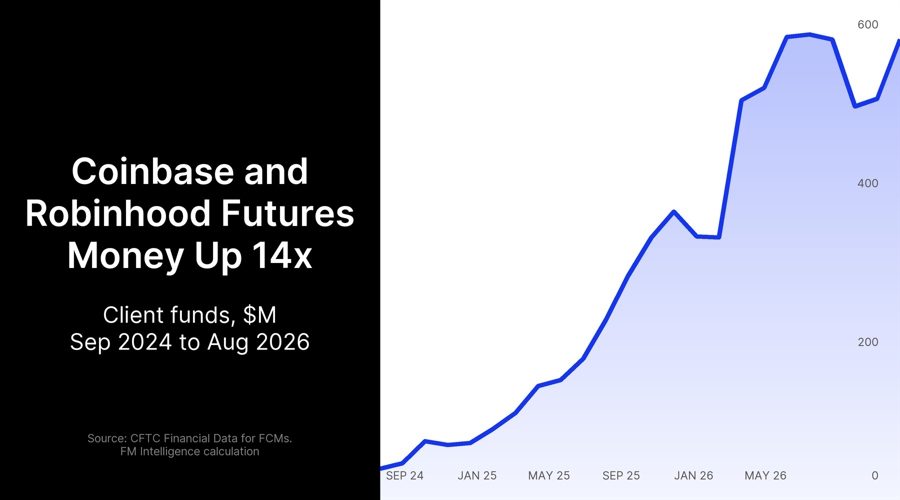
Coinbase and Robinhood Futures Arms Now Hold More Client Money Than the US Retail Forex Pool
The futures brokers of Coinbase and Robinhood held $581.4 million of segregated client money at the end of August. That is more th...
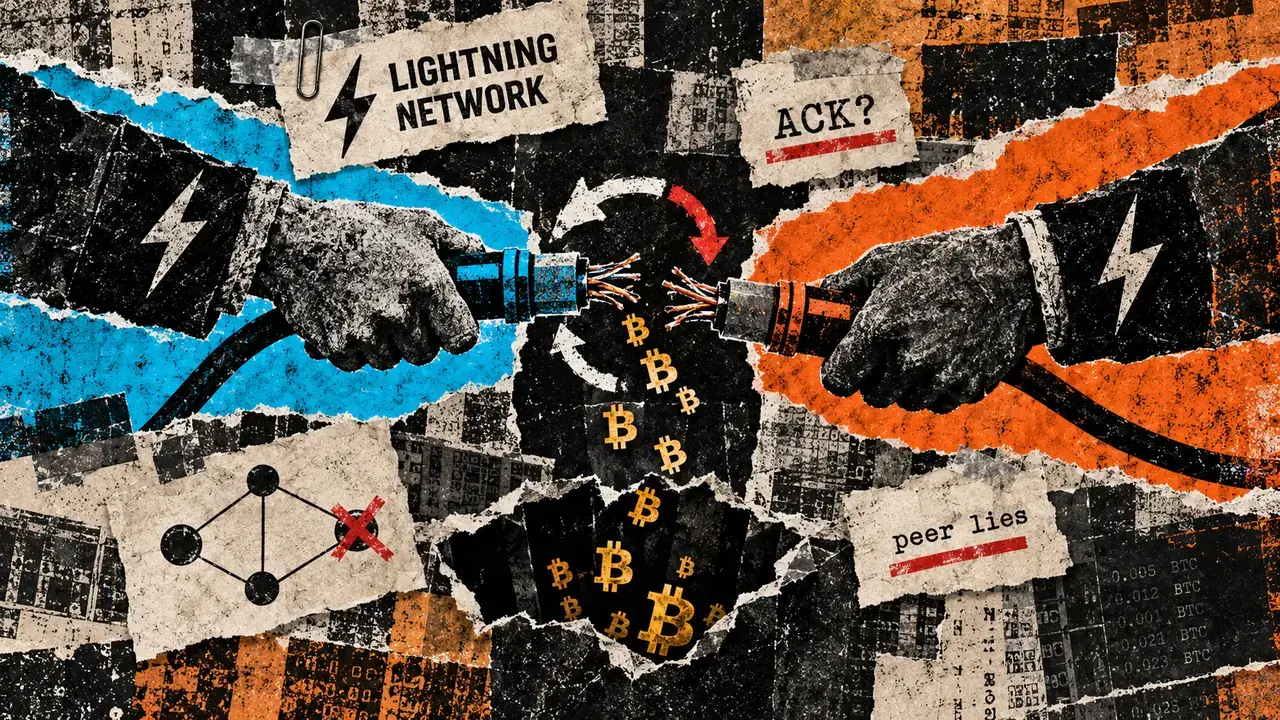
Lightning apps using unpatched LDK risk Bitcoin theft from a reconnect lie
Lightning Development Kit (LDK), a library for building Bitcoin Lightning wallets and payment applications, has patched a flaw tha...