South Korean Regulator to Reorganize AML Protocols Ahead of Stablecoin Legislation
The Financial Intelligence Unit (FIU), a top South Korean regulator, has begun to reorganizing its anti-money laundering (AML) protocols ahead of the “institutionalization” of stablecoins.The FIU said it will conduct sta...
Archive context
Older archive item. Useful for background and entity history, but not a fresh market-moving signal.
The Financial Intelligence Unit (FIU), a top South Korean regulator, has begun to reorganizing its anti-money laundering (AML) protocols ahead of the “institutionalization” of stablecoins.
The FIU said it will conduct stablecoin-related research via external contractors. It will then compile its findings in December this year before drafting a set of guidelines for stablecoin operators and issuers.
Per The Bell Korea, the regulator is likely to recommend amendments to the Specific Financial Information Act, with “significant changes” in store.
The South Korean National Assembly Building in Seoul, South Korea. (Source: National Assembly [KOGL Type 1])South Korean Regulator Readies Stablecoin RegulationsThe regulator is likely to impose entry restrictions and business conduct regulations. Many of these will likely focus on the security of the assets that underpin any South Korean stablecoins, as well as data reporting criteria.
An FIU official said that December’s research report would “serve as a foundation for developing AML response measures in response to changes in the virtual asset industry and the institutionalization of stablecoins.”
The official added that the measures would help “improve and supplement the existing system.”
The FIU currently plays a key role in policing domestic crypto exchanges and ensuring their AML compliance.
And the reorganization appears to suggest it expects to become the top AML regulatory authority for stablecoin issuers, despite plans to scrap its parent organization, the Financial Services Commission (FSC).
President Lee Jae-myung has previously announced his intention to do away with the FSC. He wants to merge its operations with those of the finance ministry and the Financial Supervisory Service.
President Lee Jae Myung’s approval rating has dropped for the second straight week, sinking to a record low of 51.1 percent, a poll showed Monday. The slide comes amid growing controversy over his Liberation Day pardons. https://t.co/VYWndBDJoZ
— The Korea JoongAng Daily (@JoongAngDaily) August 18, 2025However, recent government plan announcements have made no further mention of scrapping the FSC. And the Blue House has even assigned it crypto-related tasks for 2025.
FIU Set for Important Regulatory Role?The FIU’s plans, which involve conducting a study on international stablecoin regulations, appear to suggest the regulator expects to police the industry ahead of the rollout of legislation.
Several stablecoin bills are on the agenda at the National Assembly. However, lawmakers are yet to fine-tune the details of these draft laws. They continue to deliberate matters like the possible launch of stablecoin lending services.
Critics note that the Financial Action Task Force (FATF) and other organizations have warned that stablecoin adoption can lead to increased money laundering risks.
The Bell Korea noted that many countries, including the United States, have been “quick to develop countermeasures.” Conversely, it noted, South Korea, is a “latecomer,” in this regard, as it “still lacks a comprehensive system.”
The media outlet also added that South Korea “still lacks a clear legal definition of stablecoins.”
Thus far, most AML-related legislation (including the Special Financial Transactions Act) and regulations relate to exchanges and crypto wallet operators.
Big Businesses Ready to Make Stablecoin MovesWhile lawmakers are yet to form a firm consensus on stablecoin legislation, both major parties agree that businesses should be allowed to issue or make use of KRW-pegged coins.
The headquarters of the South Korean tech giant Naver. (Source: Maskkwon [CC BY-SA 4.0])Some of the country’s biggest banks and tech firms have responded by registering stablecoin-related trademarks.
Others have already launched dedicated stablecoin business units as they await the National Assembly’s green light.
Experts expect companies like Kakao and Naver to make significant progress in the stablecoin space.
Both already have a sophisticated network of web-based services, ranging from e-payment platforms to banking and software-as-a-service (SaaS) offerings.
The post South Korean Regulator to Reorganize AML Protocols Ahead of Stablecoin Legislation appeared first on Cryptonews.
Why this matters
This cryptocurrency story adds another data point to the current market tape and is useful when read alongside nearby source coverage.
Original source
Read on CryptonewsRelated market context
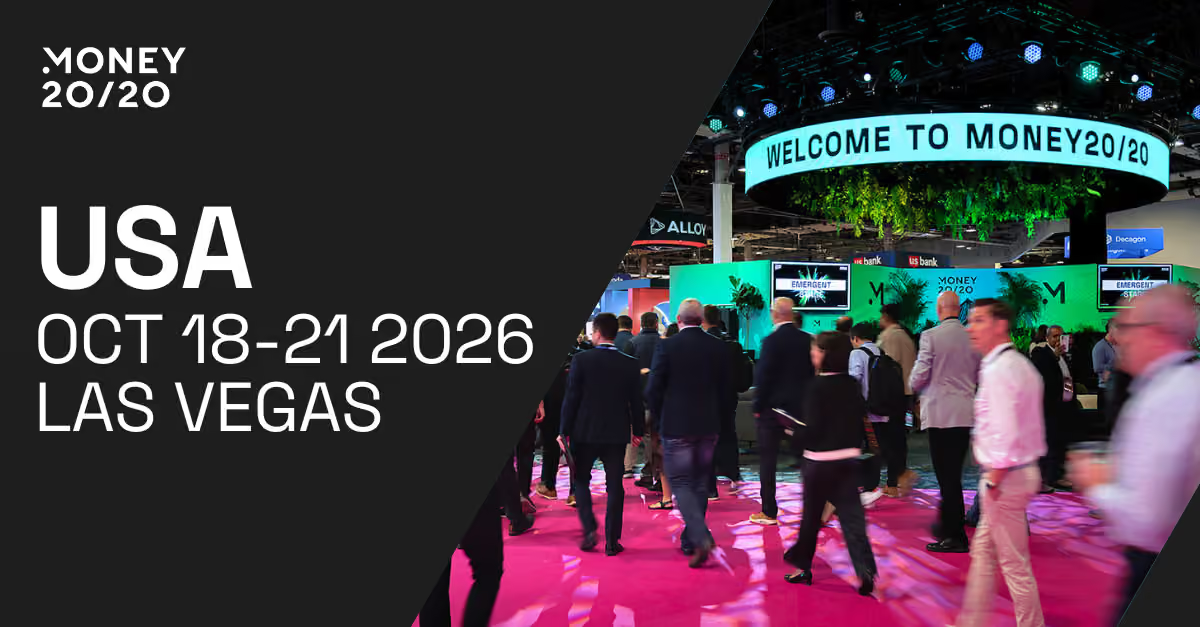
Money20/20 USA 2026: How Bitcoin, Stablecoins and AI Are Reshaping the Future of Finance
Bitcoin Magazine Money20/20 USA 2026: How Bitcoin, Stablecoins and AI Are Reshaping the Future of Finance Fintech has moved beyond...

EU crypto platforms given 3 months to remove unauthorized stablecoins
The ESMA's directive may reshape EU crypto markets by limiting non-compliant stablecoins, potentially altering global regulatory t...
ESMA orders MiCA firms to halt services for non-compliant stablecoins
The EU's deadline for crypto firms to drop non-compliant stablecoins like USDT may reshape market dynamics and regulatory strategi...

ESMA gives crypto firms 3 months to exit non-compliant stablecoins
ESMA urged EU crypto firms to halt services involving non-MiCA-compliant stablecoins, giving regulators three months to address ex...

Samsung Wallet Brings USDC Transfers to 82 Million US Galaxy Devices in Late October
Samsung announced Oct. 7 that eligible Galaxy users in the US will be able to send USDC from Samsung Wallet starting in the last w...
Kazakhstan Taps Tether to Explore a New Tenge Stablecoin Model
Kazakhstan already has a tenge stablecoin in a central-bank sandbox. Now it has brought Tether into the room to study another one....