Stop the Presses: Criticism Against the New York Times Mounts as Newspaper Is Accused of Killing 59 Million Trees Annually
After the New York Times (NYT) published an editorial about bitcoin mining, claiming the industry is harmful to the environment, an organization called Stop the Presses took issue with the Times’ paper usage. Stop the Pr...
Archive context
Older archive item. Useful for background and entity history, but not a fresh market-moving signal.
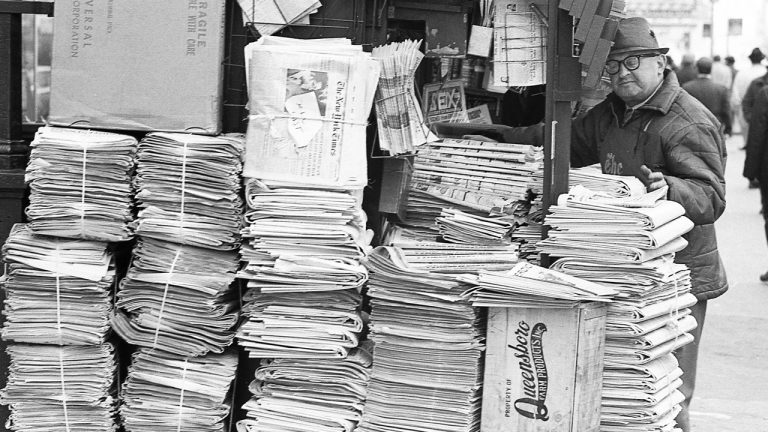
After the New York Times (NYT) published an editorial about bitcoin mining, claiming the industry is harmful to the environment, an organization called Stop the Presses took issue with the Times’ paper usage. Stop the Presses launched a social media campaign against the NYT’s newspaper production. The organization’s website, nytimesup.org, alleges that the company “kills approximately 59 million trees per year.”
Activists Blast New York Times Over Physical Newspaper Print ProductionOn April 10, 2023, the New York Times faced criticism for publishing a one-sided “hit piece” on bitcoin mining. Crypto proponents claimed that Times reporter Gabriel Dance did not use factual information. Since then, the focus has shifted to the environmental impact of the American news outlet, founded in 1851, due to its newspaper production.
A group called Stop the Presses launched a social media campaign and website exposing the news business’s current printing practices. The accusation is that the New York Times destroys a significant number of trees to produce its antiquated physical paper in a digital world.
“The New York Times kills approximately 59 million trees per year,” the website nytimesup.org details. “They kill these trees just to turn them into a newspaper that most people throw away, creating billions of pounds of CO2 each year. They print propaganda on the paper they create with dead trees, yet we live in a digital age. This wasteful practice must be stopped.”
NYTimes Bitcoin Hit Piece Backfires As #StopThePresses Movement Erupts On Social Media https://t.co/H21dbyUUbW
— zerohedge (@zerohedge) April 18, 2023
Many others share the same sentiment as Stop the Presses. Several people are sharing images and information on the subject while tagging the NYT Twitter account so the company notices the grievances. One individual estimates that if the New York Times kills 59 million trees annually, they create “2.832 billion pounds of CO2 annually.” The person notes that it is even worse when combining the 171 years of newspaper delivery.
“That means they’ve murdered over 10 billion trees and created over 484 billion pounds of CO2,” the individual emphasized. The number of trees used to create The New York Times since 1851 does not account for the CO2 used in the company’s 27 newspaper printing locations for manufacturing purposes.
Furthermore, it does not account for the delivery process and all the fossil fuels used to transport the newspaper to stores. The NYT even features a 2009 article about the subject, and the author acknowledges that physical newspapers cause a significant amount of greenhouse gas emissions.
Citing an academic paper from 2004, New York Times contributor Tom Zeller Jr. explains that the study’s conclusion notes that “receiving the news on a PDA results in significant reductions in the release of carbon dioxide, water, nitrogen, and sulfur oxides.”
In another New York Times article published in 2018 by Farhad Manjoo, the author explains how he took time off from reading digital news to read the physical paper for two months. Interestingly, Manjoo claims it was a “surprise blessing” even though he acknowledges that print “presents a narrower mix of ideas than you find online.”
The blessing, Manjoo said, despite getting news that is a day old due to the printing and delivery delay, was that “hundreds of experienced professionals had done the hard work” for him. The NYT has not responded publicly to any of the criticism stemming from Stop the Presses and other activists.
In more recent times, the paper’s social media account with 55 million followers has lost its verification checkmark on Twitter. Physical print newspapers have declined over the last decade, and over the last two years, print subscribers have dropped by 7%. Data further shows that from 2005 to 2021, roughly 2,200 American print newspapers failed, with the majority of today’s readership migrating to digital media.
What are your thoughts on the environmental impact of physical newspapers in a digital age, and do you believe that major news outlets like The New York Times should shift their focus entirely to digital media? Share your thoughts about this subject in the comments section below.
Why this matters
This cryptocurrency story adds another data point to the current market tape and is useful when read alongside nearby source coverage.
Original source
Read on Bitcoin NewsRelated market context

Judge Rejects Gemini And CFTC Bid To Overturn $5 Million Settlement
TL;DR: A federal judge has rejected a joint attempt by Gemini and the Commodity Futures Trading Commission to overturn the exchang...

Circle Reveals $819 Million USDC Payouts As Stablecoin Economics Come Under Scrutiny
TL;DR: Circle says it generated roughly $1.4 billion in first-half 2026 revenue while spending $819 million on distribution partne...

Binance.US Seeks $100 Million Funding Round At $1 Billion Valuation
TL;DR: Binance.US is reportedly seeking up to $100 million from private investors at a proposed valuation of approximately $1 bill...

Coinbase and Marqeta Bring 24/7 Stablecoin Card Spending to Millions of Merchants
Key Takeaways: Coinbase and Marqeta are taking a stab at stablecoin-based cards. Coinbase infrastructure makes it easy for busines...

BIS paper finds banks could slow stablecoin growth by raising rates
Rising bank rates could curb stablecoin growth, impacting monetary policy, regulation, and competition between banks and digital c...

Morgan Stanley’s Amy Oldenburg: The Digital Gold Investment Case for Bitcoin
Bitcoin Magazine Morgan Stanley’s Amy Oldenburg: The Digital Gold Investment Case for Bitcoin Bitcoin’s digital gold case is “a pr...