SVB Crisis: Impact on Singaporean Startups Limited, Says Central Bank
The Monetary Authority of Singapore (MAS) has said that the collapse of Silicon Valley Bank (SVB) and other two US-based banks has limited impact on startups in its ecosystem, including those with operations in the Unite...
Archive context
Older archive item. Useful for background and entity history, but not a fresh market-moving signal.
The Monetary Authority of Singapore (MAS) has said that the collapse of Silicon Valley Bank (SVB) and other two US-based banks has limited impact on startups in its ecosystem, including those with operations in the United States.
The conclusion is based on initial feedback, MAS announced on Monday, noting that it is working closely with Enterprise Singapore, a statutory board under the country’s Ministry of Trade and Industry, to assess any potential impact of the developments on the country.
“MAS and other government agencies will continue to monitor the situation closely for any signs of stress,” the central bank noted.
Singapore Has "Insignificant Exposures" to Failed US Banks
Furthermore, the financial regulator noted that the Singapore banking system, on the whole, has “insignificant exposures” to the failed United States banks, adding that banks in the Asian country are “well-capitalized and conduct regular stress tests against interest rate and other risks.”
Additionally, MAS assured that the country’s banking system remains “sound and resilient,” adding that the Singapore Dollar money and foreign exchange markets “continue to function well.”
“MAS is closely monitoring the domestic financial system and international developments. MAS stands ready to provide liquidity through its suite of facilities to ensure that Singapore’s financial system remains stable and financial markets continue to function in an orderly manner,” the central bank explained.
US Sees Largest Bank Collapse Since 2008
Last Friday, SVB, which targeted its banking and lending services at early-stage technology companies, collapsed following a run on the bank. As a result of higher interest rates, private equity funding became more expensive for technology firms, resulting in more withdrawals to meet their needs.
In a bid to meet customers’ needs, the California-based bank made efforts to raise funds, including a plan to offer $2.25 billion in common equity and preferred convertible stock. Additionally, the bank sold its bond portfolio comprising majorly of US government bonds at a $1.8 billion loss.
However, the efforts did not salvage the bank as the struggling lender was later admitted under the receivership of the Federal Deposit Insurance Corporation. The bank’s collapse has been described as the largest bank failure since the 2008 financial crisis.
New York regulators on Sunday would later shut down Signature Bank “to protect depositors.” Days earlier, another struggling crypto-friendly bank, Silvergate, winded down its operations and voluntarily liquidated its assets.
This article was written by Solomon Oladipupo at www.financemagnates.com.Why this matters
This cryptocurrency story adds another data point to the current market tape and is useful when read alongside nearby source coverage.
Original source
Read on Finance MagnatesRelated market context

Bitcoin Is More Than Just an Asset, Says TD Cowen
Bitcoin Magazine Bitcoin Is More Than Just an Asset, Says TD Cowen Investment bank TD Cowen has said that Bitcoin is more than an...

Travala’s Crypto Loyalty Program Passes 170,000 Members, Sets Long-Term Goal of 30% of AVA Supply Locked
Singapore, Singapore, October 1st, 2026, Chainwire With around 16% of AVA’s circulating supply already locked, the AVA Smart Progr...
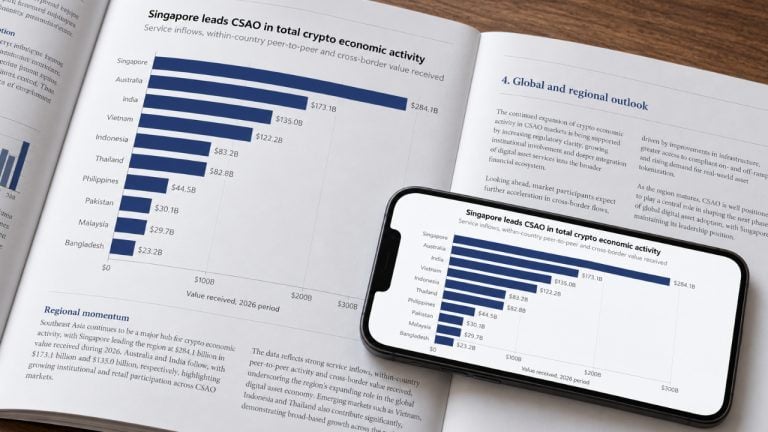
Singapore’s Crypto Activity Hits $284 Billion as Institutional Activity Jumps 94%
Singapore recorded $284 billion in crypto activity as institutional-platform business nearly doubled, according to Chainalysis. Ex...

Perplexity AI Predicts Insane $40 Price Target for XRP: How Did It Get There?
Perplexity AI predicts something that few analysts or other AI models do. It has produced an insanely wild bullish prediction for...

UK’s 2027 crypto rules let firms remove trust protection from Bitcoin lent for yield
UK crypto firms can now apply for authorization as of Sept. 30, bringing Bitcoin holders closer to a rulebook that will treat coin...

Stablecoin cards enter ‘hyper growth’ mode as monthly spending hits record $1.17 billion
Stablecoin card spending is accelerating to record levels, but the payment rail remains a fraction of the traditional card market....