Tether Reports $1.3B Q2 Profit As Excess Reserves Reach $5.2B
Tether reported $1.3 billion in Q2 net operating profit in its latest BDO attestation statement, while excess reserves rose to $5.2 billion above full USDT backing. The figures keep Tether at the center of the stablecoin...
Archive context
Older archive item. Useful for background and entity history, but not a fresh market-moving signal.

Tether reported $1.3 billion in Q2 net operating profit in its latest BDO attestation statement, while excess reserves rose to $5.2 billion above full USDT backing.
The figures keep Tether at the center of the stablecoin market’s profitability and reserve debate. USDT remains the largest dollar stablecoin in crypto, and Tether’s reserve earnings have become one of the most closely watched financial stories in the sector.
The main driver is familiar: interest income from large holdings of U.S. Treasury assets.
But the details still need careful wording. Net operating profit is not the same as total reserves, and excess reserves are not the same thing as circulating supply.
For more details, visit the official Tether platform.
TL;DR- Tether reported $1.3 billion in Q2 net operating profit.
- Its latest attestation showed $5.2 billion in excess reserves.
- The figures are separate from total USDT circulating supply and full reserve backing.
Tether’s business benefits from scale.
When users hold USDT, Tether holds reserve assets backing those tokens. A large portion of those reserves is held in short-term U.S. Treasury instruments and similar cash-equivalent assets. In a higher-rate environment, those holdings can generate substantial income.
That is why stablecoin issuers have become major financial businesses.
They may issue digital dollars, but their economics can look like a huge cash-management operation. The larger the token supply, the larger the reserve portfolio, and the more interest income can be generated when yields are favorable.
Tether’s $1.3 billion quarterly profit reflects that model.
Excess Reserves Add A CushionThe reported $5.2 billion in excess reserves is also important.
Stablecoin users want to know not only that tokens are fully backed, but that the issuer has a cushion above liabilities. Excess reserves can help absorb shocks, operational costs, or asset fluctuations.
That does not remove every risk.
Reserve composition, banking access, liquidity, legal structure, transparency, and redemption mechanics still matter. But a larger reserve cushion can strengthen market confidence.
For USDT, that confidence is critical because the token is deeply embedded in global crypto trading.
USDT’s Market Role Is HugeUSDT is used across exchanges, DeFi, payments, emerging-market dollar access, trading pairs, and liquidity venues.
That means Tether’s financial health matters beyond Tether itself. If confidence in USDT weakens, the impact can spread through crypto markets quickly. If confidence remains strong, USDT continues to serve as one of the industry’s main settlement assets.
That is why every attestation receives attention.
It is not just an accounting update. It is a health check for one of crypto’s biggest liquidity layers.
Attestations Are Still Point-In-TimeThe market should keep the limits in mind.
An attestation is a snapshot. It is not a live, second-by-second view of reserves. It does not eliminate every question around asset composition or risk. It also does not give the same kind of continuous visibility as an on-chain reserve dashboard.
But regular attestations still improve transparency compared with no disclosure at all.
They give users and institutions data to assess reserve backing, profit, and excess cushion at the reporting date.
The Stablecoin Race Is Getting BiggerTether’s profit also shows why stablecoins have become strategically important.
Banks, fintechs, payment firms, and crypto companies all want a role in digital dollar settlement. Regulation is tightening, competition is growing, and reserve economics are attractive.
Tether already has scale.
The question is how it holds that lead as regulated stablecoin frameworks, tokenized deposits, and bank-linked digital money products develop.
For now, the latest attestation shows a highly profitable issuer with a large reserve cushion and a stablecoin that remains central to crypto liquidity.
This article draws on Tether’s Q2 2026 BDO attestation materials.
This article was written by the News Desk and edited by Samuel Rae.
Why this matters
Tether is showing up inside the Stablecoins theme, so this story is worth tracking for follow-through rather than treating it as a one-off headline.
Original source
Read on NewsBTCRelated market context

Morgan Stanley Builds Crypto Lab to Test Stablecoins, Tokenization and DeFi at Scale
Key Takeaways: Morgan Stanley has opened a Digital Asset Lab dedicated to blockchain technologies. The test is to be applied to th...

BlackRock pushes deeper into tokenization with funds, portfolios and stablecoin reserves
BlackRock's tokenization efforts could revolutionize financial markets by enhancing transparency, efficiency, and accessibility gl...
Stablecoin Growth Cooled as Deposit Rates Rose, With USDC Most Exposed, Working Paper Says
When U.S. banks paid savers more, stablecoins grew more slowly, according to a Bank for International Settlements working paper pu...

Circle Reveals $819 Million USDC Payouts As Stablecoin Economics Come Under Scrutiny
TL;DR: Circle says it generated roughly $1.4 billion in first-half 2026 revenue while spending $819 million on distribution partne...
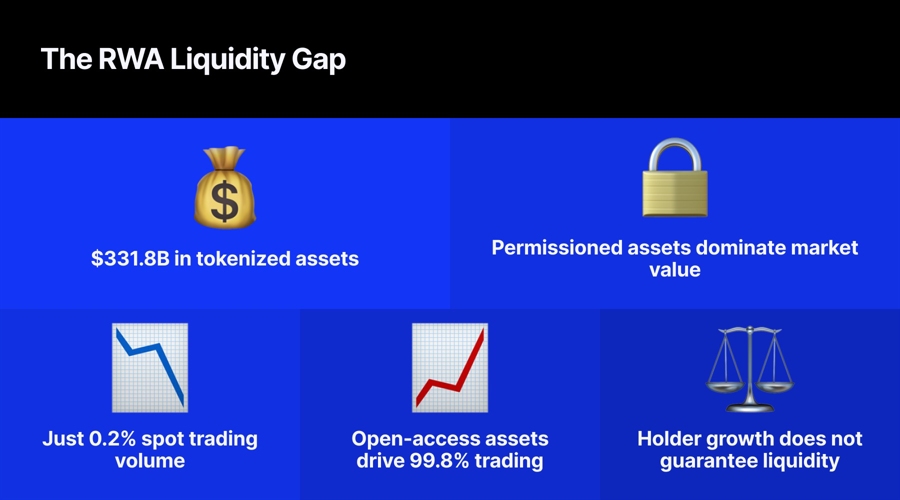
More Holders, Little Trading: The RWA Liquidity Problem Is Worse Than You Think
Let me ask you something straight. Does real-world asset trading on crypto exchanges feel like a genuine revolution, or does it fe...
Banks Hold a Lever Over Stablecoin Adoption, BIS Economists Say
A Bank for International Settlements working paper found that stablecoin growth slows when U.S. banks raise deposit rates, with Ci...