The fallacy of scalability — why layer 2s won’t save crypto
Opinion by: Dan Hughes, founder of Radix Crypto has spent years betting on layer-2 (L2) solutions as its magic bullet for fixing issues with scalability. What if they’re the very thing putting us at risk?Instead of pavin...
Archive context
Older archive item. Useful for background and entity history, but not a fresh market-moving signal.
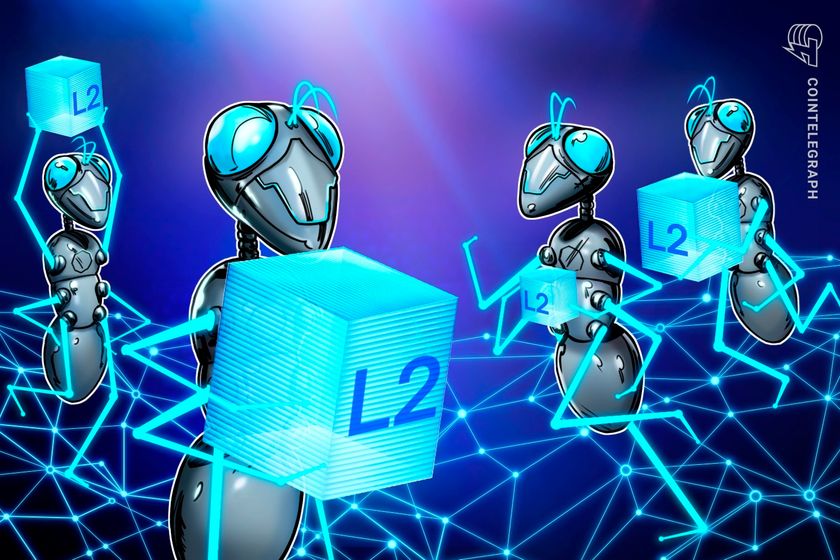
Opinion by: Dan Hughes, founder of Radix
Crypto has spent years betting on layer-2 (L2) solutions as its magic bullet for fixing issues with scalability. What if they’re the very thing putting us at risk?
Instead of paving the way for mass adoption, this fixation has created a tangled web of rollups, bridges and fragmented liquidity, threatening blockchain’s core principles of decentralization and security. The dream of a seamless, decentralized network is fading, overshadowed by a complex system that echoes the inefficiencies and centralization of the traditional financial world. Are we scaling innovation or just recreating the past?
The blockchain trilemmaL2s were supposed to mitigate the blockchain trilemma. Yet, while they may fill the gaps at the individual level, as a movement, L2 solutions have put crypto at risk of losing all three.
The growing mass of L2s has led to a highly fractured ecosystem that’s difficult to navigate and relies on complex rollups and bridging solutions. This has led to parts of the ecosystem centralizing, drawing assets into fragmented liquidity silos, hindering security and stifling competition for smaller projects.
These “solutions” have introduced large-scale friction and have also brought unnecessary security risks. While bridge-related hacks have become much less common in the last two years, hackers will always find new ways to balance the books — exploiting rollups, channels and sidechains.
Many L2s’ reliance on sequencers or trusted validators creates additional cracks in the armor, single points of failure, while siloed liquidity reduces validator availability for smaller L2s, threatening network resilience.
These solutions also leave an immense technical challenge for developers building applications hoping to integrate with L2s, requiring in-depth and specific knowledge of the mechanics of each L2 the application may need to touch.
L2 proponents argue that these trade-offs are necessary and easily overcome, but there are even more fundamental issues here than sacrificing security, scalability or liquidity.
Recent: AI has had its Cambrian moment — Blockchain’s is yet to come
Crypto’s endgame is a universal network where any asset or decentralized application can instantly interact with any other in a trustless, secure way. The friction that L2s introduce, however, sabotages this instant interoperability, while the centralization of sequencers and validators undermines the fundamentals of a trustless system. It is not just that this stymies scalability in decentralized finance (DeFi), but rather that it leads toward scaling something completely different, recreating the inefficiencies of the existing siloed, fragmented and middle-man-infested TradFi system.
If the goal of DeFi is to move all financial activity onchain, it is imperative to do better than what we already have.
Building the foundationsCrypto needs to build from the foundations up. Instead of outsourcing scalability and security, blockchain networks must prioritize them at layer 1.
Sharding offers a clear path forward, but the industry must set higher goals and build a long-term solution rather than just a quick fix to “band-aid” the immediate scalability problem of the day. It is not just about increasing the shard count; it is how we shard. The Beacon Chain just adds a bottleneck, and dynamic sharding is complicated, limiting scalability with massive overheads. Even intra-validator sharding seems to solve all of these problems until you reach resource saturation on the network-facing node, which has to ingest all transactions, simply kicking the can down the road in search of more validators and diminishing returns.
The obvious solution for scaling DeFi to the same capabilities as TradFi is state sharding, which is the state of the blockchain distributed across many different shards. Transactions that involve states from different shards create a temporary consensus process.
The validators responsible for the transaction state communicate, agree (or not), and update the state atomically in all relevant shards. This allows transactions to be processed in parallel across multiple shards and even within shards themselves, leaving a shard’s only concern that the transactions modifying the state for which they are responsible do not have intersecting dependencies, significantly increasing throughput without compromising decentralization or accessibility.
When these shards are integrated with atomic commitment, if any part of the transaction fails, everything aborts cleanly, and there’s no work needed to untangle hanging state changes.
This is just one solution. DeFi will scale to onboard the planet. It is just a question of how soon and by what means. That said, solutions that focus on the fundamentals of L1 development rather than relying on a patchwork of L2s will eliminate fragmentation, reduce complexity, and ensure scalability and accessibility are again at the heart of blockchain networks. It comes down to the future that developers want to prioritize — tokenomics or the founding promises of Web3 — decentralization, efficiency and security.
Scaling for the futureL1 solutions are solutions for everybody. They secure the very foundation of the ecosystem for developers, traders, general users and even several billion prospective users. Without resilient and scalable architecture in the foundations, one strong push is all it will take to cause this house of cards to collapse. Of course, specific use cases might be better with L2 solutions. A high-frequency trade settlement is a perfect example, but exceptions never prove the rule. From a whole-ecosystem perspective, developers must focus on integrated, native scalability solutions instead of just adding complexity and balancing more precarious “solutions” on top. Without adequately attending to the L1, nothing but problems await.
Opinion by: Dan Hughes, founder of Radix.
This article is for general information purposes and is not intended to be and should not be taken as legal or investment advice. The views, thoughts, and opinions expressed here are the author’s alone and do not necessarily reflect or represent the views and opinions of Cointelegraph.
Why this matters
This cryptocurrency story adds another data point to the current market tape and is useful when read alongside nearby source coverage.
Original source
Read on CointelegraphRelated market context

Now Accepting Bitcoin: Shortwave Coffee Bitcoin Enabled Across 3 States
Bitcoin Magazine Now Accepting Bitcoin: Shortwave Coffee Bitcoin Enabled Across 3 States This story is about Shortwave Coffee bitc...

L2 growth and $120 billion in staking hide Ethereum’s supply reality
Ethereum's institutional data hub showed about $120 billion in staked ETH and $40.4 billion in daily average total value locked on...

Narrowing price cushions leave Bitcoin loans vulnerable to 4.7% price dips as Aave weighs higher leverage
Aave governance has advanced a proposal that would give Bitcoin-backed borrowers materially more leverage while leaving less room...

Bitcoin ETFs just absorbed 11,500 BTC in their biggest buying day in nearly two years
US spot Bitcoin exchange-traded funds (ETFs) pulled in nearly $1 billion as BTC broke above $86,000, marking their strongest inflo...

Crypto Got Its Rulebook Without Congress, Chris Perkins Says
The CLARITY Act stalled in the Senate on Sept. 15, when a motion to take it up drew 49 votes to 50, 11 short of the 60 it needed a...

ZWTC 2026 Enters Squad Stage as Zoomex Opens Registration for Competition With Up to 2.5 Million USDT in Prizes
VICTORIA, Seychelles, September 21, 2026 — Zoomex, a global cryptocurrency trading platform focused on derivatives, has opened reg...