The Future of Finance Is On-Chain, but Not Necessarily Decentralized
The narrative of transitioning from fiat to crypto is old news. But, something has changed during the last couple of years. Once envisioned as a grassroots revolution led by libertarian crusaders, it's becoming increasin...
Archive context
Older archive item. Useful for background and entity history, but not a fresh market-moving signal.

The narrative of transitioning from fiat to crypto is old news. But, something has changed during the last couple of years.
Once envisioned as a grassroots revolution led by libertarian crusaders, it's becoming increasingly apparent that the primary evangelists driving this shift will be governments and financial powerhouses.
The New Architects of On-Chain Finance
Both public and private sector giants are not just embracing blockchain technology; they're actively issuing tokens and crypto-pegged financial vehicles.
Picture a pyramid, no pun intended, where the foundational layers are being replaced by on-chain components, but the basic structure remains largely unchanged.
At the base of this new paradigm are local Central Bank Digital Currencies (CBDCs), poised to become the retail medium of exchange. Countries around the world are not just working on CBDC frameworks but have already achieved substantial citizen adoption in some cases, like China and India.
Climbing up a notch, we find corporate coins designed to fuel the retail digital economy, think e-commerce, content monetization, and small cross-border payments. PayPal's recent PYUSD token launch, WorldCoin's rapidly growing orb-scanning initiative, and whispers of a forthcoming coin from X (formerly Twitter), all exemplify this trend.
Next up is the institutional tier, where once-utopian visions of Bitcoin and Ethereum's free and decentralized economies are molded into traditional financial instruments like ETFs and trust funds.
Recently, the EU has seen its first Bitcoin ETF, and while it's too early to determine if Grayscale's latest legal victory will pave the way for Bitcoin ETF approvals for industry giants like BlackRock, the momentum toward institutional crypto products is undeniable and unstoppable.
Finally, at the apex, we see multinational CBDCs designed for international trade, aiming to replace the U.S. Dollar as the global reserve currency. With the EU and BRICS nations accelerating their efforts, and a digital dollar in the pipeline, currency wars are far from over; they're simply migrating to the blockchain.
In a new results report, Swift, #Chainlink, and more than a dozen of the largest financial institutions and market infrastructure providers successfully demonstrated a secure and scalable way to transfer tokenized assets cross-chain using CCIP.Key results:• Connected existing… pic.twitter.com/AfJajWAF8F
— Chainlink (@chainlink) August 31, 2023On-Chain Centralization
So, yes, the future will be on-chain, aligned with Satoshi's original vision. But, should crypto enthusiasts be celebrating? Unfortunately, the answer is a resounding 'no'. The one common denominator across all these emerging digital currencies, financial products, and systems is centralization.
Whether the puppet masters are Vladimir Putin, Jerome Powell, or Sam Altman, our finances will continue to be governed by a concentrated power structure. If anything, this will exacerbate existing issues. The programmable nature of these new digital currencies that are already evident in European and Russian CBDCs as well as PayPal's stablecoin could mean we don't truly 'own' our money. Today's grievances over inflation and higher banking fees might soon be eclipsed by the realization that our finances could be manipulated based on our beliefs, views, or lifestyle choices.
The Silver Lining
Despite these challenges, I remain optimistic. People inherently seek freedom, and the move towards on-chain centralization could inadvertently boost blockchain literacy among the general population.
In this new landscape, assets like Bitcoin, Ethereum and other cryptocurrencies, along with the DeFi infrastructure will continue to exist. They might be confined to their current size, or even decline due to tighter regulations, but they'll serve as living examples to newcomers in the digital asset space. These decentralized options will showcase a more liberated, less centrally controlled financial model.
Perhaps this enhanced awareness could be the catalyst we've been waiting for, driving mass adoption of truly decentralized financial systems.
This article was written by Michael Pearl at www.financemagnates.com.Why this matters
This cryptocurrency story adds another data point to the current market tape and is useful when read alongside nearby source coverage.
Original source
Read on Finance MagnatesRelated market context

TopNod Wallet Debuts Access to Axil’s APT (Axil Pot), a T+0 On-Chain Yield Product for Everyday Idle Liquidity
Offering ~8% Target APY and Instant T+0 Liquidity with an Initial $10M Capacity Cap Singapore, October 1, 2026 —TopNod has integra...

Chainlink Price Analysis: LINK Holds Bullish Structure as Buyers Target Higher Levels
Investors will be on the lookout for the coin to hold the $13-$14 region and resume the bullish move. Recent traders’ technical se...

UK Brings Crypto Under Full FCA Oversight for the First Time
Bitcoin Magazine UK Brings Crypto Under Full FCA Oversight for the First Time The UK’s Financial Conduct Authority has opened appl...

Senate Republicans introduce crypto tax bill targeting digital assets
The bill's focus on crypto taxation may signal a shift towards detailed regulatory frameworks, influencing market sentiment and fu...
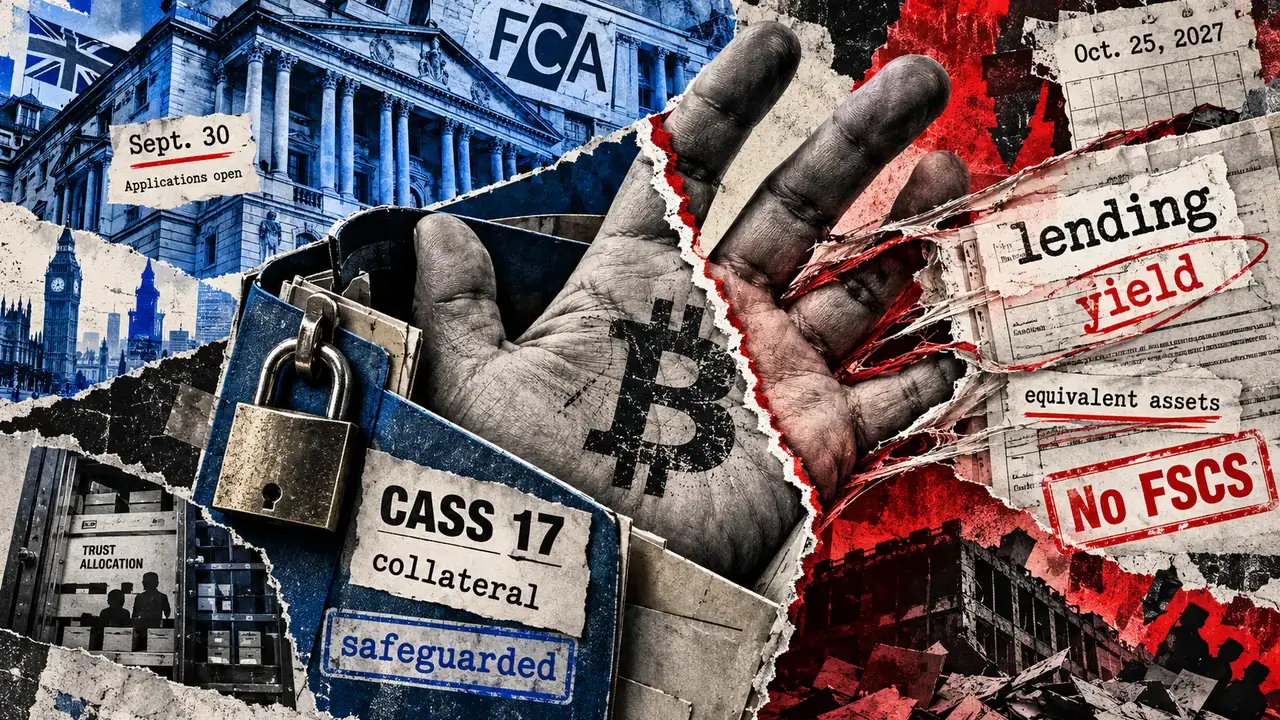
UK’s 2027 crypto rules let firms remove trust protection from Bitcoin lent for yield
UK crypto firms can now apply for authorization as of Sept. 30, bringing Bitcoin holders closer to a rulebook that will treat coin...

Hyperliquid Policy Committee urges EU to fold on-chain perps into MiFID II
Integrating on-chain perps into MiFID II could streamline regulation, fostering innovation while ensuring market stability and inv...