UK Bank Starling Blocks Payments to Crypto Platforms — Claims Crypto Is High Risk, Heavily Used for Criminal Purposes
Starling Bank has informed its customers that the bank no longer supports fund transfers to cryptocurrency platforms, including crypto exchanges. The bank stated that cryptocurrencies “are high risk and heavily used for...
Archive context
Older archive item. Useful for background and entity history, but not a fresh market-moving signal.

Starling Bank has informed its customers that the bank no longer supports fund transfers to cryptocurrency platforms, including crypto exchanges. The bank stated that cryptocurrencies “are high risk and heavily used for criminal purposes and, as such, we no longer support them.”
London-headquartered Starling Bank recently notified its customers that the bank no longer supports money transfers to cryptocurrency platforms, including crypto exchanges.
A number of people asked the bank for clarification on Twitter. Starling Bank provided the same response to all customers over the past couple of days, stating that crypto activity is considered high risk and it has decided to prevent all card payments to crypto merchants. The bank added that it is implementing further restrictions on outgoing and incoming transfers.
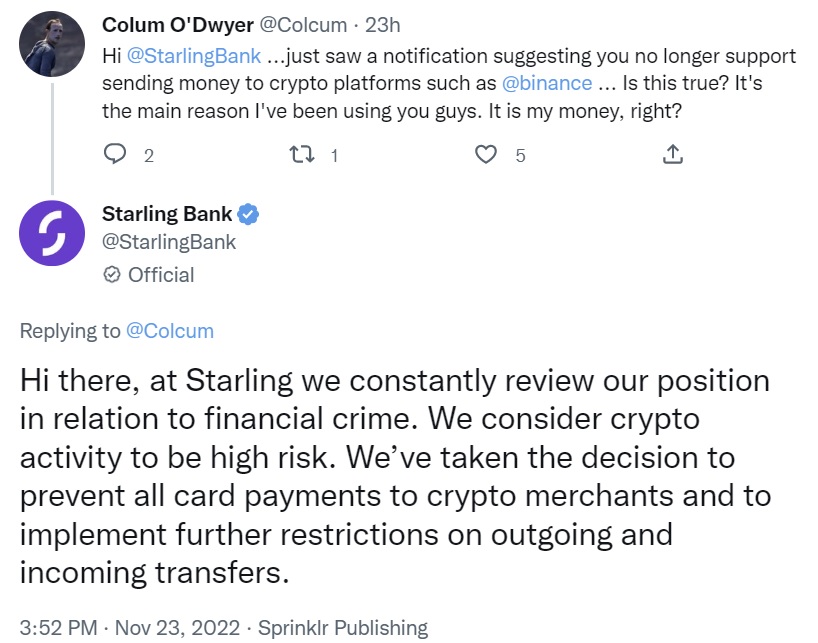
Many people are unhappy with the bank’s decision. Some even said they’ve closed their accounts at the bank due to this change. One person tweeted to the bank:
Why are you deciding what a customer can or can’t do with their money?
A spokesperson for Starling Bank was quoted by several news outlets as saying: “Starling has had restrictions of varying degrees on crypto transactions for some time, like many other banks. We recently tightened restrictions on inbound and outbound transactions by card and bank transfer.” The spokesperson added:
The innovative technology, and thinking, behind cryptocurrencies have great potential advantages. However, right now, they are high risk and heavily used for criminal purposes and, as such, we no longer support them.
Starling is among the latest banks in the U.K. to impose restrictions on customer crypto activity. According to Finder.com, 47% of U.K. banks do not support transfers to crypto platforms. Other banks, including Lloyds, Barclays, and RBS have similarly imposed a range of prohibitive measures including blocking credit card payments and transactions with crypto exchanges.
Last week, Santander Bank began limiting customer transfers to crypto exchanges to 1,000 pounds ($1,209) per transaction and 3,000 pounds in any rolling 30-day period for transfers via mobile and online banking. The bank will also block U.K. customers from sending real-time payments made in-branch and via telephone, online, or mobile banking to crypto exchanges starting next year.
What do you think about U.K. banks blocking customer payments to crypto exchanges? Let us know in the comments section below.
Why this matters
This cryptocurrency story adds another data point to the current market tape and is useful when read alongside nearby source coverage.
Original source
Read on Bitcoin NewsRelated market context
Bloomberg Adds Basel Crypto Exposure Classification For Banks And Asset Managers
TL;DR: Bloomberg has expanded its crypto analytics to classify bank exposure under Basel standards, including indirect holdings hi...

Arthur Hayes says high-FDV tokens no longer pump on Binance
The shift away from high-FDV token pumps on Binance signals a potential move towards fairer token distribution models, impacting r...

SEC flags tokenization as high-risk area in 2027 market examinations
The SEC’s latest priorities highlight tokenization as an emerging market risk, while cryptocurrencies remain absent as a standalon...
Irish Central Bank Fines Coinbase Unit €3.25 Million Over Customer Fund Safeguards
TL;DR: Ireland’s central bank imposed a €3.25 million penalty on Coinbase Ireland over electronic-money safeguarding and outsourci...
How Far Should Crypto Firms Trace a Transaction? FCA Says Risk Should Decide
Brokers and trading platforms handling cryptoassets should be able to explain why their monitoring systems flag a transaction and...
Bybit Wins Dubai VARA Approval For Spot Crypto Exchange Services
TL;DR: Bybit says its Dubai entity has secured a VARA virtual-asset service provider licence covering spot exchange activity; deri...