Weekly Crypto Regulation News Roundup: Trump’s Crypto Links Spark Ethics Concerns, Stablecoin Framework in Limbo
Washington’s crypto battleground erupted this week: the SEC will host a May 12 tokenization summit with Wall Street titans, the Senate hauled Donald Trump’s meme-coin ties into an ethics probe, and a landmark stablecoin...
Archive context
Older archive item. Useful for background and entity history, but not a fresh market-moving signal.
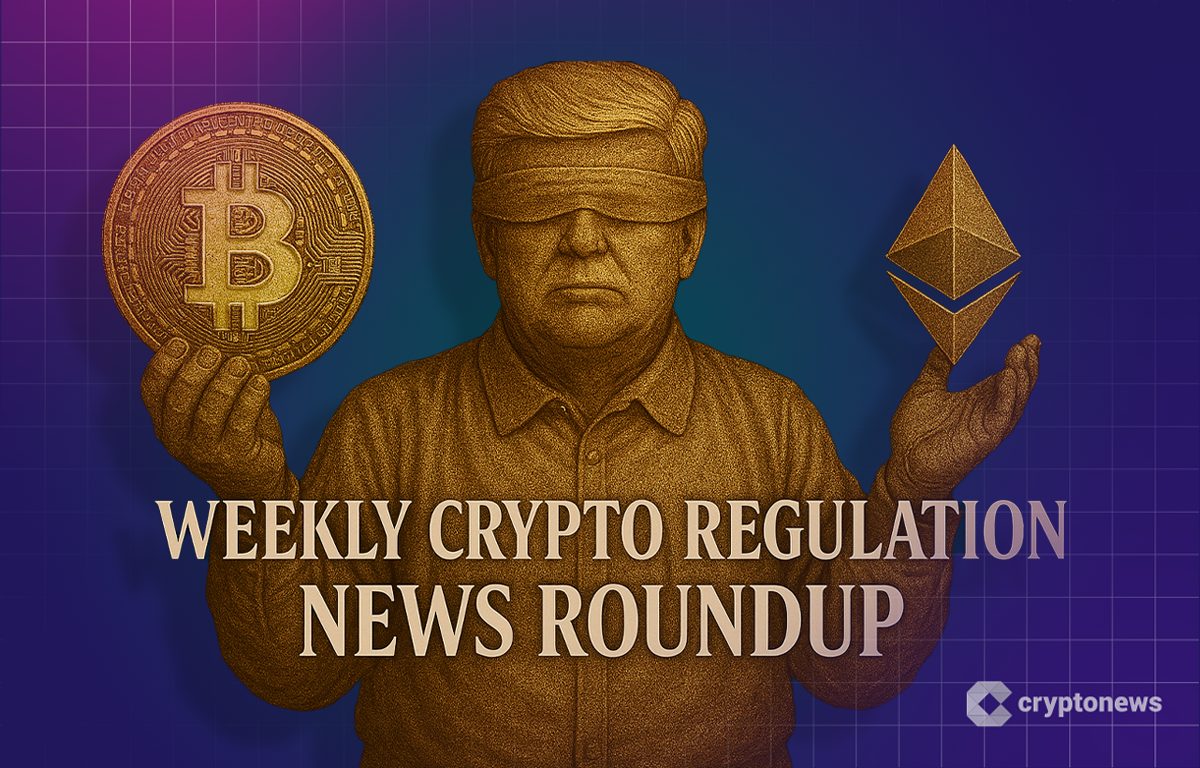
Washington’s crypto battleground erupted this week: the SEC will host a May 12 tokenization summit with Wall Street titans, the Senate hauled Donald Trump’s meme-coin ties into an ethics probe, and a landmark stablecoin bill collapsed by a single vote.
SEC Brings Wall Street to Washington for Tokenization RoundtableIn a bid to bridge traditional finance (TradFi) and decentralized finance (DeFi), the SEC will host a much-anticipated roundtable on tokenization in Washington, D.C., on May 12.
The SEC will host a public roundtable on tokenization on May 12, bringing together major financial and crypto firms to discuss regulatory implications.#sec #tokenization #rwahttps://t.co/6c3ctdxv5D
— Cryptonews.com (@cryptonews) May 5, 2025Spearheaded by Commissioner Hester Peirce, a longstanding crypto advocate within the Commission, the event indicates a growing interest among regulators in the tokenization of real-world assets.
The session, titled “Tokenization—Moving Assets Onchain: Where TradFi and DeFi Meet,” features two panels. The first will include powerhouse institutions such as BlackRock, Nasdaq, Invesco, and Franklin Templeton—entities already exploring tokenized financial instruments.
The second will delve into regulatory frameworks and long-term industry impacts, with speakers from Robinhood, Securitize, and Blockchain Capital.
This roundtable forms part of the SEC’s broader initiative to engage with emerging crypto technologies and solicit public feedback—a rare moment of openness in an otherwise tense regulatory environment.
The event may also provide clues about the agency’s stance on tokenization, particularly as firms explore digital versions of bonds, equities, and money market instruments.
Trump’s Crypto Ties Under Senate ScrutinyWhile the SEC fosters dialogue, the political arena has ignited a firestorm over Donald Trump’s growing crypto ties. A Senate investigative panel, led by Democratic Sen. Richard Blumenthal, has launched an inquiry into the president’s involvement in two crypto ventures: the $TRUMP meme coin and World Liberty Financial (WLFI), a DeFi project linked to Trump’s sons.
A US Senate panel is preparing to investigate Trump’s financial stakes in $TRUMP coin and World Liberty Financial, citing concerns over conflicts of interest and foreign influence.#SenateProbe #Trump https://t.co/DYUG2rdg4w
— Cryptonews.com (@cryptonews) May 7, 2025The probe seeks to assess whether these projects pose ethical conflicts or risk undue foreign influence. Blumenthal’s letter, sent on May 6, requested information from key figures involved in these initiatives, including Bill Zanker of Fight Fight Fight LLC (the entity behind $TRUMP) and Zach Witkoff of WLFI.
The concern is that Trump’s financial stake in these ventures could influence policy decisions, particularly as he mounts a fresh presidential campaign.
The inquiry shows the increasingly murky boundary between political influence and financial innovation, especially in the still-evolving crypto ecosystem. If Trump is found to have used his political stature to drive interest or profits in these ventures, it could trigger broader legislative action or ethics reforms.
Senate Democrats Propose Act to Curb Crypto Conflicts of InterestIn tandem with the inquiry, Senate Democrats have introduced new legislation designed to prohibit federal officials—including former presidents—from launching or profiting from cryptocurrency projects. Titled the Modern Emoluments and Malfeasance Enforcement (MEME) Act, the bill was introduced on May 6 by Senator Chris Murphy.
The proposed law would ban the issuance of cryptocurrencies by current or former federal officials, reflecting a heightened concern over the potential for digital assets to be used for self-enrichment or influence-peddling.
While critics argue that the bill is politically motivated, proponents say it is necessary to prevent what they see as the monetization of political brand capital in the volatile crypto markets.
Whether the MEME Act gains traction is uncertain, but its introduction reflects the rising political sensitivity around crypto, particularly when public trust and digital assets collide.
GENIUS Act Falters, Leaving Stablecoin Regulation in LimboPerhaps the most consequential setback of the week came in the form of a failed Senate vote on the GENIUS Act, a bill seeking to create a comprehensive federal framework for payment stablecoins. Touted as a key moment for the future of U.S. crypto regulation, the bill was narrowly defeated in a 49–48 vote.
Senate Republicans press for crucial Thursday floor vote on the GENIUS Act to establish federal stablecoin oversight, even after several key Democrats withdrew support.#GeniusAct #Stablecoinshttps://t.co/CLNuvTqp05
— Cryptonews.com (@cryptonews) May 6, 2025Introduced by Senator Bill Hagerty (R-TN) and co-sponsored by Republican lawmakers Tim Scott and Cynthia Lummis, the Guiding and Establishing National Innovation for U.S. Stablecoins (GENIUS) Act sought to unify stablecoin regulation under federal oversight.
The legislation would have allowed stablecoin issuers to operate under a standardized legal structure, promoting innovation while reinforcing consumer protections.
U.S. Treasury Secretary Scott Bessent expressed disappointment following the vote, calling the bill a “once-in-a-generation opportunity” to strengthen the dollar’s global position. “Without it, stablecoins will be subject to a patchwork of state regulations,” Bessent warned in a May 8 post on X (formerly Twitter).
The defeat reveals deep partisan divides over how best to regulate digital assets, despite bipartisan acknowledgment that stablecoins are now a permanent fixture in financial markets.
With the GENIUS Act stalled, stablecoin issuers must continue working through a fragmented regulatory environment, which poses challenges for scalability and market confidence.
Looking AheadThis week’s developments reflect the rapidly evolving intersection of politics, regulation, and digital finance. As the SEC attempts to engage with innovators through forums like its tokenization roundtable, Congress continues to wrestle with ethical dilemmas and regulatory frameworks that could shape the future of crypto in the U.S.
With Donald Trump’s crypto connections under investigation, and key legislation like the GENIUS Act faltering, the road ahead for crypto regulation remains bumpy. However, what’s clear is that digital assets are no longer a fringe issue—they are front and center in both Wall Street and Washington.
Stay tuned as these stories unfold.
The post Weekly Crypto Regulation News Roundup: Trump’s Crypto Links Spark Ethics Concerns, Stablecoin Framework in Limbo appeared first on Cryptonews.
Why this matters
This cryptocurrency story adds another data point to the current market tape and is useful when read alongside nearby source coverage.
Original source
Read on CryptonewsRelated market context

TOKEN2049 Takeaways: Stablecoins, Asset Tokenization, and AI Payments
Every crypto conference brings a wave of new partnerships, products, and concepts. After scrolling through the latest updates, you...

EU Banking Regulator Takes Over Key Oversight of Circle’s USDC Stablecoin
The European Banking Authority (EBA) classified Circle's USDC as a significant e-money token under the Markets in Crypto-Assets Re...

BlackRock’s crypto ETF assets jump 63% to roughly $80 billion in Q3
BlackRock's crypto ETF growth highlights increasing investor interest, but market volatility could impact future asset management...

Federated Hermes Targets $14B Tokenized Fund Market With Prometheum Q1 2027 Launch
Key Takeaways: Federated Hermes and Prometheum are set to launch the first tokenized fund product in Q1 2027. Prometheum will dist...

Ripple and Privy Bring XRP Wallets to XRPL After $1T Moved Across 8M Accounts
Key Takeaways: With the collaboration of Ripple, Privy offers programmable wallet infrastructure to the XRP Ledger. Developers can...

Polymarket Token Airdrop? TOKEN2049 Talk Fuels Speculation
Polymarket CEO Shayne Coplan revived speculation about a native token at TOKEN2049 Singapore, discussing a possible on-chain asset...