What are the next steps for the US stablecoin bill?
Proponents of a bill to regulate stablecoins in the US Congress will likely take up another vote on the legislation in a matter of days without responding to concerns about President Donald Trump’s financial ties to the...
Archive context
Older archive item. Useful for background and entity history, but not a fresh market-moving signal.

Proponents of a bill to regulate stablecoins in the US Congress will likely take up another vote on the legislation in a matter of days without responding to concerns about President Donald Trump’s financial ties to the cryptocurrency industry.
The Guiding and Establishing National Innovation for US Stablecoins, or GENIUS Act, failed to get enough votes to pass in the US Senate on May 8 amid calls from some Democratic lawmakers to halt any legislation related to digital assets until Republicans could address Trump’s potential conflicts of interest.
Immediately following the vote, some lawmakers from both parties suggested they could reconsider the bill as early as this week, but without agreeing on a bipartisan path forward.
After the GENIUS Act failed to proceed in a 48 to 49 vote in the Senate, Majority Leader John Thune made a motion to reconsider, setting up a possible vote on the matter within days. A source familiar with the matter told Cointelegraph Republicans who backed the bill were unlikely to modify it to block Trump or any member of his administration from investing in digital assets, claiming it was beyond Congress’s authority under the Constitution.
“[...] this delay is not inherently detrimental,“ said Liat Shetret, vice president of global policy and regulation at blockchain analytics firm Elliptic. “We can expect the bill to return to the floor, with this pause giving both parties time to clarify provisions and address lawmakers’ concerns.”
The Cedar Innovation Foundation, an organization tied to the political action committee (PAC) Fairshake, issued a warning to Senate leadership to “avoid political games” and pass a stablecoin bill “in the coming days.”
Fairshake spent more than $131 million to support candidates in the 2024 US elections, some of whom are currently serving in the House and Senate. There are still more than 500 days until the 2026 midterms, when many members of Congress are up for reelection.
On May 12, the Senate resumed consideration of the motion to proceed to consideration of the GENIUS Act, suggesting another vote soon.
Related: US Treasury Secretary expresses support for crypto bills at hearing
Changes to stablecoin or market structure bills?Should Republicans in the Senate reintroduce the bill without any changes, it’s unclear whether they would have enough support to clear a 60-vote majority to avoid a Democratic filibuster — a process to delay or sometimes block a vote on a bill.
The Trump family’s ties to the crypto platform World Liberty Financial and its stablecoin, USD1, have raised potential corruption concerns, as has offering the top holders of his TRUMP memecoin the chance to pay for access to the president through an exclusive dinner and reception.
“[...] the Republicans’ bill did nothing to address Trump’s conflict, and instead voted to hand Trump the authority to write the rules over his and his competitors’ stablecoins,” said Democratic Representative Maxine Waters in a May 6 statement. She blocked a hearing to discuss a possible digital asset market structure bill, citing concerns about Trump’s “ownership of crypto.”
Democratic lawmakers have already introduced possible solutions to what they called the “biggest corruption scandal in the history of the White House” — with legislation in the House and Senate to bar members of Congress, the president, the vice president, and their families from profiting off memecoins.
Senators Elizabeth Warren and Chris Van Hollen also reportedly called on the president to fully divest from USD1 before making any possible deals with foreign governments.
The nonpartisan organization State Democracy Defenders Action reported in April that Trump’s crypto holdings were worth roughly $2.9 billion, which accounted for 40% of his wealth.
This report came before the launch of World Liberty Financial’s stablecoin, which an Abu Dhabi-based investment firm said it would use to settle a $2 billion investment in Binance. Trump’s sons, Eric, Donald Trump Jr., and Barron, were all listed as “Web3 ambassadors” for the platform.
Magazine: Trump’s crypto ventures raise conflict of interest, insider trading questions
Why this matters
This cryptocurrency story adds another data point to the current market tape and is useful when read alongside nearby source coverage.
Original source
Read on CointelegraphRelated market context

Crypto industry blames Trump for failed landmark bill in Senate
The Senate's rejection of the crypto bill perpetuates regulatory uncertainty, potentially hindering U.S. competitiveness in the di...

Bitcoin faces an October 18 test as Trump prepares new Russia tariffs
President Donald Trump’s new Russia sanctions law gives Bitcoin traders another macro deadline to watch: Oct. 18. On Sept. 18, Tru...

CFTC Sends Proposal To Regulate Crypto Transactions Following Clarity Act Fail
Bitcoin Magazine CFTC Sends Proposal To Regulate Crypto Transactions Following Clarity Act Fail The Commodity Futures Trading Comm...

TRON’s stablecoin market cap grows by $5B in 90 days as USDT dominance accelerates
TRON's stablecoin growth highlights its role as a cost-effective settlement layer, but reliance on USDT poses significant concentr...

CFTC advances crypto rulemaking after Senate bill fails 49-50
The CFTC's proactive rulemaking highlights regulatory agility but underscores the fragility of agency-driven rules compared to leg...
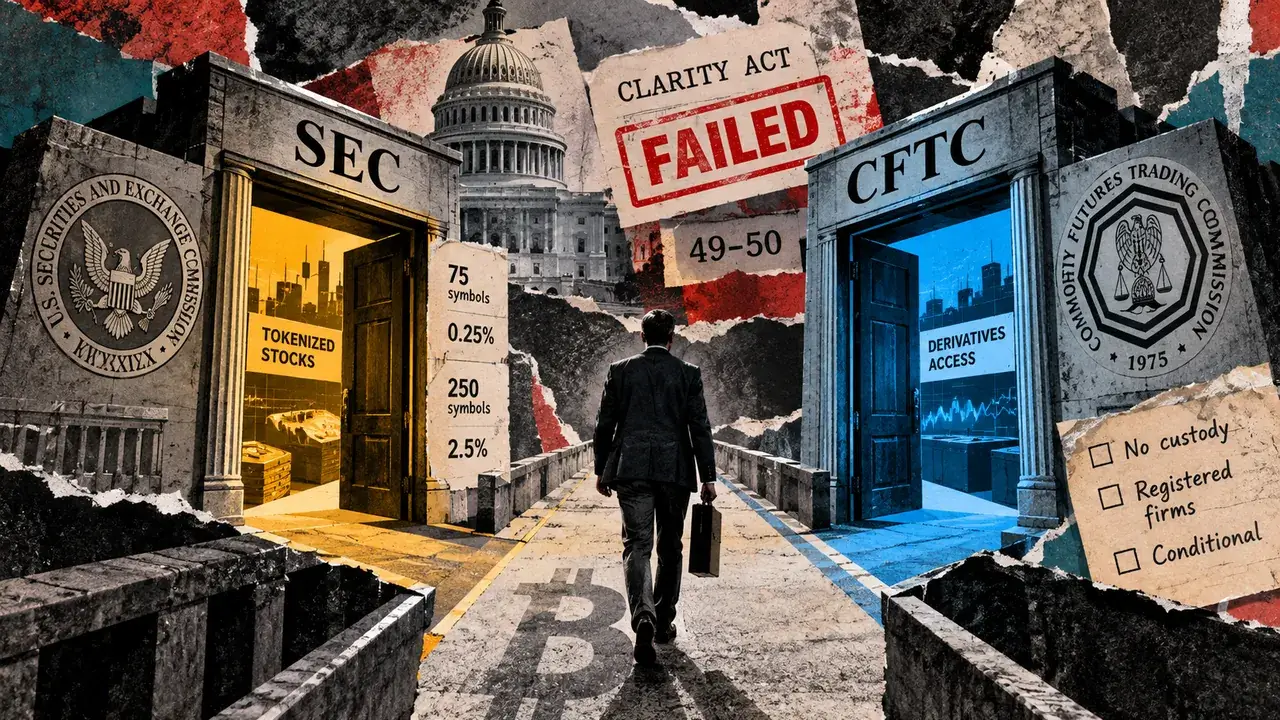
SEC and CFTC bypass Congress to open crypto access after CLARITY fails – with a catch
Two days after the US Senate failed to advance the CLARITY Act, federal regulators opened two narrower routes for crypto-linked ma...