Are the Ethereum Killers Still Deadly?
Back in 2021, and heading into 2022, there was a dominant crypto narrative around the idea of Ethereum killers. This referred to rival Layer 1 blockchains that were geared towards smart contract transactions and could be...
Archive context
Older archive item. Useful for background and entity history, but not a fresh market-moving signal.
Back in 2021, and heading into 2022, there was a dominant crypto narrative around the idea of Ethereum killers.
This referred to rival Layer 1 blockchains that were geared towards smart contract transactions and could be used for all the things that Ethereum was known for, enabling networks of decentralized applications.
Ethereum killers would run DeFi, facilitate NFT creation and trading, and open up new landscapes for web3 development.
What made these competitors a supposedly existential threat to Ethereum was that they would be so technically superior, cheaper more efficient and at least equally secure, that, with crypto still in a formative stage, Ethereum itself might become obsolete.
The Takeover Never Happened
Looking back from the start of 2023, we can see that this proposed takeover, after which Ethereum would be relegated to the sidelines, never occurred.
In the heat and euphoria of an extended bull run, ambitious proclamations can sound viable, but as sentiment shifted ever downwards throughout 2022, there was a sense that time had run out on the Ethereum killers’ opportunities to take the top spot.
What’s more, Ethereum successfully, after many delays and amid constant doubt, completed the Merge, a process which saw it switch from a Proof of Work to a Proof of Stake consensus mechanism.
This shift sets the path for Ethereum to scale better, and, eventually, bring down its unsustainable high transaction costs.
Supporters of alternative blockchains will point out that their preferred networks can already scale better than Ethereum and have lower transaction costs built in, and they’d be right to do so: the entire point of an Ethereum killer is that it has better tech than its rivals.
However, with hugely significant network effects already on Ethereum’s side, simply enabling the capacity for future improvements is enough to further embed its dominant position.
As we tentatively begin to consider the possibilities that might arise in a future bullish period, where does this all leave the Ethereum killers?
Solana
A few weeks ago, Solana looked for the count. Having crashed in price from an all-time high of around $260 down to $8 briefly, the network was suffering partly from having been favored by the disgraced Founder of FTX, Sam Bankman-Fried.
Two of the network’s top NFT projects, DeGods and y00ts, were migrating to other blockchains, and previous criticisms of the network’s unreliability and lack of robust decentralization remained unresolved.
However, since then, there has been a much-needed blast of frivolity (and profit-taking) thanks to airdrops of the ridiculously-named, Solana-based BONK token, a supportive tweet from the Founder of Ethereum Vitalik Buterin, and an upwards jump in the price of SOL.
Crypto is a deeply unpredictable space in which the atmosphere can flip overnight via surreal triggers that seem to come out of nowhere, and that’s exactly what is happening with Solana.
That said, such shifts are not always superficial, the substance of Vitalik’s tweet, that Solana has a ‘smart developer community’ and has been cleansed of ‘awful opportunistic money people’, was well received, and it seems increasingly unlikely that the lights have gone out for good on Solana.
The network still has a loyal community, particularly (and despite the departures of DeGods and y00ts) when it comes to its NFT ecosystem, and it looks capable of riding out current distress.
Check out the recent London Summit session on "To Crypto or Not to Crypto: Will Crypto Fizzle Out or Here To Stay."
Cardano
Unlike Solana, Cardano is not associated with the collapses and scandals of 2022, but nonetheless saw its price crash dramatically throughout the year just gone. In sync with Solana, January has brought Cardano an outsized price boost.
It’s striking that both Solana and Cardano prices should break out at the same time, since they are, arguably, the two most prominent Ethereum rivals, and perhaps this coupled competitive action is a shape of things to come.
Where Cardano is distinct, though, is that it now is looking at tackling some very specific real-world problems, perhaps taking Cardano down a unique path.
Most notably, there are Cardano projects working on using the blockchain to enable self-custodial digital identity solutions, and there is also a strong emphasis on reaching new users in Africa.
Atala Prism and IAMX are examples of the former while World Mobile utilizes Cardano for its work in rural Africa.
The Layer 2 Factor
The other alternative option for developers, besides utilizing a so-called Ethereum killer, such as Solana or Cardano, is to build on a Layer 2 solution.
Layer 2 refers to a secondary blockchain built on top of or alongside a main blockchain, which takes transactions off the main network to improve efficiency, before finally settling transactions back to the base layer.
Prime among these is Polygon, which operates alongside Ethereum, and recently partnered with Mastercard to become the network of choice for the finance company’s upcoming artist incubator program.
This news comes after a period in which a stream of famous brands have opted to use Polygon for their web3 strategies.
Looking around the various Layer 1s and sidechains, a possible scenario now starts to resolve into view, sketching out the direction in which smart contract blockchains may be heading.
Ethereum looks firmly placed, but activity relating to incoming brands may take place on Polygon, while Arbitrum is another notable Layer 2 option.
Meanwhile, Solana and Cardano look likely to remain relevant, but rather than superseding Ethereum (which was always a tall order), can instead start to define their own specialties and niche applications.
Beyond these protocols, further alternatives are in the mix too, including Avalanche and BNB Chain, and they should be kept in mind when the market picks up, always remembering that narratives can shift quickly.
This article was written by Sam White at www.financemagnates.com.Why this matters
This ethereum story adds another data point to the current market tape and is useful when read alongside nearby source coverage.
Original source
Read on Finance MagnatesRelated market context

Ethereum’s 2030 Shift: Vitalik Maps a Cryptographic World Computer Beyond Blockchain
Key Takeaways: According to Vitalik Buterin, Ethereum is going further than simply being a blockchain to “cryptographic world comp...

Ethereum is not instant, but collateral could make it feel that way
When a payment app tells you a transfer is complete, you start making decisions. You hand over whatever you've sold, spend the mon...

Elon Musk Grok AI Predicts a Bold Move for Ethereum in 2026
When prompted, the Elon Musk-backed Grok AI predicts a bold move for Ethereum (ETH) over the remainder of 2026. It claims that if...
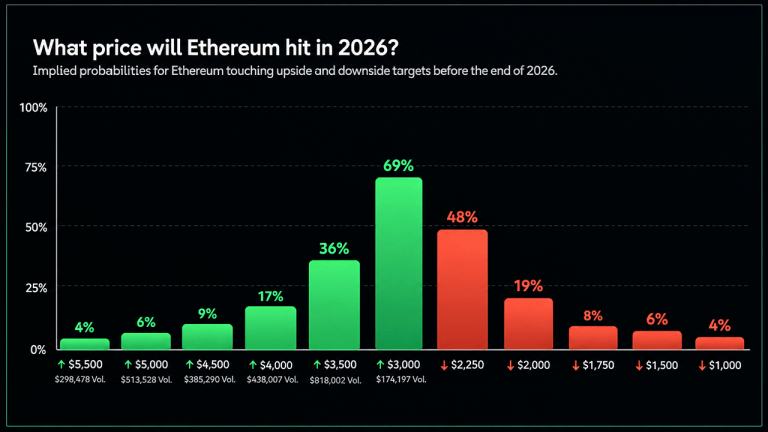
Ethereum, Solana and Zcash Face Wild Year-End Price Predictions
Three cryptocurrencies, three very different bets and millions of dollars riding on what happens before New Year’s Day. Prediction...

SEC Clarifies When Crypto Buybacks And Network Upgrades Can Raise Securities Questions
TL;DR SEC staff has published new FAQs explaining how federal securities laws may apply to crypto-asset buybacks, network upgrades...
Solana News: Ex-Binance and Polygon Execs Join the Solana Foundation
In Solana news, the Solana Foundation recently announced the hiring of Rachel Conlan, former Chief Marketing Officer at Binance, a...