Coinbase Prime grows its staking offering with ETH
Tl:dr: We’re launching Ethereum staking to US domestic institutional clients on Coinbase Prime. Using our industry-leading cold storage, clients can now generate yield by staking ETH.By Aaron Schnarch, Vice President of...
Archive context
Older archive item. Useful for background and entity history, but not a fresh market-moving signal.
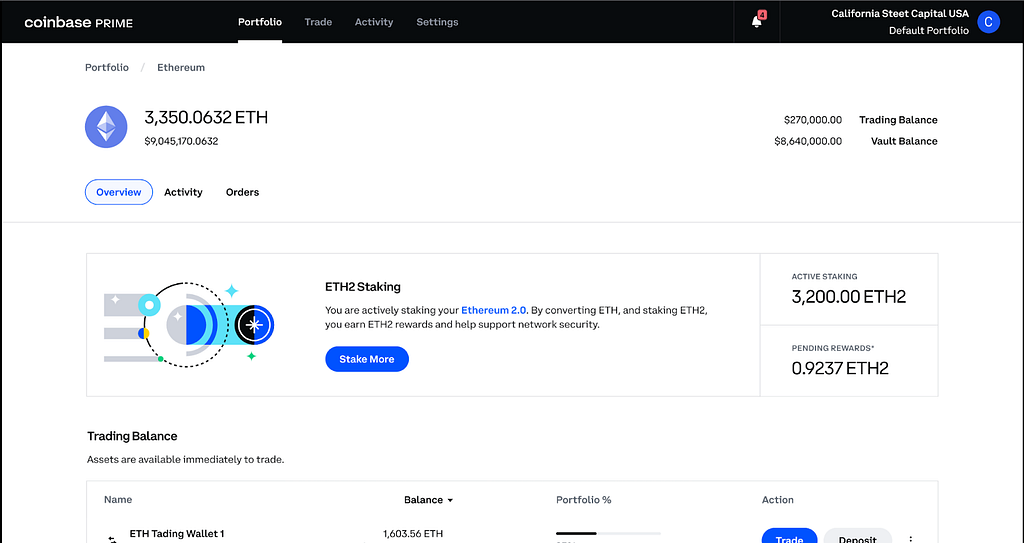
Tl:dr: We’re launching Ethereum staking to US domestic institutional clients on Coinbase Prime. Using our industry-leading cold storage, clients can now generate yield by staking ETH.
By Aaron Schnarch, Vice President of Product, Custody
Fully-integrated staking on Coinbase Prime
Coinbase Prime provides institutions with an end-to-end staking experience. Clients can create a wallet, decide how much to stake, and initiate staking from the ETH asset page on their Coinbase Prime account.
Securing client funds is our highest priority. We hold withdrawal keys in our cold storage custody vault at all times, meaning staked ETH and accumulated yield are always safe. To further ensure the security of client accounts, staking transactions must first complete consensus before they are executed.
ETH vs ETH2
The term eth2 has been used frequently to describe an upgrade to the Ethereum network that aims to improve the network’s security and scalability. This upgrade involves a shift in Ethereum’s security model from mining (“Proof-of-Work”) to staking (“Proof-of-Stake”).
Once a client stakes their ETH, our system uses the ticker ETH2 to represent those staked ETH tokens. Note that there is no separate/new “eth2” token or asset. The price of ETH and ETH2 is identical. Once the upgrade to the Ethereum network is complete, the tickers ETH and ETH2 will merge into a single ticker: ETH. The merge is currently expected to occur in September 2022, so moving forward you likely will see the term ETH2 fall into disuse.
Why institutions are staking
Staking can offer passive income on assets already held in custody by providing useful work in the form of security to the underlying blockchain. The Ethereum blockchain rewards stakers that do a good job, but also punishes those that fail in their duties, for example by having downtime. This is why it’s important to stake with a reputable and effective provider to earn maximal rewards while minimizing risk.
Staking rewards for most assets can be thought of similarly to compound interest, not unlike in traditional markets when dividends are reinvested. Because staking rewards are paid in the token being staked, users may “reinvest” those tokens to receive a higher payout at the next period. Furthermore, staked tokens are typically stored within their respective wallets, meaning that users earn yield without rehypothecation.
Staking on Coinbase Prime
With Coinbase Prime, institutional customers have the ability to stake their ETH and a number of other assets to begin generating yield. Staking is also supported for Solana, Polkadot, Cosmos, Tezos, Celo, and more. Read more about institutional staking in our Staking 101 for Institutions article.
Coinbase Prime grows its staking offering with ETH was originally published in The Coinbase Blog on Medium, where people are continuing the conversation by highlighting and responding to this story.
Why this matters
This ethereum story adds another data point to the current market tape and is useful when read alongside nearby source coverage.
Original source
Read on CoinbaseRelated market context

Coinbase Institutional says Fed rate expectations, not the Binance hack, sank Bitcoin
Bitcoin's sensitivity to Fed rate expectations highlights its growing correlation with macroeconomic factors, overshadowing isolat...

Ethereum Dancing on Two Fronts as Quantum Upgrade Advances and Treasury Leverage Bites
Ethereum developers want to upgrade the network to be quantum-ready by 2027, potentially accelerating one of its biggest security...

Jupiter launches Vaults Beta with three Bitwise-curated yield strategies
Jupiter's Vaults Beta could redefine stablecoin yield strategies, impacting DeFi participation and token utility while highlightin...

Ethereum and Layer 1s Explained
Ethereum 101 explains how Ethereum made blockchains programmable. It covers smart contracts, accounts and the EVM, ETH and gas fee...

Sygnum Launches ETH Fund Targeting 8–10% Returns in Ether
TL;DR: Sygnum has announced an ETH-denominated fund targeting 8–10% annual returns after fees. The target includes staking income,...

Ethereum Gas Fees: From Wallet Estimate to Final Cost
Gas measures computational work. A real Ethereum transaction shows why a spending ceiling can exceed the fee finally charged.... R...