Crypto Assets Flow From Ethereum To BSC, Are Users Escaping High Gas Fees?
There is a substantial flow of assets from Ethereum to the Binance Smart Chain (BSC), according to data from Cryptoflows. Migration From Ethereum To BSC The shift to move assets from the legacy smart contracting network...
Archive context
Older archive item. Useful for background and entity history, but not a fresh market-moving signal.

There is a substantial flow of assets from Ethereum to the Binance Smart Chain (BSC), according to data from Cryptoflows.
Migration From Ethereum To BSCThe shift to move assets from the legacy smart contracting network could be driven by the desire to escape high gas fees.
For every transaction executed on public ledgers like Ethereum and BSC, a fee is paid. In Ethereum, gas fees remain higher, especially for users deploying smart contracts.
Analysis of the latest gas fee trends on Etherscan indicates shows that network fees have been fluctuating, and generally higher in the past weeks. As of May 17, Gas fees stood at 43 gwei or roughly $1.59 for simple transfers.
Meanwhile, BscScan data shows that users have to pay 3 gwei for transfers, regardless of the urgency of the transaction.
The difference in gas fees between Ethereum and BSC, when analyzed in USD terms, is apparent and could explain why users are seeking alternatives, moving assets from Ethereum to alternative blockchains like BSC that offer lower Gas fees.
Is PEPE FOMO The Reason?The recent surge in Ethereum gas fees can be attributed, in part, to the hype surrounding the PEPE, a meme token. With PEPE spurring demand and forcing on-chain activity higher, Ethereum gas fees rose in tandem. According to Y-Charts, Gas fees on Ethereum increased from $43 on April 22 to $155 as of May 5, 2023.
The unprecedented demand for PEPE due to the fear of missing out (FOMO) coincided with the near-exponential increase of fees from the last week of April to early May.
This spike highlighted the scalability challenges faced by Ethereum during periods of increased activity.
Fluctuating Gas fees, depending on network activity, is primarily one of the reasons why developers are looking to integrate long-lasting solutions, including on-chain and off-chain scaling methods.
According to the roadmap, Ethereum will introduce Sharding, where the network will be broken into portions called “shards”.
Shards are sub-networks that will form part of the whole of the Ethereum blockchain. Each Shard will process transactions independently but remain connected to other shards. In this system, Ethereum developers hope to scale transaction processing throughput on-chain, lowering fees. Shards remain an idea and are being studied.
Given this, layer-2 scaling options are gaining traction as a means of improving scalability by re-routing transactions to an off-chain platform, relieving the underlying blockchain, and reducing processing fees.
L2Beat currently shows that there are over 20 layer-2 scaling options aiming to scale the mainnet. Arbitrum and Optimism, two of the most active general-purpose platforms for deploying smart contracts and decentralized applications are the most active. The two, Optimism and Arbitrum, control over $7.5 billion of assets as measured by total value locked (TVL).
Optimism will release “bedrock,” via a hard fork in early June 2023. This upgrade aims to enhance scalability, improve transaction speeds, and reduce gas fees on the off-chain solution. With these improvements, Optimism hopes to carve out a larger market share, pushing its TVL higher.
Why this matters
This ethereum story adds another data point to the current market tape and is useful when read alongside nearby source coverage.
Original source
Read on NewsBTCRelated market context

Ethereum is not instant, but collateral could make it feel that way
When a payment app tells you a transfer is complete, you start making decisions. You hand over whatever you've sold, spend the mon...
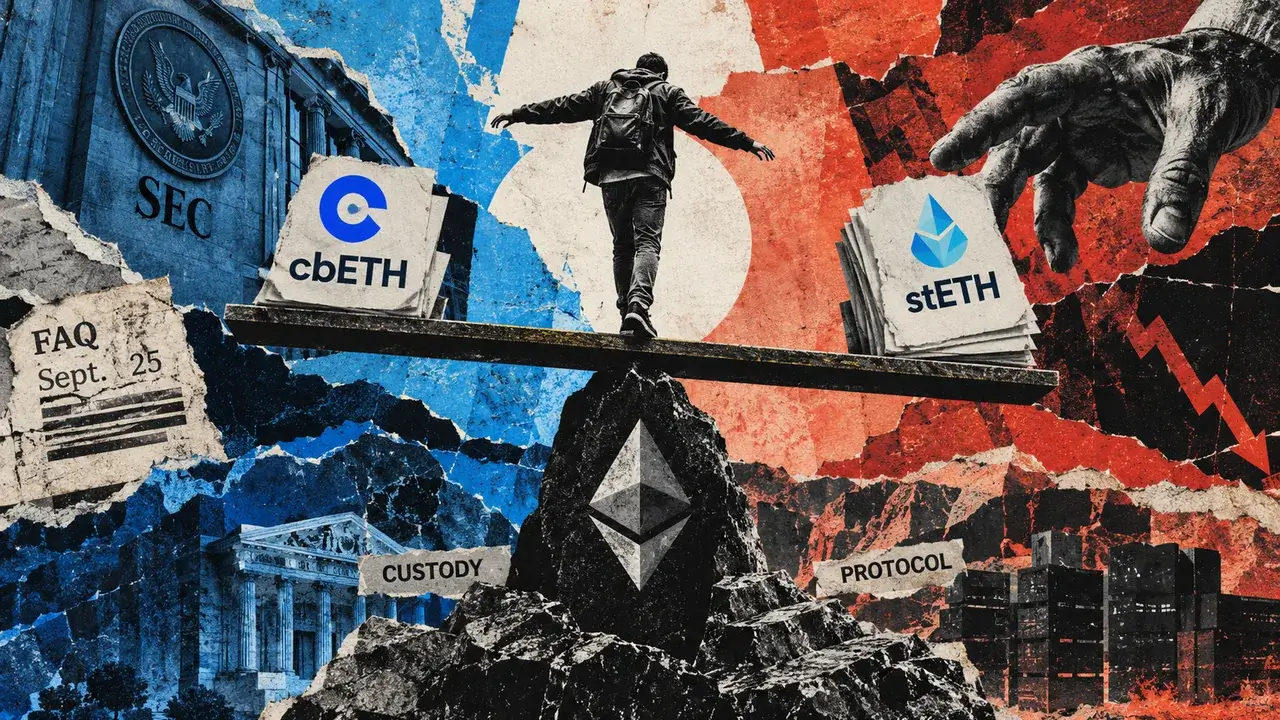
SEC staff’s staking-token split spotlights the exit risks behind staked ETH tokens
An ETH holder can sell a liquid-staking token while the ETH behind it remains staked. A Sept. 25 SEC staff FAQ draws a conditional...

Tokenized iShares MSCI South Korea ETF Arrives on StonkFun for Solana Coin Launches
Key Takeaways: StonkFun now supports coin launches paired with $EWY, the tokenized iShares MSCI South Korea ETF. Overall, the inte...
Elon Musk Grok AI Predicts a Bold Move for Ethereum in 2026
When prompted, the Elon Musk-backed Grok AI predicts a bold move for Ethereum (ETH) over the remainder of 2026. It claims that if...
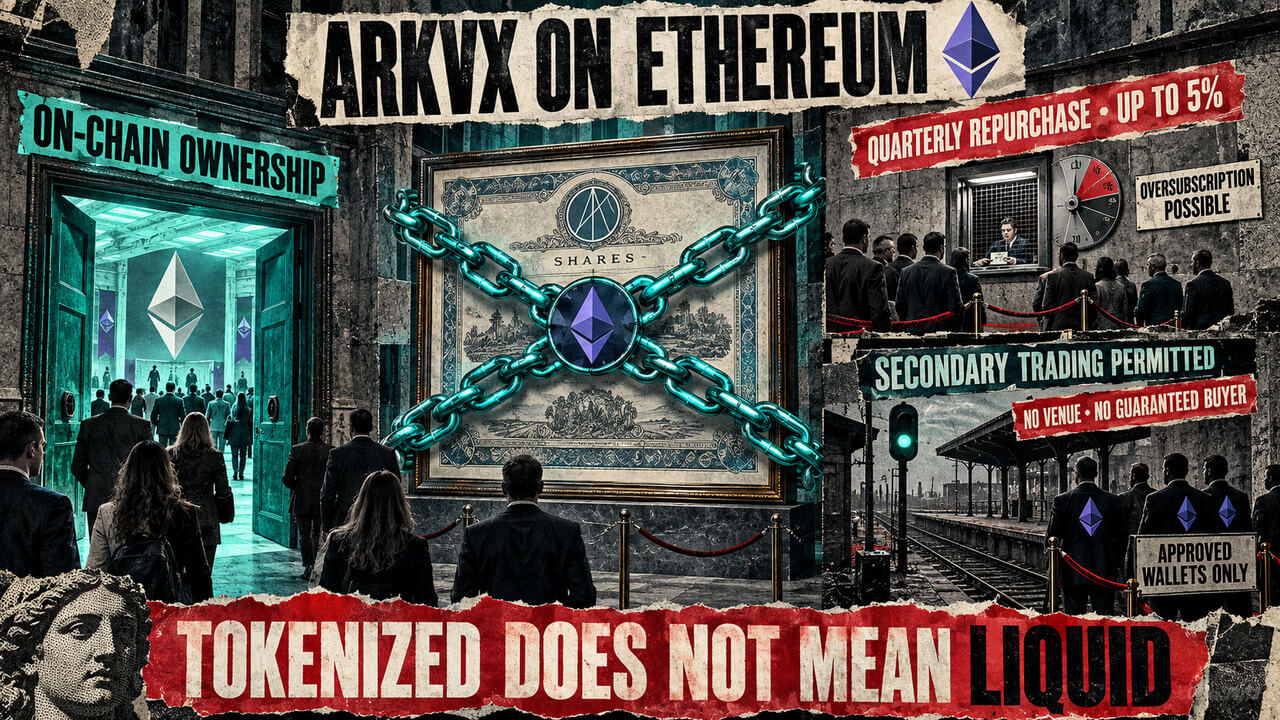
ARK partners with Securitize to put a venture fund on Ethereum, but leaves exit doors locked
ARK Invest and Securitize announced on Sept. 24 that eligible investors would be able to hold tokenized interests in the ARK Ventu...

The Clearing House Picks Quant For US Tokenized Deposit Network
The Clearing House has selected Quant to provide the interoperability and transaction-management layer for its On-Chain Money Init...