Ethereum Developers Merge Glamsterdam Fix to Keep Validator Deposits Out of Builder Accounts
Ethereum developers merged a fix on Oct. 26 for a Glamsterdam bug that could have credited a staker’s validator deposit to someone else’s builder account, one week after closing the same change for lack of client support...
Watchlist
Published in the last two hours. A tracked entity is involved.

Ethereum developers merged a fix on Oct. 26 for a Glamsterdam bug that could have credited a staker’s validator deposit to someone else’s builder account, one week after closing the same change for lack of client support.
The pull request, written by Lido Chief Protocol Architect George Avsetsin, changes how Gloas, the consensus-layer half of the upgrade, treats deposits still sitting in the queue when the fork activates. The new rule looks at the withdrawal credentials on every deposit still pending at activation. Those meant for validators stay put, and builder accounts get funded only by deposits with builder credentials.
Get Unchained’s crypto news in your inbox with the free Unchained Daily newsletter.
How the Bug WorkedGlamsterdam gives block builders a registry of their own, separate from validators. In a bug report filed on Oct. 12, Avsetsin wrote that “the party that pays for a deposit is not always the key holder.” Under the old fork rules, once a pending deposit registered a builder for a public key, every later deposit for that key went to the builder, whatever credentials it carried.
The report walked through an operator who queues a builder deposit for a new key, after which a staking protocol funds a validator deposit for the same key. “If both deposits are pending at the fork, both amounts go to the builder. The operator can withdraw the protocol’s funds,” Avsetsin wrote.
In a follow-up comment, the author shared what they called “quick AI research” naming Lido, Origin and Rocket Pool contracts that could be affected, and warned it “may contain errors.” The comment added, “These are conditional code findings, not confirmed live exploits.”
Closed, Then ReopenedEthereum researcher Justin Traglia closed the issue and the fix on Oct. 19 after discussions on two developer calls, writing that “there was not enough support from clients to make this change at this time.”
Three days later, developers unscheduled Glamsterdam’s Oct. 26 activation on the Hoodi testnet, which had followed the upgrade’s Sepolia launch on Oct. 6. On Oct. 23, Lido Staking Head of Engineering Dmitry Gusakov asked to reopen the issue “due to changes in the Glamsterdam timeline and a potential chance to fix it.”
Prysm developer Potuz approved the change that day while asking for extra tests. “I’m still scared of putting this change before the fork,” Potuz wrote in the review, adding that with the fork’s status now “Unknown,” there was “more than adequate time to study this change both in the specs and how it affects our caches.”
ChainSafe Protocol Engineer Nico Flaig approved on Oct. 26, saying the Lodestar client “is passing them too on my branch” and that extra differential testing turned up no findings. Traglia approved and merged the fix the same day.
Related Listen: Why an Ethereum Proposal to Zero Out Staking Yield Sparked a Revolt
The post Ethereum Developers Merge Glamsterdam Fix to Keep Validator Deposits Out of Builder Accounts appeared first on Unchained.
Why this matters
Ethereum is showing up inside the DeFi theme, so this story is worth tracking for follow-through rather than treating it as a one-off headline.
Original source
Read on UnchainedRelated market context

AAVE V4 on Base sees $10M surge in tokenized stock deposits
The surge in tokenized stock deposits on Aave V4 may boost DeFi confidence and influence sentiment towards a potential Base token...

CertiK flags Tornado Cash deposits tied to wallet behind $1.58 million drain
The recurring use of mixers like Tornado Cash for laundering highlights ongoing challenges in crypto security and the need for imp...

SoFi’s tokenized deposits put banks in competition with stablecoins, Truth Ventures CEO says
SoFi's tokenized deposits may drive innovation in banking, challenging stablecoins and prompting regulatory and consumer protectio...

Chainlink Targets $700B Custody Market With CustodySync and Anchorage DeFi Access
Key Takeaways: Chainlink introduced CustodySync, a new solution that connects loan markets in DeFi and qualified custody. The laun...
Solana Web3.js 3.1 Targets a Less Fragmented Developer Stack
TL;DR: Solana’s October 16 changelog confirms Web3.js v3.1 alongside validator-client releases and developer tooling updates. A ma...
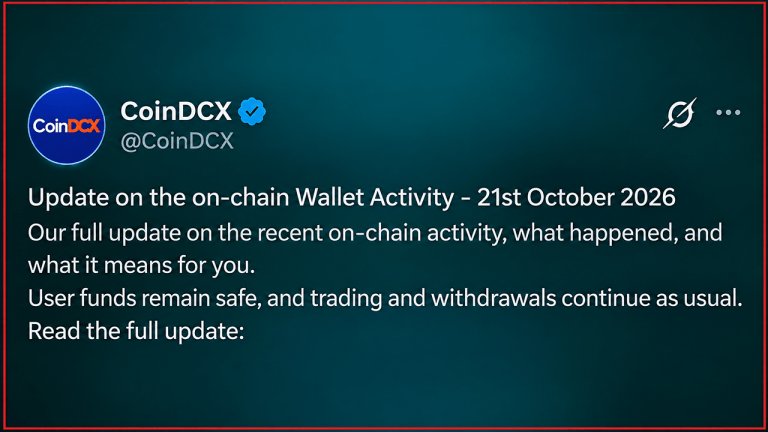
Indian Exchange CoinDCX Admits $16M Hit After CEO Dismissed Suspicious Transfers
CoinDCX has confirmed a $16 million cryptocurrency loss just three days after its CEO dismissed suspicious wallet activity as a “f...