Ethereum fees drop to a 5-year low as transaction volumes lull
Transaction costs on the Ethereum network have dropped to the lowest level in five years as the amount of activity on the blockchain is in a lull, according to the onchain analytics platform Santiment.Ethereum network fe...
Archive context
Older archive item. Useful for background and entity history, but not a fresh market-moving signal.

Transaction costs on the Ethereum network have dropped to the lowest level in five years as the amount of activity on the blockchain is in a lull, according to the onchain analytics platform Santiment.
Ethereum network fees are now around $0.168 per transaction and the reduction in fees coincides with fewer people sending Ether (ETH) and interacting with smart contracts, Santiment marketing director Brian Quinlivan said in an April 17 blog post.
“When many people are using Ethereum, users bid higher fees to get their transactions confirmed faster This drives the average costs up,” Quinlivan said.
“When fewer people are transacting, like we see now, users don’t need to bid much. As a result, the average fee drops,” he explained. “It’s essentially a supply and demand system.”
Source: SantimentQuinlivan said that, from a trading perspective, low fees can preclude a price rebound, still, he added that traders appear to be patiently waiting for the global economic uncertainty to pass before scaling up their usual frequency of Ether and altcoin transactions.
Traditional and crypto markets tanked after US President Trump’s sweeping tariffs were announced on April 2. Many assets haven’t recovered to the same level as before their unveiling, despite tariff exemptions and a 90-day pause for most countries.
ETH has fallen over 12.5% in the past 14 days and has traded flat over the past 24 hours, hovering just under $1,600, according to CoinGecko.
“We can visibly see the increased sensitivity toward Ethereum discussions and tariff/economy news as prices have really threatened long-time support levels,” Quinlivan said.
“The more the retail community leans away from an asset, especially one with still thriving development, the higher the likelihood of an eventual surprise rebound with little resistance,” he added.
Pectra upgrade on the wayAfter delays due to configuration issues and an unknown attacker causing headaches during the Holesky and Sepolia testnet activations, the Pectra upgrade for the Ethereum network is now scheduled to go live on the mainnet on May 7.
Phase one is expected to double the layer-2 blob capacity from three to six, reduce transaction fees and network congestion and allow fees to be paid in stablecoins like USDC (USDC) and DAI (DAI).
Related: Ethereum devs prepare final Pectra test before mainnet launch
The maximum staking limit will also be increased from 32 ETH to 2,048 ETH.
The second phase of Pectra is expected in late 2025 or early 2026 and will introduce a new data structure to enhance data storage efficiency and a system that improves scalability by enabling nodes to verify transaction data without storing the entire data set.
The Pectra fork follows the network’s Dencun upgrade in March 2024, which slashed transaction fees for layer-2 networks and improved the economics of Ethereum rollups.
Magazine: What are native rollups? Full guide to Ethereum’s latest innovation
Why this matters
This ethereum story adds another data point to the current market tape and is useful when read alongside nearby source coverage.
Original source
Read on CointelegraphRelated market context

Ethereum Dancing on Two Fronts as Quantum Upgrade Advances and Treasury Leverage Bites
Ethereum developers want to upgrade the network to be quantum-ready by 2027, potentially accelerating one of its biggest security...

Ethlabs Calls for Ethereum Quantum Protection in 2027 as Upgrade Priorities Shift
TL;DR: Ethlabs proposes quantum readiness in 2027 and plans to withdraw its quick-slots work from Hegotá. Developers still need to...

Arca’s Jeff Dorman Calls Vitalik Buterin’s ETH Store-of-Value Pitch ‘Really Misguided’
Jeff Dorman said on Unchained that Ethereum co-founder Vitalik Buterin‘s case for ETH as a store of value is “really misguided.” D...

Ethereum and Layer 1s Explained
Ethereum 101 explains how Ethereum made blockchains programmable. It covers smart contracts, accounts and the EVM, ETH and gas fee...
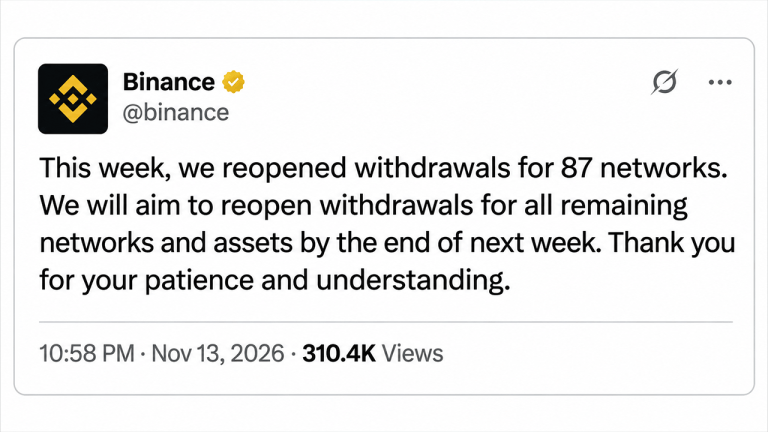
Binance Reopens 87 Networks Following Historic $6.3 Billion Breach
Binance has reopened withdrawals across 87 blockchain networks as the cryptocurrency exchange continues recovering from its devast...

Ethereum faces temporary issues due to cloud provider malfunction
Cloud dependency highlights Ethereum's vulnerability, urging diversification to ensure network resilience and uninterrupted user a...