Half of Aave’s debt sits in just 9% of positions built around one Ethereum correlation trade
Galaxy's Aug. 7 snapshot of Aave V3 Core found 19,073 loans on the protocol after applying standard filters. Fewer than 9% of those positions are using Aave's E-mode setting, account for roughly half of all outstanding d...
Archive context
Older archive item. Useful for background and entity history, but not a fresh market-moving signal.
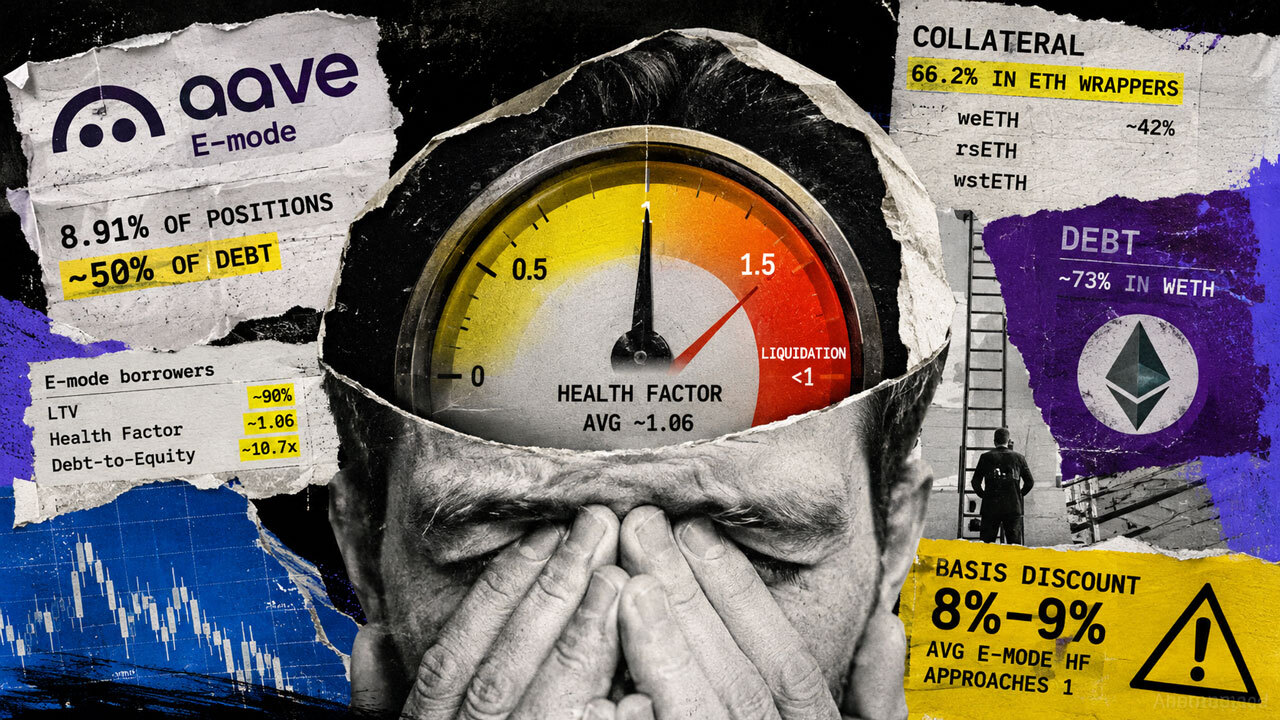
Galaxy's Aug. 7 snapshot of Aave V3 Core found 19,073 loans on the protocol after applying standard filters. Fewer than 9% of those positions are using Aave's E-mode setting, account for roughly half of all outstanding debt on the platform, and show an Ethereum correlation trade.
Galaxy puts their debt-weighted loan-to-value near 90%, their average health factor around 1.06, and their debt-to-equity ratio near 10.7 times. The remaining 91% of positions carry a debt-weighted LTV closer to 49%, a health factor around 1.79, and debt-to-equity near 1.07 times, a profile with far more room to absorb a bad day.
Borrower group Share of positions Share of debt Debt-weighted LTV Avg. health factor Debt-to-equity E-mode borrowers 8.91% ~50% ~90% ~1.06 ~10.7x Other analyzed borrowers ~91% ~50% ~49% ~1.79 ~1.07x The concentrated cohort is holding EthereumGalaxy found that Ethereum staking and restaking wrappers, including weETH, rsETH, and wstETH, make up about 66.2% of the collateral backing these loans, with weETH alone accounting for roughly 42%. On the other side of the ledger, WETH makes up about 73% of the group's debt.
Galaxy describes the exposure as a concentrated bet on Ethereum's staking basis and the relationship between these liquid-staking tokens and the ETH they represent.
E-mode lets Aave extend higher borrowing limits when collateral and debt are expected to move together. If a borrower's collateral and debt track each other closely, a much higher LTV can carry roughly the same risk as a conservative loan between two unrelated assets.
Related Reading DeFi lost $13B this month as the KelpDAO rescue shows both the best and worst of DeFi The rescue effort that has already lined up tens of thousands of ETH also exposes the uncomfortable reality that DeFi’s biggest crises still depend on multiple factors. Apr 26, 2026 · Gino MatosIf weETH falls 10% and the WETH debt against it falls the same 10%, the health factor barely moves, since both sides of the position are sliding together. The real danger sits in the exchange rate between the wrapper and Ethereum itself.
If weETH, rsETH, or wstETH starts trading at a discount to the ETH they represent while the debt stays fixed in WETH terms, the collateral weakens relative to what is owed. That can happen even if ETH's price never moves.
How much of a gap it would takeAave calculates the health factor by multiplying collateral value by a weighted liquidation threshold and dividing the result by total borrowed value. A position becomes eligible for liquidation once that figure drops below 1.
Starting from Galaxy's 1.06 average for the E-mode cohort, the built-in cushion works out to roughly 5.7% before the average position reaches that line.
A rough proportional model applies that cushion to the 66.2% of collateral held in Ethereum wrappers. It points to a broad-basis discount in the high single digits, around 8% to 9%, as the level that could push the average E-mode health factor toward 1.
Liquidations would depend far more on each account's specific collateral mix, liquidation thresholds, oracle pricing, and debt composition than on the cohort average.
In a May analysis, Galaxy found that a 10% weETH depeg would leave Aave with about $2.47 billion in debt against $2.42 billion in post-shock collateral, pushing 205 accounts below a health factor of 1. Stress escalated sharply once the depeg moved from 3% to 5%.
Wrapper/ETH basis move Approx. effect on E-mode risk What it means 0%–2% discount Correlation mostly holds E-mode remains a high-efficiency trade, not a liquidation event 3%–5% discount Weakest accounts become sensitive Borrowers may need to add collateral or repay WETH 8%–9% discount Average E-mode health factor approaches 1 Cohort-wide liquidation risk becomes material 10% discount Galaxy’s May model showed 205 accounts below a health factor of 1 Forced deleveraging becomes visible in the ETH-staking loop Why the aggregate deleveraging story hides thisGalaxy's broader second-quarter report describes crypto lending as shrinking in a controlled way. Total crypto-related debt fell 15.08% from the prior quarter to $73.2 billion, a third straight quarterly decline the firm likens to taking the stairs down.
Related Reading Crypto lending turns to Wall Street credit rules to win back institutional trust after 2022 collapse Crypto lending is coming back with Wall Street-style machinery, but Maple and Kraken’s new facility still has to prove that better structure can survive BTC and ETH stress. Jun 26, 2026 · Gino MatosThat language is deliberately different from the single-quarter collapse that defined 2022.
The debt split between Aave's E-mode and standard loans ran closer to 60/40 in favor of E-mode back in April and has since narrowed to roughly 50/50 by Aug. 7, entirely because outstanding E-mode debt declined.
Even with that decline, the cohort still carries close to half of all debt on the platform while making up fewer than one in ten positions, which raises the real question behind the aggregate numbers.
Has crypto leverage spread itself thinner, or has it concentrated into a smaller number of positions still large enough to carry real systemic weight?
A widening discount between an Ethereum wrapper and ETH itself weakens collateral relative to WETH debt, pulling health factors down. Borrowers watching that decline have two ways to respond: adding fresh collateral or repaying part of the WETH they owe.
Anyone who does neither and drops below a health factor of 1 becomes eligible for liquidation, a permissionless process where liquidators repay debt and take the underlying collateral plus a bonus for doing so.
Which way the Ethereum correlation trade goesThe bull case assumes the ETH wrapper basis holds inside a narrow band, probably under 2%, while E-mode debt keeps shrinking at its current gradual pace and health factors stay comfortably above 1.
Under that path, the concentration Galaxy identified keeps fading on its own, and crypto's broader deleveraging story extends into its highest-risk corner without ever forcing a wave of liquidations.
The bear case assumes that basis widens into the high single digits across weETH, rsETH, and wstETH at once. That pushes the average E-mode health factor down toward 1 and forces the weakest accounts into liquidation first.
Related Reading Crypto lending turns to Wall Street credit rules to win back institutional trust after 2022 collapse Crypto lending is coming back with Wall Street-style machinery, but Maple and Kraken’s new facility still has to prove that better structure can survive BTC and ETH stress. Jun 26, 2026 · Gino MatosUnder that path, the forced selling would concentrate specifically in leveraged ETH staking exposure, since that is what the collateral and debt in this cohort represent.
Scenario Wrapper/ETH basis What happens to E-mode borrowers Market implication Bull case Discount stays under ~2% Health factors remain above 1; E-mode debt keeps shrinking gradually Concentration fades without forced liquidations Stress case Discount widens to ~3%–5% Weakest accounts add collateral or repay WETH Leverage pressure appears, but remains contained Bear case Discount reaches ~8%–9% Average E-mode health factor moves toward 1 Liquidation risk becomes systemic inside the cohort Severe depeg Around 10% or more Galaxy’s May model showed 205 accounts below a health factor of 1 Forced selling concentrates in leveraged ETH staking exposureCrypto leverage is shrinking in aggregate, but Aave's own numbers show that shrinkage has not been even. What remains is concentrated in a small number of highly leveraged ETH-basis positions.
The risk is whether the collateral backing these loans keeps trading like ETH, a narrower and more specific question than the direction in which ETH itself moves.
The post Half of Aave’s debt sits in just 9% of positions built around one Ethereum correlation trade appeared first on CryptoSlate.
Why this matters
Aave is showing up inside the Institutional Adoption theme, so this story is worth tracking for follow-through rather than treating it as a one-off headline.
Original source
Read on CryptoSlateRelated market context

Standard Chartered brings Ripple’s RLUSD into banking custody after $765 million quarterly surge
Standard Chartered has launched custody for Ripple's RLUSD stablecoin as it prepares to expand its use as collateral for instituti...

South Korea clears way for courts to seize and sell Bitcoin for unpaid debts under new November rules
South Korea has established procedures for courts to seize and sell debtors' cryptocurrency to satisfy civil claims. On Oct. 12, t...

Bitcoin-Backed Bank Lending, Bitget Hack Trail and Ledger Supply-Chain Scare Define a Pivotal Week for Crypto Custody
Jeonbuk Bank offers Bitcoin-collateralised loans, SlowMist traces the $388m Bitget hack to a four-week compromise, and Ledger prob...

Australia moves to close crypto derivatives loophole after retail traders lose A$458 million
Australia's markets regulator proposed extending retail leverage restrictions to crypto-settled derivatives amid mounting losses a...

Interactive Brokers launches Ethereum staking as crypto push expands
Interactive Brokers' Ethereum staking launch signifies a growing integration of crypto services into traditional investment platfo...

Kraken exec highlights US crypto regulation void amid CFTC efforts
The regulatory gap in U.S. crypto oversight may lead to market uncertainty, affecting investor confidence and hindering industry g...