Understanding Ethereum Merge: A Game-Changer for Cryptocurrency Investors
The cryptocurrency industry was buzzing with expectation and excitement as Ethereum, the second-largest blockchain by market capitalization, prepared for the Ethereum Merge. In this detailed article, we will look at the...
Archive context
Older archive item. Useful for background and entity history, but not a fresh market-moving signal.

The cryptocurrency industry was buzzing with expectation and excitement as Ethereum, the second-largest blockchain by market capitalization, prepared for the Ethereum Merge. In this detailed article, we will look at the Ethereum Merge concept, its relevance in the crypto industry, the mechanics of this transfer, and the impact it had on cryptocurrency investors.
Introduction
Since its creation, Ethereum, also known as the backbone of the decentralized finance (DeFi) ecosystem and non-fungible tokens (NFTs), has used a proof-of-work (PoW) consensus mechanism. However, the scalability and energy efficiency of Ethereum have long been a source of contention. The Ethereum community went through a long journey known as the Ethereum Merge to address these concerns and pave the path for a more sustainable and scalable future.
Understanding the Ethereum Network
Before we go into the Ethereum Merge, let's take a quick look at the Ethereum network and its current state. Ethereum is a decentralized blockchain that allows smart contracts and decentralized apps (DApps) to be created. It has garnered significant acceptance because to its adaptability and programmability, enabling a plethora of initiatives in the cryptocurrency industry.
Introduction of Ethereum Merge
The Ethereum Merge includes the network's consensus mechanism switching from proof of work (PoW) to proof-of-stake (PoS). This modification fundamentally alters how transactions are validated and new blocks are added to the ethereum blockchain. PoS selects validators to create new blocks based on the amount of cryptocurrency they own and are prepared to stake ether as collateral, whereas PoW relies on miners solving complicated mathematical riddles.
One Year After the Ethereum Merge: What Has Changed?
Ethereum's transition from proof of work to proof of stake led to a dramatic reduction in energy consumption. The network's carbon footprint decreased by 99.99%, aligning with growing environmental concerns associated with crypto.
In what concerns liquid staking, the amount of Ethereum staked has nearly doubled since the merge, with 26.5 million Ethereum, worth around $43 billion, now staked.
Ethereum's scalability, however, still remains a key concern for adoption. While the merge itself didn't directly impact speed, the upcoming "surge" upgrades are expected to enhance Ethereum's scalability. Layer-2 solutions have already increased transactions per second significantly.
As for regulatory challenges, staking has become a regulatory focal point in the U.S., with the SEC targeting crypto exchanges offering staking services. Ethereum's classification remains uncertain, creating a regulatory divide between the SEC and CFTC.
Lastly, in terms of supply and the project’s direction, the merge has altered Ethereum's token supply dynamics, resulting in a decrease in the overall circulating supply. This change highlights Ethereum's long-term direction and its ability to implement major technical upgrades.
Exploring Proof-of-Stake
The Ethereum Merge is a component of Ethereum 2.0, a set of improvements designed at improving the network's scalability, security, and sustainability. Ethereum 2.0, also known as ETH2 or Serenity, introduced numerous significant enhancements, including shard chains for greater throughput, eWASM for enhanced smart contract capabilities, and, of course, the Ethereum Merge to shift to PoS.
Examining the Pros and Cons of Using Proof of Stake for Ethereum Merge
The adoption of PoS via the Ethereum Merge has both advantages and cons.
Pros:
- Energy Efficiency: When compared to PoW, PoS utilizes substantially less energy, alleviating concerns about Ethereum's carbon footprint.
- Security: By forcing validators to maintain a considerable stake, PoS adds a stronger level of security, making malevolent behavior monetarily impractical.
- Scalability: PoS can theoretically process more transactions per second than Ethereum, potentially addressing Ethereum's scalability difficulties.
Cons:
- Critics contended that PoS could lead to centralization because individuals with larger stakes would have more control over the network.
- Transition Difficulties: Transitioning from PoW to PoS is always a challenging process fraught with technical difficulties that must be properly addressed.
While PoS has numerous benefits, it also raises questions about the allocation of money and power within the network. Critics were concerned that these changes would benefit the wealthy and powerful, potentially leading to a more centralized ecosystem. Furthermore, the switch to PoS demanded a robust and secure network upgrade, which was no easy task.
Impact on Cryptocurrency Investors
Let us now look at how the Ethereum Merge influenced cryptocurrency investors.
The switch to PoS was expected to boost Ethereum's value by addressing worries about energy usage and scalability. It enticed more institutional investors who have been wary of PoW networks like Bitcoin due to environmental issues.
Furthermore, Ethereum's update to Ethereum 2.0, which includes the introduction of shard chains, created new opportunities for developers, resulting in an increase in decentralized applications and DeFi initiatives. Active investors in these industries seek to benefit from higher returns.
The shift was bound to bring up uncertainties and price swings which is why diversifying one's crypto portfolio beyond Ethereum was recommended for optimal risk management.
Conclusion
The Ethereum Merge was a watershed point in the evolution of blockchain technology. As Ethereum upgraded and transitioned from PoW to PoS, it aspired to become more sustainable, scalable, and secure, hence offering up new opportunities for innovation and growth within the cryptocurrency ecosystem. While the transformation was fraught with difficulties and uncertainty, it also presented tremendous potential for both investors and developers.
FAQ
What Is Beacon Chain?
The Beacon Chain is a PoS blockchain that runs alongside Ethereum's existing PoW chain. It was introduced to lay the groundwork for Ethereum 2.0 and to make the transition to PoS easier. The major function of the Beacon Chain is to coordinate validators and administer the PoS consensus mechanism.
What Is Ethereum 2.0?
Ethereum 2.0, also known as Eth2 or Serenity, is a set of improvements intended at improving Ethereum's scalability, security, and long-term viability. It features the Ethereum Merge shift to PoS, the introduction of shard chains for increased throughput, and the inclusion of eWASM for advanced smart contract capabilities.
What are the benefits of the Ethereum merge?
The Ethereum Merge provides various advantages, including higher energy efficiency, increased security via PoS, improved scalability, and the potential for a value boom. It overcomes the environmental concerns raised by PoW, making Ethereum more appealing to institutional investors and environmentally sensitive users. Furthermore, the enhancements to Ethereum 2.0 may stimulate innovation and growth in the DeFi and DApp sectors, benefiting both investors and developers.
This article was written by Pedro Ferreira at www.financemagnates.com.Why this matters
This ethereum story adds another data point to the current market tape and is useful when read alongside nearby source coverage.
Original source
Read on Finance MagnatesRelated market context
SEC Staff Says Token Buybacks Don't Make Crypto a Security—If the Network Works
New SEC staff guidance says announcing a token buyback on a functional network isn't a promise that turns the token into a securit...

Ethereum is not instant, but collateral could make it feel that way
When a payment app tells you a transfer is complete, you start making decisions. You hand over whatever you've sold, spend the mon...
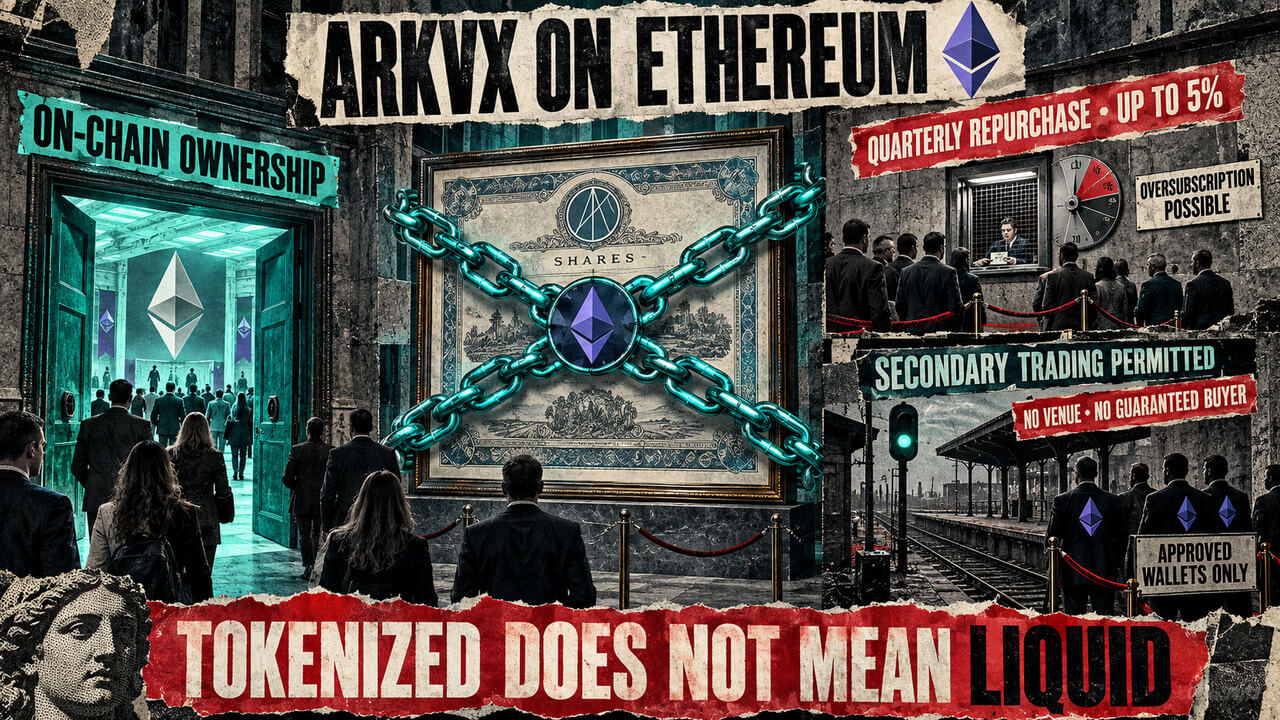
ARK partners with Securitize to put a venture fund on Ethereum, but leaves exit doors locked
ARK Invest and Securitize announced on Sept. 24 that eligible investors would be able to hold tokenized interests in the ARK Ventu...

Buterin Maps Ethereum's Post-Hegota 'Cryptographic World Computer'
Ethereum’s upgrades after Hegota should make cryptographic proof-checking and distributed offchain work central to the network, re...

Vitalik Buterin outlines Ethereum’s ambitious roadmap to 2030
Ethereum's ambitious roadmap could redefine its scalability and security, potentially boosting long-term market confidence and val...

Visa cuts reported stablecoin volume but there’s no proof payments fell
Visa’s September 18 data refresh lowered its adjusted stablecoin volume measure, while its adjusted transaction count fell by less...