BIP-110 Fork Stalls at Two Blocks as Bitcoin Miners Refuse to Follow
Bitcoin Magazine BIP-110 Fork Stalls at Two Blocks as Bitcoin Miners Refuse to Follow The Bitcoin Improvement Proposal (BIP)-110 appeared to stall at the weekend, when the nodes that support the proposal broke away from...
Archive context
Older archive item. Useful for background and entity history, but not a fresh market-moving signal.

Bitcoin Magazine
BIP-110 Fork Stalls at Two Blocks as Bitcoin Miners Refuse to Follow
The Bitcoin Improvement Proposal (BIP)-110 appeared to stall at the weekend, when the nodes that support the proposal broke away from the main network and produced the chain split people had been warning about — a tiny, stalled one.
The split came Saturday at block 961,632, when the proposal entered its mandatory signaling window. Nodes running BIP-110 software began rejecting any block that failed to signal support through version bit 4. When the first block at that height arrived without the signal, those nodes rejected it and peeled away onto a separate chain.
And it has gone almost nowhere since.
A pseudonymous mining group called Roughnecks produced both BIP-110 blocks — heights 961,632 and 961,633 — using Ocean’s DATUM protocol, then stopped. By Sunday afternoon the enforcing branch remained stuck at 961,633 while Bitcoin’s dominant chain had advanced to 961,744, a gap of 111 blocks and roughly 17 hours without a new block on the fork.
The support was never there. Only 51 of the 2,016 blocks in the preceding difficulty period signaled for the proposal, about 2.53%, against the 55% threshold needed for voluntary lock-in. Since the mandatory window opened, none of the first 113 blocks on the dominant chain have signaled.
Bitcoin’s difficulty adjustment compounds the problem. The fork inherited the main chain’s difficulty but commands a negligible share of hashpower, and cannot make mining easier until it completes a full 2,016-block period. Estimates of how long that would take range from under a year to decades, depending on the hashrate assumed.
BIP-110, formally the Reduced Data Temporary Softfork, would have capped arbitrary data in transactions for roughly a year, targeting Ordinals inscriptions and oversized OP_RETURN payloads.
Michael Saylor and Blockstream’s Adam Back both opposed it publicly, objecting less to the goal than to an activation method they argued invited exactly this outcome. Saylor wrote Sunday that Bitcoin had worked as designed, putting 99.85% of hashpower on the main chain.
Mining company Ocean, whose team supported the proposal, informed clients that some miners using Ocean’s Stratum templates may have believed they were mining on Bitcoin while their hashrate was directed to the new BIP-110 chain.
The company said it would reimburse miners affected with rewards they would have earned on the non-BIP-110 chain during that window.
This post BIP-110 Fork Stalls at Two Blocks as Bitcoin Miners Refuse to Follow first appeared on Bitcoin Magazine and is written by Mathew Di Salvo.
Why this matters
Bitcoin is showing up inside the Mining theme, so this story is worth tracking for follow-through rather than treating it as a one-off headline.
Original source
Read on Bitcoin MagazineRelated market context

Nine Blockchain Groups Unite as Quantum Threat Hangs Over Bitcoin
A new coalition of nine blockchain organizations is tackling a problem that could eventually put roughly 6.4 million bitcoin at ri...

Block’s Proto Bitcoin Mining Hardware Now Available to Own via Sazmining
Bitcoin mining services provider Sazmining has launched a new offering that allows individual investors to purchase mining hardwar...

Taiwan Blocks Coinbase and Kalshi Over Bets on Its November Elections
Taiwan has blocked the websites of Coinbase and Kalshi under a court order sought by police investigating election betting, six we...
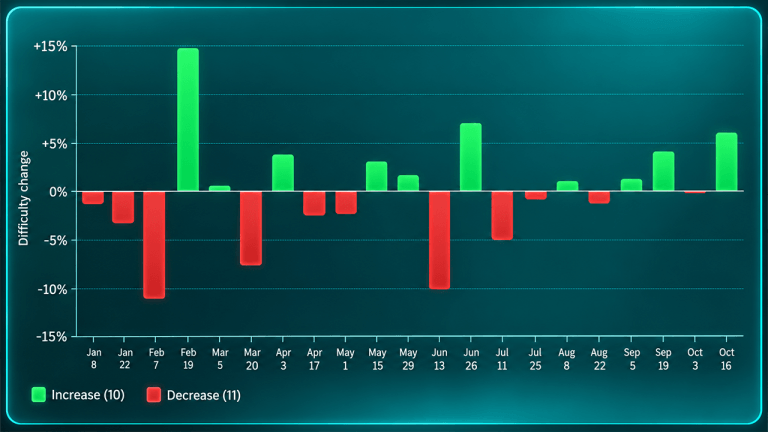
Bitcoin Mining Difficulty Jumps 5.92% in Third-Largest Hike of 2026
On Friday, at block height 971712, bitcoin mining grew considerably more demanding as the network’s latest difficulty adjustment c...
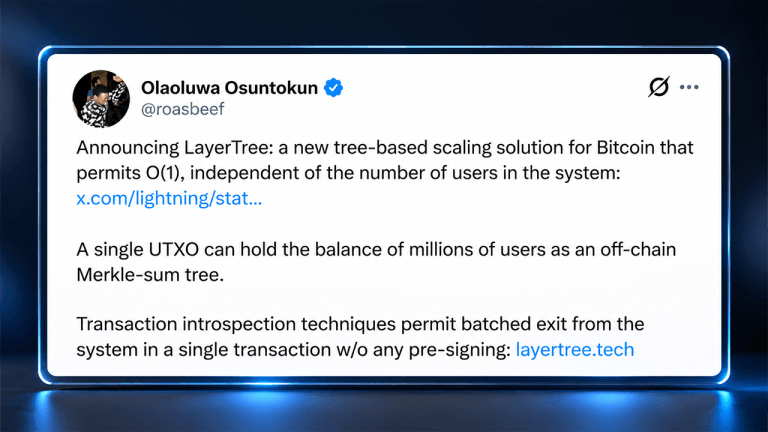
New Tree-Based Bitcoin Scaling Proposal Targets Millions of Users
Bitcoin developer Olaoluwa Osuntokun has unveiled Layertree, a proposal that could squeeze millions of bitcoin owners into a singl...

Claude AI Predicts that Chainlink (LINK) Could Hit Triple Digits in 2026
Claude AI predicts a wildly bullish price target for Chainlink (LINK), claiming it could reach $100 by January 1, 2027, if a near-...