Bitcoin Hashrate Soars to New Record High as Price Stumbles
Bitcoin’s network hashrate, a critical measure of its processing power and security, surged to an unprecedented 769.8 exahashes per second (EH/s) on October 21st. This milestone, reported by BitInfoCharts, signals a robu...
Archive context
Older archive item. Useful for background and entity history, but not a fresh market-moving signal.

Bitcoin’s network hashrate, a critical measure of its processing power and security, surged to an unprecedented 769.8 exahashes per second (EH/s) on October 21st. This milestone, reported by BitInfoCharts, signals a robust and increasingly secure blockchain, as higher hashrate makes the network more resistant to attacks. The surge is largely attributed to the expansion of publicly traded mining companies, who are leveraging their financial resources and economies of scale to deploy advanced mining equipment.
Despite this positive development on the network security front, Bitcoin’s price has faced headwinds, retracing after failing to break through the $70,000 resistance level. The cryptocurrency fell below $67,000 during U.S. morning trading on October 22nd, underperforming other major cryptocurrencies like Ethereum and Litecoin. Market analysts suggest that rising interest rates in Western economies and uncertainty surrounding upcoming U.S. earnings reports could be contributing to the pullback.
The record-breaking hashrate, while a testament to the network’s strength, also presents challenges for Bitcoin miners, particularly smaller operations. Increased computational difficulty translates to higher operating costs, squeezing profit margins, especially in the aftermath of the Bitcoin halving, which reduced block rewards.
Source: Blockchain.com
Bitcoin mining profitability, measured by hashprice, did experience a brief surge in August, reaching $50 per petahash per second (PH/s). This was largely fueled by a spike in transaction fees associated with the on-chain minting of the Runes protocol. However, profitability has since declined, and analysts from Jefferies warn of a potentially challenging October for miners.
Publicly traded mining companies are steadily increasing their dominance in the Bitcoin mining ecosystem. Data reveals that 12 of the largest public miners now control nearly 29% of the network’s total hashrate. Their access to capital and ability to scale operations efficiently position them to navigate market volatility and potentially expand their market share.
Market observers are closely monitoring the upcoming U.S. elections and broader macroeconomic developments, as these factors could significantly impact Bitcoin’s price trajectory and, consequently, mining profitability. The interplay between Bitcoin’s price volatility, evolving mining landscape, and macroeconomic factors will continue to shape the future of the cryptocurrency.
Does Hash Follow Price?
Christopher Bendiksen, Head of Research at CoinShares, presents a compelling view that Bitcoin’s hash rate is inherently tied to its price movements. In his blog post, An Honest Explanation of Price, Hashrate & Bitcoin Mining Network Dynamics, Bendiksen explains that while Bitcoin’s price may surge, the corresponding increase in hash rate lags due to the time miners need to procure and install more efficient hardware. As the price rises, block rewards become more lucrative, incentivizing miners to upgrade their equipment. However, the delay in these upgrades is why hash rate increases often trail behind Bitcoin’s price spikes.
Bendiksen also highlights that miners are paid in Bitcoin but face operational costs in local currency. This dynamic means miners won’t expand operations or invest in additional hash power unless the price of Bitcoin supports profitability. When mining becomes unprofitable, miners won’t continue simply to “support the network”; they need economic incentive. Higher Bitcoin prices allow smaller miners to enter the competition, pushing the network’s hash rate higher as participation grows.
Proponents of the “price follows hash” theory, like vocal Bitcoin advocate Max Keiser, argue the opposite—claiming that hash rate is the driving force behind Bitcoin’s price movements. Keiser, a firm believer in this perspective, frequently asserts that the Bitcoin price lags behind hash rate growth. Following a new all-time high in hash rate on July 8, 2020, Keiser tweeted, “The constant 10-minute emission schedule of #Bitcoin is the lure that will always attract miners – even acting irrationally – that pushes up hash rate with price following.”
For Keiser, the hash rate isn’t just a technical measure of network health but a macro indicator of adoption and a growing rejection of traditional financial systems. Yet, the idea that miners would act irrationally or continue mining at a loss seems far-fetched, as financial realities typically dictate miner behavior, aligning more with Bendiksen’s profitability-driven outlook.
Why this matters
This mining story adds another data point to the current market tape and is useful when read alongside nearby source coverage.
Original source
Read on Brave New CoinRelated market context
Bitcoin Hashrate Reclaims One Zettahash As Mining Competition Rebounds
TL;DR: BlocksBridge reported Bitcoin’s seven-day hashrate above one zettahash in the week to October 22. Mining competition has re...
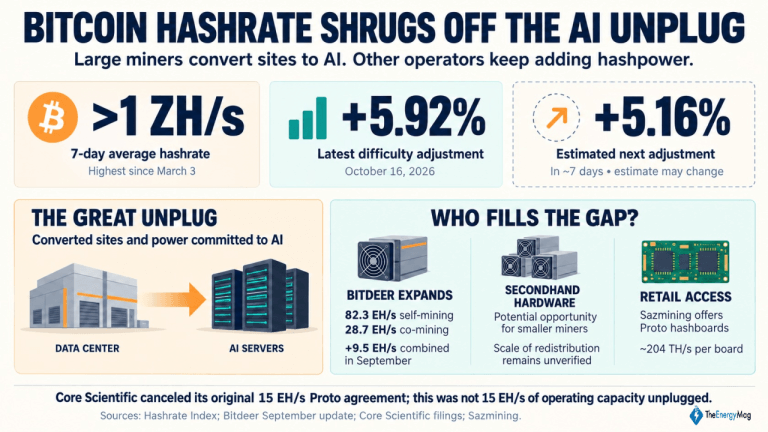
Miner Weekly: Bitcoin Hashrate Shrugs off the AI Unplug, Regaining 1 ZH/s Level
Big public miners are making room for artificial intelligence (AI). Bitcoin’s hashrate is climbing anyway. This article first appe...
Tether Wins Mining Industry Support For Its Open Automation Toolkit
Tether is trying to make Bitcoin mining equipment easier to operate as one system. Its October 24 announcement brings 15 industry...

Lido Opens Higher-Balance Ethereum Validators With A Deliberately Small Start
Lido has opened a permissionless route to Ethereum validators that can hold much larger effective balances, but the first allocati...

NIP Group Signs Bitcoin Miner Purchase To Add 4.47 Exahash Of Capacity
TL;DR: NIP Group has agreed to purchase already deployed Bitcoin mining machines with about 4.47 EH/s of hash rate, subject to clo...

China Sets 2030 Deadline for National Blockchain Network Despite Sweeping Crypto Ban
Key Takeaways: Under the new 5-year digital strategy, China aims to achieve a national blockchain network which will be largely co...