Bitcoin Miners Go Nuclear in Search of Clean Energy
Amid ongoing criticism around Bitcoin’s hefty carbon footprint, mining firms are now turning to a new source of energy: nuclear. In July, Bitcoin mining firm Compass Mining already embraced nuclear energy after partnerin...
Archive context
Older archive item. Useful for background and entity history, but not a fresh market-moving signal.
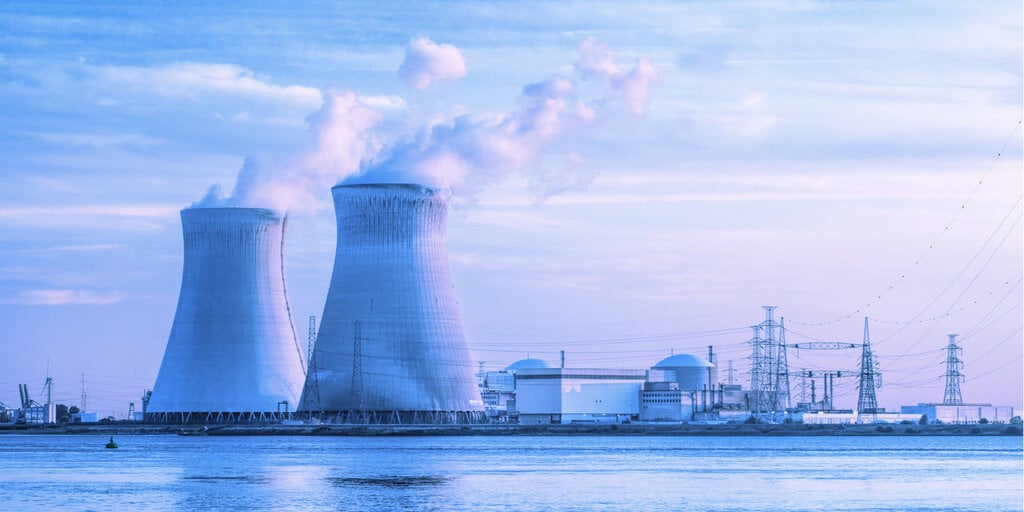
Amid ongoing criticism around Bitcoin’s hefty carbon footprint, mining firms are now turning to a new source of energy: nuclear.
In July, Bitcoin mining firm Compass Mining already embraced nuclear energy after partnering with Oklo, a nuclear energy startup. Oklo is building out so-called “microreactors” in order to sidestep the enormous logistical hurdles of a full-scale nuclear reactor.
An artist’s rendition of Oklo’s microreactors. Source: GenslerTalen Energy, an American energy firm, also announced a similar partnership with TeraWulf Inc., a U.S.-based Bitcoin miner. Talen is building a mining facility the size of four American football fields in Pennsylvania to support the venture. Called the “Nautilus Cryptomine,” the mining site “will create zero-carbon coins with the appropriate regulatory overlay, mined in the United States in a secure location,” said Talen’s president, Alex Hernandez.
The primary intrigue of this variety of partnership comes down to Bitcoin’s reputation as a net polluter and the nuclear industry’s ability to generate clean energy.
Thus, instead of using harmful fossil fuels to generate the electricity needed to mine Bitcoin, nuclear fission could provide the same results without the carbon emissions.
“We are building demand adjacent to the existing nuclear plant,” reportedly said Alex Hernandez, president of Talen Energy, suggesting that mining Bitcoin provides the energy provider with a new revenue stream besides serving energy grids.
It’s well understood by many that the flagship cryptocurrency is in urgent need of clean, reliable energy that doesn’t carry hefty carbon emissions.
Bitcoin’s energy problemBitcoin’s impact on the environment is now well documented.
The Hard Truth About Bitcoin's Energy ConsumptionPer Cambridge University, the Bitcoin network consumes just under 100 terawatt-hours (TWh) per year. This places the Bitcoin network in the company of some of the world’s most energy-guzzling countries. Last year, the network was consuming up to 141 TWh, meaning it would be one of the top 30 countries in the world by energy consumption.
Exactly how much of this energy consumption translates into a carbon footprint depends on how much of the energy was sourced from non-renewable—or carbon-intensive—energy sources.
According to Cambridge University, only 39% of the Bitcoin network runs on renewable energy. Since the university’s September 2020 study, Bitcoin miners have tried their hand at studies of their own—although their findings have been greeted with skepticism.
Bitcoin's High E-Waste Rate Worsens Environmental Concerns: DigiconomistDue to the fact that Bitcoin mining machines are typically single-purpose machines with short shelf lives, mining also generates a lot of e-waste.
According to a recent study by Alex de Vries, founder of the Digiconomist website which tracks the unintended consequences of digital trends, Bitcoin produces as much e-waste as the Netherlands on an annual basis.
With that track record, it’s not surprising Bitcoin miners are looking to nuclear energy for a solution.
Why this matters
This mining story adds another data point to the current market tape and is useful when read alongside nearby source coverage.
Original source
Read on DecryptRelated market context

Bitdeer Reports 1,355 Bitcoin Mined In September While Building AI Capacity
TL;DR: Bitdeer says its September Bitcoin production reached 1,355 BTC, highlighting the miner’s expanding hash rate alongside sep...

SEC Examiners Set Sights on Tokenization at Clearing Agencies for Fiscal 2027
The SEC’s Division of Examinations has named tokenization among the “high-risk areas” its staff will focus on when examining clear...

Bitcoin Is Busier Than Ever, but Bitcoin Mining Isn’t Getting Paid More
Bitcoin is processing more transactions than ever before on an annual basis, but the growing activity is doing little to improve o...

Square Tech and GOAT Network Sign MOU to Advance AI Agent-Powered Stablecoin Payments in South Korea
Bitcoin Magazine Square Tech and GOAT Network Sign MOU to Advance AI Agent-Powered Stablecoin Payments in South Korea Square Tech...

Tether’s mining development kit gets backing from 15 mining firms
Tether's MDK initiative could revolutionize Bitcoin mining by fostering interoperability and automation, potentially reshaping ind...

Chinese national extradited to US over alleged Cambodian crypto scam network
The extradition highlights the global crackdown on crypto scams, emphasizing the need for international cooperation to combat fina...