Bitcoin Mining Difficulty Hits New All-Time High As BTC Price Moves Sideways
Bitcoin price has been trading sideways in the past weeks, significantly declining from the $29,000 support. This bearish pattern spread panic among traders but has not deterred miners. Instead, Bitcoin mining participan...
Archive context
Older archive item. Useful for background and entity history, but not a fresh market-moving signal.

Bitcoin price has been trading sideways in the past weeks, significantly declining from the $29,000 support. This bearish pattern spread panic among traders but has not deterred miners. Instead, Bitcoin mining participants appear to have increased.
This is evident in the increased mining difficulty, which soared to a new record high. According to available data, Bitcoin mining difficulty surged 6.17% in the last week, alongside a spike in network activity on August 22.
Bitcoin Mining Difficulty Spikes Up Amid Nosediving PricesWhile BTC price tanked by over 10% in a 7-day period, miners’ confidence remains at its peak. According to data from btc.com, this uptick marks the sixth-largest increase in Bitcoin mining difficulty in 2023. For context, Bitcoin mining difficulty measures the difficulty and time it takes to solve a complex cryptographic puzzle.
Related Reading: AVAX Network Activity Down – Will The Planned Token Unlock Bring Back The Energy?
The Bitcoin network adjusts mining difficulty periodically depending on the number of miners onboard. The next difficulty adjustment date is about two weeks aways, with the estimated rate at 16.05%. Furthermore, the hash rate increases as more miners compete for limited Bitcoin block rewards, increasing mining difficulty.
Therefore, the uptick in mining difficulty suggests Bitcoin’s bearish price trajectory has not affected miners’ profitability.
Increase In Hash Rates Reflects High Investor Confidence In BitcoinHash rate and mining difficulty correlate; therefore, as the Bitcoin mining difficulty increases, the hash rate follows a similar trend. Although calculating the hash rate is tricky and challenging, the ongoing figure is about to break the existing record high of 538.05 EH/s.
In an August 22 report: CryptoQuant analyst MAC_D attributed the increased hash rate to high confidence in BTC and ETH network reliability and security among investors.
MAC-D wrote:
Recently the prices of BTC and ETH have fallen by 10%. However, the network security and reliability have increased.
He also identified two plausible reasons behind the uptick in the hash rate. Firstly, the analyst explained that Bitcoin’s hash rate increased during the recent price decline. He said the observation depicts that miners became more active amid the downtrend. Secondly, MAC_D mentioned that staked ETH has increased despite the decline in Ether price.
Nonetheless, the analyst believes the fall in price suggests BTC and ETH have become undervalued. And according to him, this presents an opportunity for bullish investors to accumulate more assets in anticipation of the next bull run.
This assumption must have prompted miners to increase their mining capacity, increasing the hash rate and difficulty. And data from the on-chain analytics platform Glassnode supports these claims.
According to Glassnode data, there has been a slight increase in the number of BTC in the portfolios of mining firms. As of August 22, miners’ BTC holdings hovered over 1.83 million Bitcoin. This figure represents a 0.08% increase from the value at the beginning of August.
Why this matters
This mining story adds another data point to the current market tape and is useful when read alongside nearby source coverage.
Original source
Read on NewsBTCRelated market context

Bitcoin’s 7-Day Hashrate Returns to 1 ZH/s After Nearly 8 Months
Bitcoin’s computational firepower, measured by its network hashrate, has reclaimed the 1 zettahash per second (ZH/s) threshold, wi...
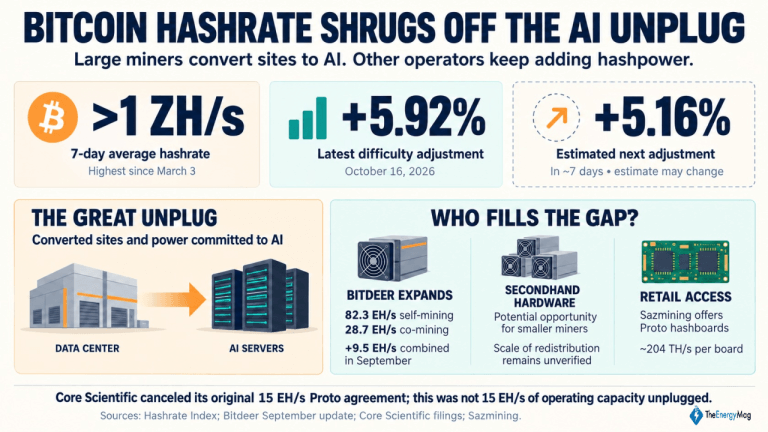
Miner Weekly: Bitcoin Hashrate Shrugs off the AI Unplug, Regaining 1 ZH/s Level
Big public miners are making room for artificial intelligence (AI). Bitcoin’s hashrate is climbing anyway. This article first appe...

China Sets 2030 Deadline for National Blockchain Network Despite Sweeping Crypto Ban
Key Takeaways: Under the new 5-year digital strategy, China aims to achieve a national blockchain network which will be largely co...

Lido Opens Higher-Balance Ethereum Validators With A Deliberately Small Start
Lido has opened a permissionless route to Ethereum validators that can hold much larger effective balances, but the first allocati...
Tether Wins Mining Industry Support For Its Open Automation Toolkit
Tether is trying to make Bitcoin mining equipment easier to operate as one system. Its October 24 announcement brings 15 industry...

Grayscale Looks Beyond AI Tokens To The Data And Credit Behind Computing
Grayscale’s October 23 research note looks at a more specific crypto-and-AI proposition than a general bet on smarter software: wh...