Escaping Jack Dorsey’s BTC miners cost $41.9 million
Core Scientific, starting in 2024, handed Jack Dorsey’s Block at least $67.9 million for BTC mining chips. It then booked a $41.9 million loss for the right to stop buying them. The data center operator paid Block $10 mi...
Archive context
Older archive item. Useful for background and entity history, but not a fresh market-moving signal.

Core Scientific, starting in 2024, handed Jack Dorsey’s Block at least $67.9 million for BTC mining chips. It then booked a $41.9 million loss for the right to stop buying them.
The data center operator paid Block $10 million in July 2024, another $21.3 million in January 2025, and a final $36.6 million in January 2026.
However, a new quarterly report published today says Core has “entered into a termination and settlement agreement with Block, Inc. and Proto Global LLC to terminate our existing contract and all future delivery obligations of mining equipment thereunder, resulting in a loss of $41.9 million.”
Core decided to wind-down its mining obligations to Proto, Block’s mining hardware division, to complete a “strategic transition,” despite the $41.9 million loss required.
Block announced the purchase agreement for roughly 15 exahashes of its own three-nanometer chips in July 2024. Core was Proto’s first chip customer and remains the only large buyer Block has ever named.
Five-year chart of Block. Source: TradingView Jack Dorsey’s BTC miners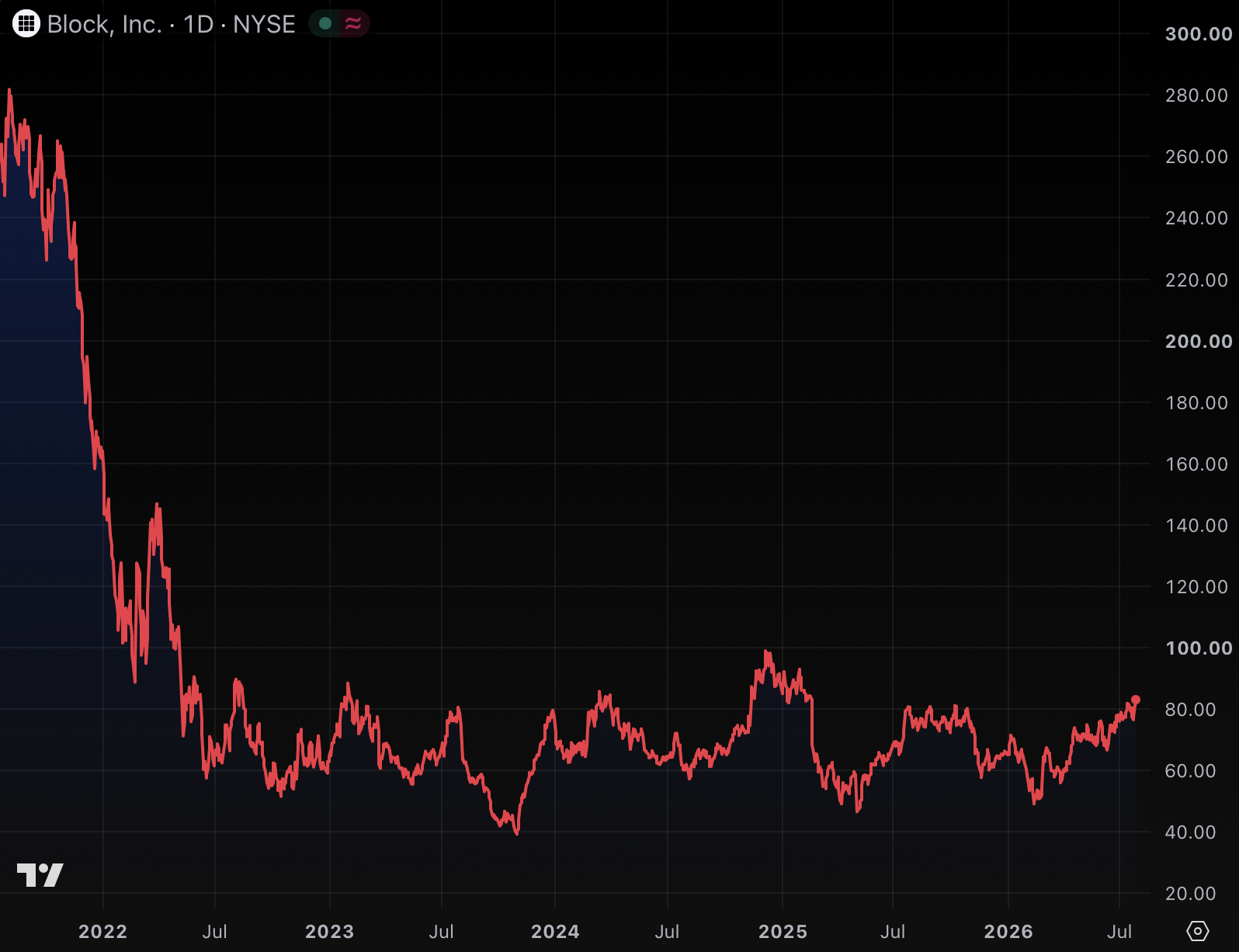
By the time Core had paid Block $31.3 million worth of deposits and prepayments by January 2025, it still estimated another $64.8 million of payments still to come.
In January 2026, it actually paid another $36.6 million upon delivery of certain rigs.
Then it booked a $41.9 million loss to make the rest of the order go away.
Core’s filing today doesn’t break down what that charge represents in precise detail but the result of the termination is obvious: Core recognized a big loss to stop buying Dorsey’s BTC miners.
A day earlier, Core Scientific signed 15-year leases covering 529 megawatts, most of it directly to AMD. The company says those leases, unrelated to Block, could produce more than $14 billion of contracted revenue.
Renting warehouses to AMD now pays better than mining BTC using Dorsey’s chips.
Block wound down TBD, the unit that incubated its BTC mining initiative and so-called Web5 identity project, in November 2024, as Protos reported at the time.
That quarter’s shareholder letter explained, “We are scaling back our investment in [music streaming service] TIDAL and winding down TBD. This gives us room to invest in our BTC mining initiative, which has strong product market fit and a healthy pipeline of demand, and Bitkey, our self-custody wallet for BTC.”
The healthy pipeline of demand has convinced a customer to take $41.9 million loss to get out of its purchase commitments.
Dorsey went further on Block’s Q2 2025 earnings call, saying of its mining division: “So we’re gonna have some really happy customers and we’re going to grow the market and take a lot of market share.”
The week after that call, Block unveiled its Proto Rig miner on stage at Core Scientific’s own facility in Dalton, Georgia.
Less than a year later, its marquee customer took a loss to cancel the remainder of its order.
Jack Dorsey wants to you to mine Bitcoin with new imaginary gizmoRead more: Uganda threatens to block Jack Dorsey’s Bitchat ahead of elections
A series of failures by Jack DorseyBlock’s disappointing mining rigs continue a series of business failures. Indeed, its common stock has lost 68% of its value over the past five years.
In 2021, the company paid $237.3 million after adjustments for most of Jay-Z’s music service, Tidal. Reuters reported that the acquisition was widely perceived as “a terrible business decision.”
Block later wrote off $132.3 million of that Tidal investment entirely as goodwill.
In July 2025, Dorsey shipped an open-source messaging app called Bitchat. Within days, he’d added a warning to its code repository that the software “has not received external security review and may contain vulnerabilities and does not necessarily meet its stated security goals.”
The US Consumer Financial Protection Bureau ordered Block in January 2025 to pay a $55 million penalty plus up to $120 million in redress over Cash App’s handling of fraud claims.
State financial regulators had fined it $80 million the day before.
In February 2026, Block told shareholders it was “reducing Block by nearly half, from over 10,000 people to just under 6,000, which means that over 4,000 people are being asked to leave or entering into consultation.”
Block reports Q2 2026 results after the close of trading on August 5, and has not commented on Core’s termination.
Got a tip? Send us an email securely via Protos Leaks. For more informed news and investigations, follow us on X, Bluesky, and Google News, or subscribe to our YouTube channel.
The post Escaping Jack Dorsey’s BTC miners cost $41.9 million appeared first on Protos.
Why this matters
Bitcoin is showing up inside the Mining theme, so this story is worth tracking for follow-through rather than treating it as a one-off headline.
Original source
Read on ProtosRelated market context

Block’s Proto Mining Hardware Gets A Smaller Entry Point With Sazmining
TL;DR: Sazmining is offering individual Proto immersion hashboards at $4,187 each, with financing and managed hosting. The arrange...

Binance Pay Opens Crypto Payments at Millions of PayPay Merchants Across Japan
Key Takeaways: Binance Pay is now available for visitors to use at PayPay merchants in Japan. Crypto is immediately converted to J...

Tokenized Stocks Reach $262 Million In DeFi, But The Growth Is Not All On Base
TL;DR: Stock-linked tokens deployed in DeFi reached an estimated $262.4 million across blockchains at the end of September, up nea...
Binance Pool To Close November 10, Giving Bitcoin Miners Weeks To Move
TL;DR: Binance will discontinue its mining pool and related services at 07:00 UTC on November 10, 2026. Miners must redirect their...

ChatGPT AI Predicts Million-Dollar Bitcoin by 2027
ChatGPT AI predicts Bitcoin will hit $1M+, which isn’t a crazy call, since many analysts share the same view. What makes this pred...
Coinbase and Marqeta Bring 24/7 Stablecoin Card Spending to Millions of Merchants
Key Takeaways: Coinbase and Marqeta are taking a stab at stablecoin-based cards. Coinbase infrastructure makes it easy for busines...