Landmark Bill Protecting Bitcoin Mining Rights Passes in Arizona
Key Takeaways: HB 2342 has passed the Arizona Senate, protecting home-based Bitcoin miners and node operators. The measure preempts local zoning laws related to digital asset activities. Protections over “computational p...
Archive context
Older archive item. Useful for background and entity history, but not a fresh market-moving signal.

Key Takeaways:
- HB 2342 has passed the Arizona Senate, protecting home-based Bitcoin miners and node operators.
- The measure preempts local zoning laws related to digital asset activities.
- Protections over “computational power” also apply to AI, cloud computing, and scientific research, for instance.
By taking this step, Arizona reinforces its support for blockchain innovation and individual rights in the digital era. On April 10, the state Senate moved to approve House Bill 2342 (HB 2342), which seeks to protect people running personal computing power facilities — including Bitcoin miners and blockchain node operators — from interference by local authorities. The bill passed 17–12 and now awaits Governor Katie Hobbs’ signature to become law.
If signed into law, Arizona will join with only a handful of other U.S. states that have clear, state-level protections for decentralized technologies such as Bitcoin mining, node validation, A.I., and scientific computing.
What HB 2342 Really MeansIn January 2025, Representative Teresa Martinez introduced HB 2342, which targets what it calls “computational power.” As a result, cities and counties will not be able to prohibit or limit residents from running blockchain nodes or, going forward, mining digital assets from home, under this law.
Specifically, the bill:
- Prevents local zoning laws from prohibiting people from using computational power at home.
- Defines computational power broadly to include AI, blockchain, cloud computing, and high-performance scientific research.
- And then declares regulation of these activities a statewide concern, making cities and counties powerless to regulate them.
Granting legal protection in this way could enable tech-savvy residents and entrepreneurs to operate decentralized infrastructure without worrying about local enforcement or shutdowns.
More News: Kentucky Set to Become a Bitcoin Paradise as Landmark Self-Custody Bill Clears Senate
Beyond Bitcoin: Implications for Tech and InnovationThough the headlines are about Bitcoin mining, HB 2342 goes much, much further. The bill’s legal definition of “computational power,” in addition, would seem to enable the protection of many kinds of at-home tech work, ranging from Ethereum validators to AI models running on powerful GPUs.
Legal clarity of this sort is particularly critical as the growth of edge computing and decentralized infrastructure become more and more commonplace.
Arizona’s Robustly Crypto-Curious StanceFor the last several years, Arizona has been positioning itself as one of the most crypto-progressive states in the U.S. In 2022, while the Biden administration pushed ahead with executive orders aimed at federal crypto regulation, Arizona remained a state pursuing higher Bitcoin adoption.
Senator Wendy Rogers made waves earlier this year by submitting a bill to make Bitcoin legal tender in Arizona, although that bill did not pass. The state’s willingness to consider such bold moves signals a coherent strategy of seizing financial and technological sovereignty.
The Arizona Senate also introduced the Arizona Strategic Bitcoin Reserve Act (SB 1025) in January 2025 and the Strategic Digital Assets Reserve Bill (SB 1373). If enacted, these bills would enable Arizona to:
Utilize Bitcoin (BTC) as one of its official reserve assets:
- Use sovereign treasury or pension fund to invest in Bitcoin up to 10% of state treasury.
- Utilize confiscated cryptocurrencies to establish a state-controlled pool of digital assets.
- Should Arizona eventually pass HB 2342 alongside the reserve bills, the state may lead the nation in adoption of crypto, both personally and institutionally.
Perhaps the most remarkable feature of HB 2342 is its language regarding state preemption. The bill clearly strips power away from local jurisdictions — it’s a shift in how digital infrastructure is governed.
Claims on behalf of Sections 9-500.42 and 11-269.22, Arizona Revised Statutes, will make it clear that no city or county may prevent, deter, or otherwise limit a person from lawfully obtaining or utilizing computational power in their home. Legally speaking, that puts digital rights on par with other protected utilities and technologies.
Lawmakers emphasized that decentralized technologies are too essential to be hindered by fragmented local rules. Instead of a direct quote, supporters generally felt innovation at the state level is the key to attracting talent and capital.
More News: Crypto Reserve Status Draws Closer for Arizona on Senate Confirmations
The post Landmark Bill Protecting Bitcoin Mining Rights Passes in Arizona appeared first on CryptoNinjas.
Why this matters
This mining story adds another data point to the current market tape and is useful when read alongside nearby source coverage.
Original source
Read on CryptoNinjasRelated market context

US Hoovers up Bitcoin While the World Runs on Its Digital Dollars: Report
Bitcoin Magazine US Hoovers up Bitcoin While the World Runs on Its Digital Dollars: Report America is accumulating bitcoin while e...

MEXC Releases October 2026 Proof of Reserves, Reinforcing User Trust Through Verifiable Transparency
Mutsamudu, Comoros, October 16, 2026 – MEXC, a pioneer in 0-fee digital asset trading, has released its October 2026 Proof of Rese...

Network School acquires Farcaster from Neynar, rebrands it as Network State Protocol
The acquisition and rebranding could reshape digital social platforms, emphasizing AI moderation and human verification, impacting...

USDC’s EU Reserves and Capital Shift to EBA Supervision in MiCA’s First ‘Significant’ Call
Circle’s European USDC issuer will answer to the European Banking Authority (EBA) on reserves, liquidity and capital from Nov. 12,...
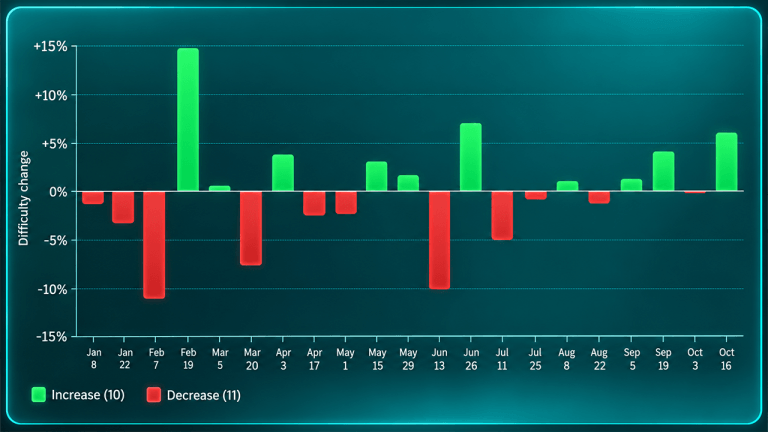
Bitcoin Mining Difficulty Jumps 5.92% in Third-Largest Hike of 2026
On Friday, at block height 971712, bitcoin mining grew considerably more demanding as the network’s latest difficulty adjustment c...

BFFS26 Denver: Joseph Kelly on Bitcoin Custody and Credit; Alan Lane on Banking Lessons
Bitcoin Magazine BFFS26 Denver: Joseph Kelly on Bitcoin Custody and Credit; Alan Lane on Banking Lessons The Bitcoin for Financial...