Luxor’s Hashrate Index 2022 Mining Year In Review Shows Bitcoin’s Resilience
Analysis shows that even though the mining industry saw major pressure this year, the network hashrate still grew immensely.Hashrate Index has released its 2022 Bitcoin Mining Year In Review, an extensive report on the m...
Archive context
Older archive item. Useful for background and entity history, but not a fresh market-moving signal.
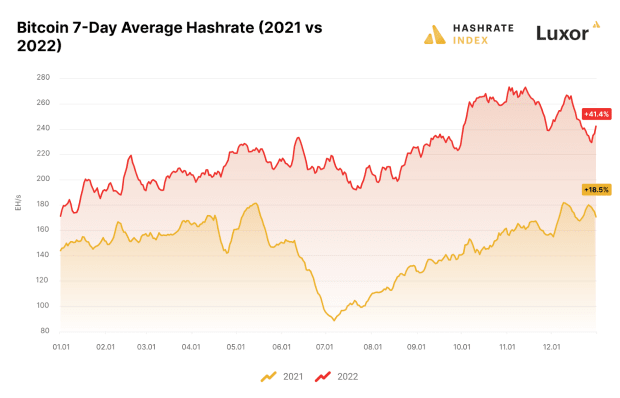
Analysis shows that even though the mining industry saw major pressure this year, the network hashrate still grew immensely.
Hashrate Index has released its 2022 Bitcoin Mining Year In Review, an extensive report on the mining industry and markets surrounding it.
2022 was a difficult year for Bitcoin mining, with the bear market leading to a hashprice all-time low, bankruptcies and losses for miners. Despite this, hash rate still grew 41%, and Bitcoin mining still generated nearly double the rewards compared to the previous three years. The report covers all of these topics and more in detail.
One of the main focuses of the report is the growth of hash rate.
Although the year involved many challenges to the mining industry, from an all-time low hashprice, to several public miner bankruptcies and even an arctic cyclone at the end of the year to top things off, hash rate still climbed, and at a much greater rate than 2021, which was stunted by China’s mining ban.
The report also describes a large decline in hashprice, with the high of the year being recorded on January 1 at $246.86/PH/day and only declining from there. Indeed, the year saw an all-time low in hashprice at $55.94/PH/day.
One factor that played into this, according to the report, is increasing industrial electricity rates across the country. But many states have been insulated from this rise in cost through abundant energy production sources like Washington’s hydropower, or other states’ access to natural gas, leading to certain states retaining viable mining operations. The report also notes that “power strategies can take many forms, but a common theme is that miners exploit the unique low-consequence-interruptibility of the bitcoin mining process by adjusting their electricity consumption based on market signals.” This was on display most recently when Texas miners turned off their operations in order to return energy supply to the grid, while getting paid nearly as much as they would have had they continued mining.
Average U.S. industrial power rate 2022 vs. 2021 — Source: EIA.govHashrate Index also highlighted the increase in hosting costs, which prior to 2022, hovered around $0.05-$0.06/kWh. But now, “Anything below $0.075/kWh is considered “a steal” given market conditions.”
Suffering public miners were also a focal point in the analysis.
Bitcoin mining stock performances in 2022 — Source: TradingViewWith the bull market in full swing, public bitcoin miners made big bets with their equipment purchases and expansionary moves. But the bear market hit some larger performers particularly hard, with behemoths like Core Scientific taking losses of nearly 100% — the company is currently undergoing Chapter 11 bankruptcy procedures. These were difficult-to-swallow pills for the market, but public miners did expand in terms of their hash rate dominance, ending the year at 19%.
Overall, the report signified Bitcoin’s resilience in the face of various major headwinds. Macroeconomic pressures, environmental anomalies and major public mining stocks tumbling more than 90% still couldn’t hamper major growth in network hash rate. Apparently, even such horrendous extraneous conditions as those on display in 2022 cannot temper the growth of the Bitcoin mining industry.
Why this matters
This mining story adds another data point to the current market tape and is useful when read alongside nearby source coverage.
Original source
Read on Bitcoin MagazineRelated market context

Bitcoin’s 7-Day Hashrate Returns to 1 ZH/s After Nearly 8 Months
Bitcoin’s computational firepower, measured by its network hashrate, has reclaimed the 1 zettahash per second (ZH/s) threshold, wi...
Tokenised US Stock Venues Must Give 30 Days’ Public Notice, SEC Clarifies
TL;DR: SEC staff guidance spells out a 30-day public-notice requirement for venues seeking to operate under the temporary tokenise...

Strategy (MSTR) Pauses Bitcoin Buying and Spends $205 Million on Preferred Stock
Bitcoin Magazine Strategy (MSTR) Pauses Bitcoin Buying and Spends $205 Million on Preferred Stock Strategy reported no bitcoin pur...

Kraken wins Fintech Company of the Year – Established at the National Fintech Awards 2026
TL;DR Kraken was named Fintech Company of the Year – Established at the Business Post’s National Fintech Awards 2026 in Dublin. Th...

UNDP And Blockchain For Good Put Public-Service Security Ahead Of New Payment Rails
UNDP and the Blockchain for Good Alliance announced a two-year cybersecurity programme on October 19. The initiative brings a prac...

Strategy’s Weekly STRC Buyback Climbs to $205 Million While Its Bitcoin Stack Stays Put
Strategy spent $204.9 million repurchasing 2,068,459 shares of its STRC preferred stock between Oct. 19 and Oct. 25 and bought no...