Next Bitcoin Mining Difficulty Change Estimated to Decrease as Block Times Have Lengthened
The last two mining difficulty changes on the Bitcoin network have driven difficulty to an all-time high, causing a decrease in hashrate and block interval speed. Before the latest difficulty retarget increase of 4.68%,...
Archive context
Older archive item. Useful for background and entity history, but not a fresh market-moving signal.

The last two mining difficulty changes on the Bitcoin network have driven difficulty to an all-time high, causing a decrease in hashrate and block interval speed. Before the latest difficulty retarget increase of 4.68%, block intervals were faster than the 10-minute average, at approximately 8 minutes 54 seconds to 9 minutes 31 seconds. However, since the change, block times have slowed, with statistics showing durations of 10 minutes 44 seconds to 10 minutes 36 seconds.
Slower-Than-Average Block Intervals May Lead to Decrease in Bitcoin Mining DifficultyThe next mining difficulty change is slated for Feb. 12, 2023. At the time of writing, metrics indicate the difficulty could drop as low as 5.6% below the current rate. The decline in estimated mining difficulty for Bitcoin is due to slower-than-average block intervals. Prior to the last two difficulty increases, block times were faster, leading to the increases. Currently, data shows that block times have slowed since the last difficulty change, with times ranging from 10 minutes 44 seconds to 10 minutes 36 seconds.
Bitcoin’s hashrate has been below average, with an average of 279 exahash per second (EH/s) over the past 2,016 blocks. As of 11:30 a.m. ET on Feb. 4, 2023, statistics show the hashrate at 258 EH/s. On Feb. 1, 2023, the total hashrate dropped to 217 EH/s after reaching a peak of 279 EH/s the previous day. The hashrate then increased, reaching 309 EH/s on Feb. 2, before declining 16.50% to its current level of 258 EH/s.
As of Saturday, the top Bitcoin mining pool is Foundry USA, with 90.61 exahash per second (EH/s) or 33.4% of the total hashrate. Foundry is followed by Antpool (18.14%), F2pool (14.08%), Binance Pool (13.13%), and Viabtc (9.07%). Thirteen known Bitcoin mining pools are contributing hashrate to the blockchain, while unknown miners, known as stealth miners, control 1.67% of the hashrate, or 4.53 EH/s. If the slowdown in block intervals results in a difficulty decrease eight days from now, miners will receive a two-week reprieve from the all-time high difficulty.
What impact will the decrease in Bitcoin’s mining difficulty have on the cryptocurrency’s overall network and hashrate? Let us know what you think about this subject in the comments section below.
Why this matters
This mining story adds another data point to the current market tape and is useful when read alongside nearby source coverage.
Original source
Read on Bitcoin NewsRelated market context
Tether Wins Mining Industry Support For Its Open Automation Toolkit
Tether is trying to make Bitcoin mining equipment easier to operate as one system. Its October 24 announcement brings 15 industry...

Netanyahu Floats Blockchain as a Sanctions Workaround; Israel’s Central Bank Objects
Israeli Prime Minister Benjamin Netanyahu said in a Channel 10 interview on Friday, Oct. 23, that Israel has to get ready for poss...
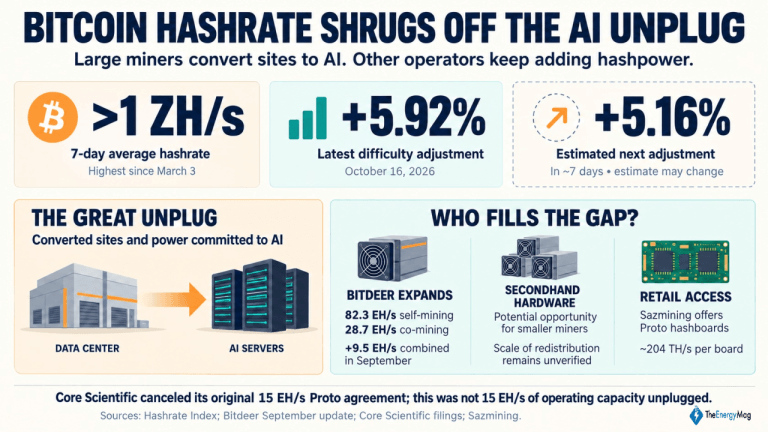
Miner Weekly: Bitcoin Hashrate Shrugs off the AI Unplug, Regaining 1 ZH/s Level
Big public miners are making room for artificial intelligence (AI). Bitcoin’s hashrate is climbing anyway. This article first appe...
Circle minted another ~4 billion USDC on Solana in the last 7 days
Circle's minting of USDC on Solana may signal strategic shifts, impacting blockchain activity and potentially influencing Solana's...

UNDP And Blockchain For Good Put Public-Service Security Ahead Of New Payment Rails
UNDP and the Blockchain for Good Alliance announced a two-year cybersecurity programme on October 19. The initiative brings a prac...
Bitcoin’s 7-Day Hashrate Returns to 1 ZH/s After Nearly 8 Months
Bitcoin’s computational firepower, measured by its network hashrate, has reclaimed the 1 zettahash per second (ZH/s) threshold, wi...