Proto Mining Launches American-Made Bitcoin Chips to Compete with Bitmain
Block’s Chief Financial Officer Amrita Ahuja announced the launch during a Friday interview on CNBC’s Squawk Box. Dorsey hinted at the launch on social media platform X the day before. Taking on the $6 Billion Mining Mar...
Archive context
Older archive item. Useful for background and entity history, but not a fresh market-moving signal.
Block’s Chief Financial Officer Amrita Ahuja announced the launch during a Friday interview on CNBC’s Squawk Box. Dorsey hinted at the launch on social media platform X the day before.
Taking on the $6 Billion Mining MarketThe Bitcoin mining hardware industry is worth between $3-6 billion annually. Currently, Chinese companies like Bitmain, MicroBT, and Canaan control most of this market. Block aims to become the first major American competitor to challenge their dominance.
“We have very close relationships with our vendors and manufacturers, and we are building in the United States,” Dorsey said during Block’s first quarter earnings call. This American production strategy helps the company avoid problems from trade wars and tariffs that affect overseas manufacturing.
Source: @Jack
The timing is important for Block’s business. The company reported a $93.4 million loss on its Bitcoin holdings in the first quarter, compared to a $233.4 million gain the previous quarter. Bitcoin trading revenue also dropped 15.7% year-over-year to $2.30 billion.
Open-Source Strategy Sets Proto ApartUnlike other mining chip makers, Block is making Proto completely open-source. This means other developers can see the chip’s design and suggest improvements.
“This is a completely open-source initiative… allowing us to get a lot of feedback from the community and also integrate any improvements right away and just build an entirely new developer ecosystem around mining which has not been done at scale before,” Dorsey explained.
This approach could help smaller mining operations compete with large industrial farms. The open design means more companies can build mining systems using Proto chips, potentially lowering costs and increasing options for miners.
Core Scientific Becomes First Major CustomerCore Scientific, one of the largest public Bitcoin mining companies, has already agreed to buy Proto chips. The deal will provide Core Scientific with 15 exahashes per second worth of mining power. This represents a 60% increase to the company’s current mining capacity.
The agreement is one of the largest Bitcoin mining chip deals announced in terms of total computing power. Core Scientific made a $21.3 million prepayment in January, with chip deliveries expected to begin in the second half of 2025.
Block and Core Scientific have not revealed the total value of their deal. However, the partnership shows that major mining companies are willing to try alternatives to Chinese-made equipment.
Part of Block’s Broader Bitcoin StrategyProto Mining fits into Block’s larger plan to build a complete Bitcoin ecosystem. The company already offers Bitcoin buying and selling through its Cash App, which serves 8 million customers. Block also makes the Bitkey hardware wallet and funds open-source Bitcoin projects through its Spiral initiative.
Block recently began rolling out Bitcoin payments for Square merchants. The company plans to offer this service to all 4 million Square sellers by 2026.
“We think Bitcoin can be the open protocol that powers the internet,” Ahuja told CNBC. “Our customers, the efficiency at which their money can move across jurisdictions is much greater when Bitcoin is powering money for the internet.”
Block also automatically converts 10% of its Bitcoin-related profits back into Bitcoin purchases each month. This shows the company’s long-term commitment to the cryptocurrency.
Market Impact and CompetitionThe Proto chip launch comes as the United States has become the world’s largest Bitcoin mining country. American miners now control about 37% of the global network’s computing power, up from almost nothing before China banned Bitcoin mining in 2021.
However, most of the mining equipment in America still comes from Chinese manufacturers. This creates potential security concerns for government officials who worry about foreign control over critical infrastructure.
Bitmain recently announced plans to open its first U.S. factory by early 2026. The Chinese company is responding to the same trade tensions and government pressure that motivated Block’s domestic production strategy.
American chip maker Auradine, backed by mining company MARA Holdings, has asked the government to limit Chinese mining equipment. The company argues that hundreds of thousands of Chinese machines connected to America’s power grid could pose security risks.
What’s Next for ProtoBlock expects the Proto chip launch to help improve its financial performance in the second half of 2025. The company cut its profit growth forecast earlier this year due to economic headwinds and reduced consumer spending.
The success of Proto will depend on whether it can offer better performance or lower costs than established competitors. Block’s open-source approach and American manufacturing could appeal to miners who want alternatives to Chinese suppliers.
Why this matters
This mining story adds another data point to the current market tape and is useful when read alongside nearby source coverage.
Original source
Read on Brave New CoinRelated market context
Bitcoin Hashrate Reclaims One Zettahash As Mining Competition Rebounds
TL;DR: BlocksBridge reported Bitcoin’s seven-day hashrate above one zettahash in the week to October 22. Mining competition has re...

Bitcoin Core Ends Long Embargoes for Bugs AI Can Rediscover
Bitcoin Magazine Bitcoin Core Ends Long Embargoes for Bugs AI Can Rediscover Bitcoin Core has changed its security disclosure poli...

Phantom Starts a Staged US Launch of In-Wallet Prediction Markets
US users of Phantom can now trade prediction markets in the wallet, under a staged launch that began Friday and runs through Kalsh...
Solayer Pay Adds Five Blockchain Networks For Direct Stablecoin Card Deposits
TL;DR: Solayer Pay says its card app now accepts supported stablecoin deposits from Solana, Ethereum, Arbitrum, BNB Chain and Base...
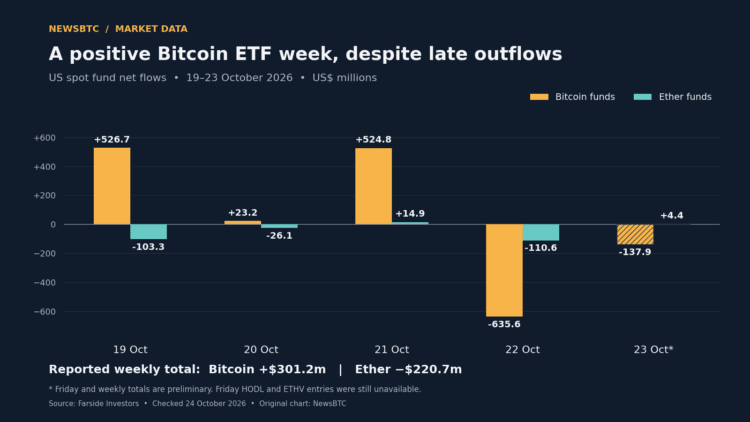
Bitcoin ETF Week Stays Positive After Nearly $774 Million In Late Outflows
TL;DR: Farside’s preliminary figures show US Bitcoin funds retaining a $301.2 million weekly inflow despite two days of withdrawal...
FCA Proposes Crypto Crime Guidance On Wallet Checks And Blockchain Analytics
TL;DR: The FCA is consulting on updated financial crime guidance for crypto businesses, including customer checks, blockchain anal...