U.S. Leads Global Bitcoin Hashrate Growth, Contributing Over 40% by End of 2024
This milestone reflects significant contributions from U.S.-based mining pools, Foundry USA and MARA Pool, which collectively mined over 38.5% of Bitcoin blocks during the year. Foundry USA: A Leader in Hashrate Expansio...
Archive context
Older archive item. Useful for background and entity history, but not a fresh market-moving signal.

This milestone reflects significant contributions from U.S.-based mining pools, Foundry USA and MARA Pool, which collectively mined over 38.5% of Bitcoin blocks during the year.
Foundry USA: A Leader in Hashrate ExpansionFoundry USA, already the world’s largest Bitcoin mining pool by hashrate, more than doubled its computing power, starting the year at 157 EH/s in January and closing it at an impressive 280 EH/s by December 2024. This is a growth of 68% within one year and thus puts Foundry in charge of 36.5% of the total hashrate on the Bitcoin network.
Market share of bitcoin mining pools. Source: TheMinerMag
The MARA Pool also grew remarkably to scale its hashrate to 32 EH/s, which accounted for 4.35% of global hash power. Combined, these pools have played a key role in increasing the U.S. share of Bitcoin mining power.
Challenges in Hashrate Distribution and CentralizationChinese mining pools remain influential despite U.S. advances, commanding an estimated 55% of the global hashrate, according to CryptoQuant CEO Ki Young Ju. That’s despite a 2021 ban on cryptocurrency mining in China. Chinese miners continue to circumvent restrictions through virtual private networks (VPNs) and P2P applications that allow them to contribute to mining pools anonymously.
Bitcoin mining pools comparison. Source: Hashrate Index
It is complicated to determine the exact geographical distribution of mining power. While some mining pools are headquartered in specific countries, their hashrate contributions often come from international participants. For example, Bitmain, a leading mining hardware manufacturer, reportedly sold 32 EH/s of U.S.-generated hashrate to a Chinese company in late 2024, further blurring regional distinctions.
Industry Concerns Over CentralizationThis has also concentrated mining power in the hands of a few large pools, raising debates on the risks it creates for the decentralized nature of Bitcoin. Rajiv Khemani, CEO of mining chip maker Auradine, emphasized the potential for vulnerabilities: “No single country or entity should control the majority of Bitcoin’s hashrate.”
He further reiterated that such critical infrastructure, like ASICs, should be manufactured from a diverse number of sources to avoid supply chain risks and ensure the integrity of the Bitcoin network.
U.S. Initiatives to Enhance Mining InfrastructureNotably, amid concerns of centralization, the U.S. has made attempts at strengthening its mining infrastructure. Mining hardware giant Bitmain recently expanded production operations in the U.S. to enhance supply chain efficiency and adapt to geopolitical challenges.
At the same time, Bitcoin mining is supported by legislative efforts in states like Texas. The North American Blockchain Summit in late 2024 unveiled discussions on establishing a Strategic Bitcoin Reserve to further cement the U.S.’s leadership in the sector.
The Path AheadAlthough the United States’ position in Bitcoin mining marks a vital achievement, industry leaders caution that more needs to be done if it is to be truly decentralized and secure. While the hashrate debate continues, only by regulators, leaders in the sector, and miners themselves taking responsibility will problems and opportunities alike begin to be resolved and explored further in the future of Bitcoin mining.
This is a fundamental shift that underlines the changing global landscape of Bitcoin, where the U.S. is increasingly becoming crucial for the security of the network while juggling decentralization and geopolitical dynamics.
Why this matters
This mining story adds another data point to the current market tape and is useful when read alongside nearby source coverage.
Original source
Read on Brave New CoinRelated market context
Bitcoin Hashrate Reclaims One Zettahash As Mining Competition Rebounds
TL;DR: BlocksBridge reported Bitcoin’s seven-day hashrate above one zettahash in the week to October 22. Mining competition has re...
Tether Wins Mining Industry Support For Its Open Automation Toolkit
Tether is trying to make Bitcoin mining equipment easier to operate as one system. Its October 24 announcement brings 15 industry...

Chinese national extradited to US over alleged Cambodian crypto scam network
The extradition highlights the global crackdown on crypto scams, emphasizing the need for international cooperation to combat fina...
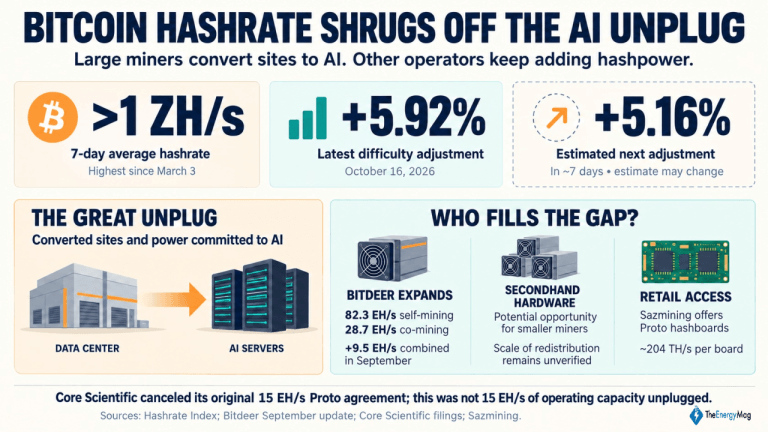
Miner Weekly: Bitcoin Hashrate Shrugs off the AI Unplug, Regaining 1 ZH/s Level
Big public miners are making room for artificial intelligence (AI). Bitcoin’s hashrate is climbing anyway. This article first appe...

Bitdeer Reports 1,355 Bitcoin Mined In September While Building AI Capacity
TL;DR: Bitdeer says its September Bitcoin production reached 1,355 BTC, highlighting the miner’s expanding hash rate alongside sep...

China Targets 2030 to Complete National Blockchain Network
As part of a 15-year plan outlined by the Central Cyberspace Affairs Commission, China’s national blockchain network is expected t...