Why The Bitcoin Miners’ Revenue Hit Lowest Point Since 2020
Many crypto investors are still skeptical about the profitability of Bitcoin mining. This is not surprising considering the growing rate of energy prices in recent times. Moreover, the Bitcoin miners’ revenue has been on...
Archive context
Older archive item. Useful for background and entity history, but not a fresh market-moving signal.

Many crypto investors are still skeptical about the profitability of Bitcoin mining. This is not surprising considering the growing rate of energy prices in recent times. Moreover, the Bitcoin miners’ revenue has been on a downtrend since November 2020.
Current Bitcoin Miners’ RevenueMeanwhile, BTC miners are experiencing some downturn in their revenue lately. This situation results from reduced prices and the present bearish state of the crypto market. It’s not overly surprising to miners, seeing that the token’s value against the dollar is going down the drain.
As of November 2021, Bitcoin miners recorded the highest revenue ever had. But information from Blockchain.com showed that these BTC miners’ revenue had dropped significantly since its peak surge.
Bitcoin mining revenue chart l Source: Blockchain.comThe Bitcoin miners’ revenue is now down to its lowest value since November 2020. At the time of writing, the figure stands at a little over $11.67 million.
While this downtrend is primarily due to the plummeting price of the BTC token, other metrics also contribute to the occurrence. A noteworthy example is the growing energy prices. Another instance is the decline in the profitable days of Bitcoin. Around 83.40% decline in the profitable days has already been recorded.
BTC holders have witnessed approximately 3,738 days of profits since 2015. On the opposite side, Bitcoin holders would have gained little or nothing for about 747 days in the same period. At the time of writing, BTC trades at $16,146 showing a 24-hour change of -1.72%.
Source: Blockchain.Com Working System Of Bitcoin MiningThe working process of BTC mining is simpler than it sounds. However, it demands the right understanding from intending and existing miners. Primarily, Bitcoin miners guess a 64-digit number called a hash. In most cases, it’s termed hash mining.
Miners depend on powerful computers to quickly guess this 64-digit number (hash). There are about 16 possibilities for every digit in the number. They consist of digits 1 to 10 and letters A to F.
Generating a guess involves rolling a die having 16 sides 64 times. This action alone only generates one guess. Miners still have many more possible answers, and this is where they need their mining systems.
These computers roll the 16-sided die at a very high speed with lots of computer energy. The reward for mining goes to the miner who first arrives at the right hash – adding a block to the Bitcoin blockchain. The continuity of this process and the price of BTC add up to the revenue of these BTC miners.
Bitcoin is currently on a downward trend l BTCUSDT on Tradingview.com Featured image from Pixabay, chart from TradingView.comWhy this matters
This mining story adds another data point to the current market tape and is useful when read alongside nearby source coverage.
Original source
Read on NewsBTCRelated market context
Bitcoin Hashrate Reclaims One Zettahash As Mining Competition Rebounds
TL;DR: BlocksBridge reported Bitcoin’s seven-day hashrate above one zettahash in the week to October 22. Mining competition has re...

Bitcoin’s $80K consolidation could end within days as macro events approach, ARP Digital says
Bitcoin's price movement could significantly shift soon, impacting investor strategies and market dynamics amid key macroeconomic...
Bitcoin’s 7-Day Hashrate Returns to 1 ZH/s After Nearly 8 Months
Bitcoin’s computational firepower, measured by its network hashrate, has reclaimed the 1 zettahash per second (ZH/s) threshold, wi...
Tether Wins Mining Industry Support For Its Open Automation Toolkit
Tether is trying to make Bitcoin mining equipment easier to operate as one system. Its October 24 announcement brings 15 industry...
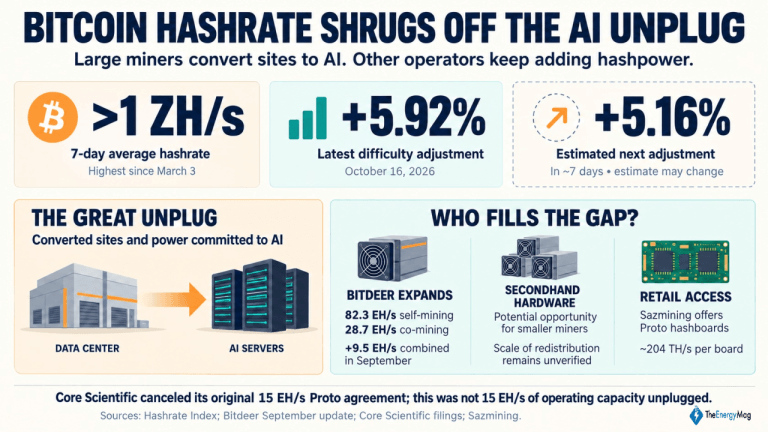
Miner Weekly: Bitcoin Hashrate Shrugs off the AI Unplug, Regaining 1 ZH/s Level
Big public miners are making room for artificial intelligence (AI). Bitcoin’s hashrate is climbing anyway. This article first appe...
Tokenised US Stock Venues Must Give 30 Days’ Public Notice, SEC Clarifies
TL;DR: SEC staff guidance spells out a 30-day public-notice requirement for venues seeking to operate under the temporary tokenise...