Coinbase World Cup error shows prediction markets still have a proof problem
A reported Coinbase announcement about a World Cup result, likely using AI, created a problem bigger than a flawed alert. It showed how quickly exchange-run prediction markets can blur the line between tradable outcomes...
Archive context
Older archive item. Useful for background and entity history, but not a fresh market-moving signal.
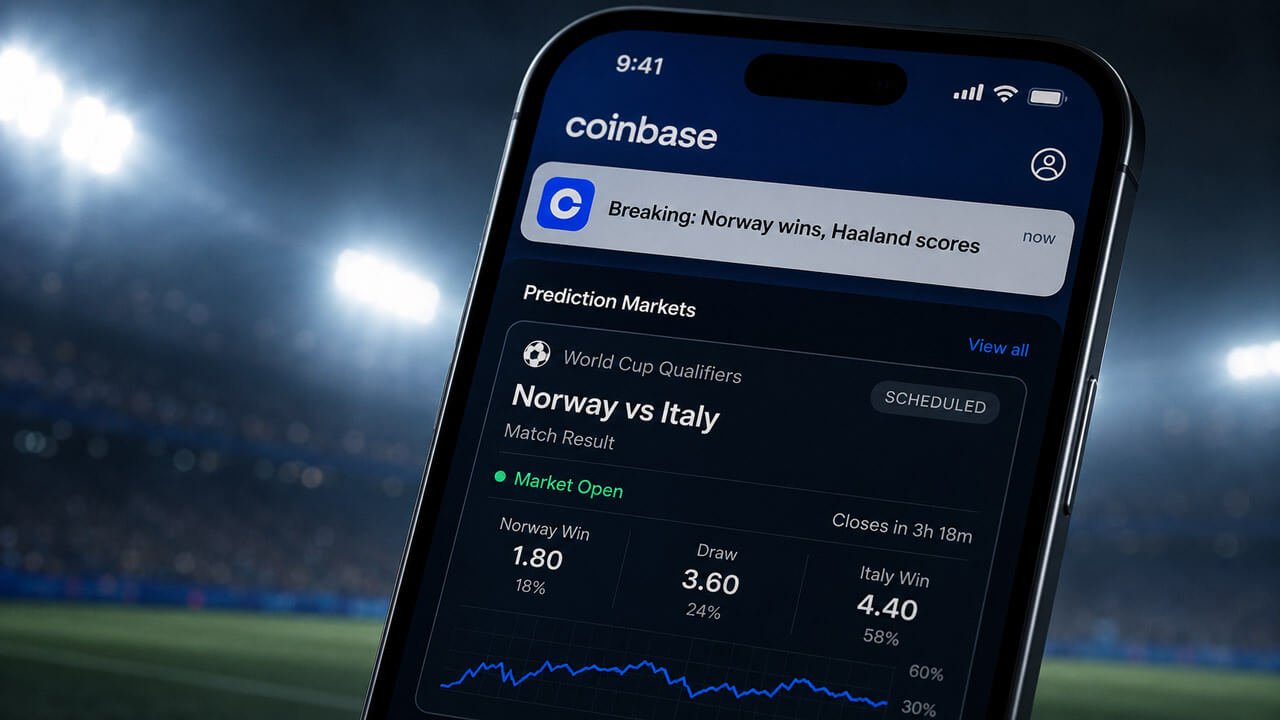
A reported Coinbase announcement about a World Cup result, likely using AI, created a problem bigger than a flawed alert. It showed how quickly exchange-run prediction markets can blur the line between tradable outcomes and unverified automated content inside the same consumer app.
The episode surfaced on July 5, when a user posting as jay_drainjr said on X that Coinbase had sent a breaking-news-style alert claiming Norway had won a World Cup game, with Erling Haaland scoring, before the match had been played.
Coinbase CEO Brian Armstrong replied later that day, saying he was looking into it with the team.
Coinbase has not published a full public postmortem as of press time. The public record also does not yet show how many users saw the notification, whether anyone traded after seeing it, or which system generated it. Those unanswered facts are material, but they do not erase the design problem the alert surfaced.
Exchanges are moving toward a product mix in which AI-generated alerts, sports-event contracts, and retail trading interfaces can sit within the same user journey. That means users need to see exactly what has been verified, what is automated, and what remains unresolved before market-adjacent content reaches them.
The timing made the episode sharper. Armstrong had already framed prediction markets as a breakthrough in how markets discover truth, saying in January that Coinbase users in the US could trade outcomes across sports, politics, culture, news, and more through the app's Predict tab.
Coinbase's own prediction markets page presents the product as focused on real-world outcomes, while its sports page shows event markets tied to World Cup, goalscorer, correct-score, and other sports outcomes.
That creates a basic tension for any exchange operating this kind of product. If a prediction market is meant to let prices reflect what participants believe will happen, the app also has to preserve the difference between an unresolved event, a live update, and a verified result.
Related Reading When the CEO reads the script: Did Coinbase Brian Armstrong manipulate a market? Armstrong said words at the end of Coinbase's earnings call to settle nearly $90,000 in prediction markets bets. Some called it a harmless troll. Others called it market manipulation by a regulated CEO. Nov 1, 2025 · Gino Matos A bad alert becomes market infrastructure when trading is one tap awayA mistaken pre-match alert would be a content failure in most consumer apps. In a trading app, it can become more serious because information and action sit side by side.
Prediction markets are contracts whose value can move as users react to new information. A notification that an event has already occurred can change a user's understanding before the user sees the market, places a trade, exits a position, or decides to wait.
Even if no trades later show they relied on the alert, the product design has exposed the pressure point.
The reported Coinbase incident therefore belongs in a different category from a generic AI hallucination story. A wrong sentence from a model is embarrassing. A wrong sentence near a tradable event market can appear to be market-relevant information if the app does not indicate whether the event has been resolved.
The later outcome of the match does not settle that risk. If an alert reports a result before a reliable source has resolved the event, it has crossed the key boundary.
In prediction markets, the boundary is between pre- and post-resolution as much as between true and false.
That distinction will become more important as exchanges add more event markets to retail apps. Sports markets are especially sensitive because they produce constant live data, user attention is close, and the line between commentary, odds movement, and outcome confirmation can be thin.
Related Reading Polymarket’s $3.3B World Cup boom exposes the longshot trap inside prediction markets Traders are pricing a possible rematch of the 2022 final, even as billions in historical volume remain scattered across longshot teams. Jun 29, 2026 · Oluwapelumi AdejumoA product can disclaim that users bear risk, but the interface still teaches users what to treat as settled.
Coinbase's own pages already contain the legal and risk framing that makes the question of standards hard to avoid. The sports prediction market page says prediction markets are offered by Coinbase Financial Markets, a CFTC-registered futures commission merchant and National Futures Association member.
The same disclosure warns that event contracts can result in the loss of the full investment.
The product pages also state that information is provided for informational purposes and is not investment advice. They include language saying Coinbase is not responsible for third-party content errors, delays, or actions taken in reliance on that content.
That kind of disclosure may help allocate legal risk, but it cannot replace product-level clarity.
Users experience one app. If that app shows an event market, pushes a breaking alert, and presents a price that moves with new information, users will naturally treat the information environment as part of the product.
That is where provenance becomes more than a label. A trading app that uses automated alerts around event markets may need to show the source of the claim, the time it was verified, the status of the underlying event, and whether the alert was generated, summarized, or approved by a human.
A simple AI label would be too weak if it does not say whether the event itself has been resolved.
A practical standard would separate at least four states: rumor or social report, scheduled event, live event, and officially resolved result. The user should not need to infer those states from the wording of a push notification.
The app should make the state visible before the user can mistake commentary for settlement.
Latency is also a risk control. Prediction markets can move on seconds-old information. If the app's alert pipeline is faster than its verification pipeline, the product can push users toward a claim before the market has a reliable basis to treat it as fact.
Speed is valuable only if proof travels with it.
Proof controls have to sit above the contractThe CFTC's June 12 Federal Register proposal discusses prediction markets as registered venues offering event contracts and frames the category around public-interest determinations, market integrity, manipulation prevention, clear settlement terms, and objective information that can be publicly verified.
Those concepts are usually discussed in relation to the contract itself: what event is being traded, how the outcome is determined, and what conditions trigger settlement.
The Coinbase alert episode points to the layer above the contract. If the market's settlement criteria are objective but the app's surrounding content pipeline lacks the same discipline, users can still receive a misleading signal before settlement.
That is the gap exchanges will have to close as prediction markets move from specialist venues into mainstream crypto apps. The settlement rule may say one thing. The app notification may imply another.
The user experiences both as part of the same financial interface.
CryptoSlate has already covered how sportsbooks and prediction markets are converging as event contracts draw more trading interest. That trend raises the stakes for Coinbase because the company's advantage is distribution.
Related Reading Americans lost hundreds of billions on crypto speculation. Why is only some of it considered gambling? As speculation spreads across new asset classes, the line between investing and gambling has become a matter of which regulator gets there first. Jul 4, 2026 · Andjela RadmilacIf event markets live in the same app as spot crypto trading, wallets, alerts, and consumer finance tools, a content failure can travel faster and feel more authoritative than it would on a smaller market-only platform.
The regulatory context also explains why a disclaimer alone is incomplete. Prediction markets depend on clear evidence of what happened and when.
If the content layer can race ahead of that proof, the market still has a trust problem even when the contract's final settlement criteria are objective.
For consumer exchange apps, verification has to cover both layers. The contract can have objective settlement terms while the surrounding feed still creates confusion if an alert uses final-result language too early.
Controls around content, data vendors, and push timing therefore become part of the same trust system that supports the market.
The next standard is operationalThe core Coinbase question is operational. Did the alert come from a model-generated summary, a data vendor, a third-party feed, a human-entered story card, or a mix of those systems?
What source marked the event as resolved? What check should have stopped a pre-match result from being pushed? Could users distinguish a generated alert from an official result?
Those details remain unresolved without a Coinbase postmortem, but the most likely conclusion is clear: exchange-run prediction markets will need visible proof standards before AI-generated alerts can scale alongside tradable outcomes.
Those standards should be measurable. A market operator can log the data source for every event alert, the timestamp when a result becomes eligible to be described as final, separate the generated commentary from the official settlement language, and retain an audit trail for any push notification tied to a tradable market.
It can also prevent content systems from using final-result language until a verified source has crossed a predefined threshold.
The hard part is that these controls may slow down the very alerts that make consumer apps feel timely. That is the tradeoff.
If an exchange chooses speed over provenance, it risks turning the alert layer into an unpriced part of the market structure.
The Coinbase incident is therefore a preview of a larger fight over the credibility of prediction markets. Market prices can serve as useful signals only when users can distinguish among a forecast, a report, and a resolved fact.
As exchanges add AI summaries and real-time alerts, the next competitive standard may shift from who lists the most markets first to who can show the fastest proof without asking users to trust a black box.
Until Coinbase explains the alert pipeline, the unanswered facts remain important. How many users saw the notification, whether anyone traded because of it, and what system generated it are all material details.
The broader lesson is already visible: prediction markets sold as truth-seeking tools need proof infrastructure before automated content becomes part of the trading experience.
The post Coinbase World Cup error shows prediction markets still have a proof problem appeared first on CryptoSlate.
Why this matters
Coinbase is showing up inside the Regulation theme, so this story is worth tracking for follow-through rather than treating it as a one-off headline.
Original source
Read on CryptoSlateRelated market context
U.S. judge rejects Gemini’s appeal to void $5 million settlement despite CFTC backing
The crypto exchange already paid up, but a court order and restrictions from its 2025 settlement will not be lifted even though th...

Judge refuses to let Gemini and CFTC undo $5 million settlement
The ruling underscores the permanence of legal settlements, limiting the impact of policy shifts on finalized judgments and regula...

MEXC Releases October 2026 Proof of Reserves, Reinforcing User Trust Through Verifiable Transparency
Mutsamudu, Comoros, October 16, 2026 – MEXC, a pioneer in 0-fee digital asset trading, has released its October 2026 Proof of Rese...

Gemini Can’t Shed Its CFTC Consent Order Even With the Agency’s Backing, Judge Rules
A federal judge in Manhattan on Thursday refused to vacate Gemini’s 2025 settlement with the Commodity Futures Trading Commission,...

Coinbase and Marqeta Expand Partnership for Enterprise Stablecoin Cards
The planned offering would let businesses fund card programs around the clock, with Coinbase holding balances and Base providing o...

Ethereum Price Prediction: ETH Outpaces the Market as Crypto Rebounds
Ethereum is outperforming the crypto market, rising by almost 3% over the past 24 hours to just a notch under $2,500 as digital as...