A ‘Sustained’ Crypto Winter? Trading Volume Hits Lowest Levels Since 2023 – Report
A recent report has suggested that the digital assets market has likely entered its “crypto winter” after the sector’s market capitalization and trading volume continued to decline for a second consecutive quarter. Crypt...
Archive context
Older archive item. Useful for background and entity history, but not a fresh market-moving signal.

A recent report has suggested that the digital assets market has likely entered its “crypto winter” after the sector’s market capitalization and trading volume continued to decline for a second consecutive quarter.
Crypto Winter Arrives As Volumes DropOn Thursday, CoinGecko affirmed that the market transitioned from a sharp correction to a “sustained” crypto winter in Q1 2026. This shift occurred as the late 2025 bearish momentum collided with the onset of global geopolitical tensions in the first quarter of the year.
According to its 2026 Q1 Crypto Industry Report, the total crypto market capitalization dropped around 20.4%, roughly $622 billion, ending the first quarter at $2.4 trillion and marking the second consecutive quarter of decline.
This contraction, which accelerated between mid-January and early February, left the market around 45% below its October peak of $4.27 trillion. During this period, daily trading activity also declined by 27.2% Quarter-over-Quarter (QoQ), with an average daily trading volume of $117.8 billion.
Meanwhile, spot trading volume on the top 10 centralized exchanges (CEXes), including Binance, MEXC, KuCoin, and Bybit, decreased 39.1% QoQ to $2.7 trillion, seeing a notable decline by the end of Q1.
Per CoinGecko data, volumes held above the $1 trillion mark in January, but fell throughout the quarter. With only $0.8 trillion in trading volume, March was the weakest month of Q1, recording the lowest levels since November 2023.
While Binance maintained its dominance, with a 37% market share, MEXC was the only other exchange with a double-digit market share in Q1, at 10%.
“All top 10 spot CEXes saw trading volume decline in Q1, with drops ranging from -23% to -55%. HTX saw the biggest slump, with its quarterly trading volume dropping to $133.6 billion in 2026 Q1 from $294.4 billion in 2025 Q4. Its market share fell to 4.9%, placing it in #10,” the report added.
Majors Decline, Stablecoins Remain FlatCrypto market-wide declines continued in Q1, as majors pulled back for a second consecutive quarter. Bitcoin (BTC) fell 22% during the quarter but outperformed the other top five crypto assets by a narrow margin. However, it continued to underperform other major assets, including Oil, Gold, and the S&P 500.
Ethereum (ETH), BNB, XRP, and Solana (SOL) recorded similar drawdowns as Bitcoin, which “weighed heavily on total market capitalization.” Legacy tokens such as Uniswap (UNI) and Chainlink (LINK) also faced continued pressure despite institutional adoption and gaining “digital commodity” status under the SEC-CFTC Joint Interpretive Guidance issued last month.
The report noted that relative strength emerged amongst some altcoins after the Q4 2025 sell-off, including Hyperliquid (HYPE) and Bittensor (TAO), which outperformed the broader sector.
Meanwhile, the total stablecoin market capitalization stayed mostly flat in Q1, seeing a marginal 0.5% increase to end the quarter at $309.9 billion. During this period, Tether’s USDT saw its supply decline 1.6% to $184.1 billion, the first meaningful drop since Q2 2022. Circle’s USDC grew 2.4% to hit $77.1 billion, while Sky’s USDS and WLFI’s USD1 recorded double-digit growth.
Nonetheless, stablecoin’s stability despite the challenging landscape for the broader crypto market in Q1 highlighted “the sector’s role as a liquidity anchor,” CoinGecko emphasized.
Why this matters
Bitcoin is showing up inside the Stablecoins theme, so this story is worth tracking for follow-through rather than treating it as a one-off headline.
Original source
Read on NewsBTCRelated market context

Circle mints approximately $3.5 billion USDC on Solana in the past seven days
Circle's USDC minting on Solana may boost liquidity and network activity, potentially influencing Solana's market dynamics and pri...
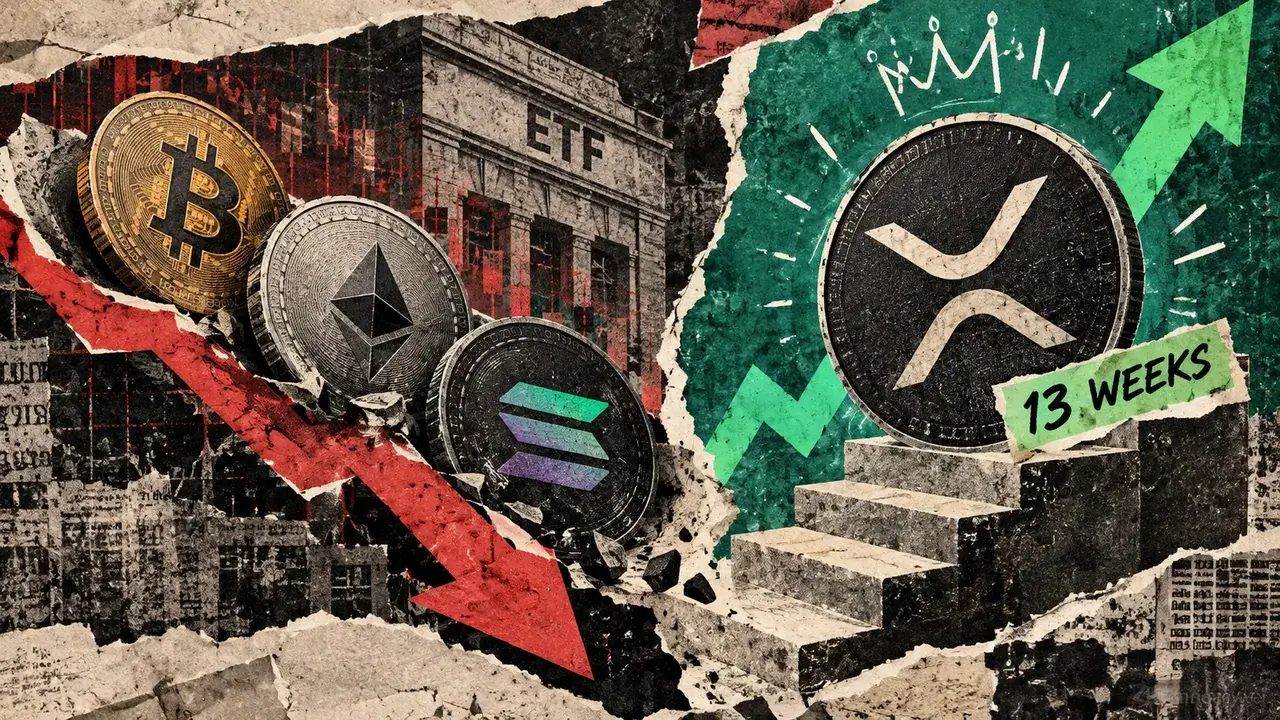
XRP ETFs extend a 13-week inflow streak as Bitcoin, Ethereum and Solana funds shed $1.25 billion
US-listed XRP ETFs extended their inflow streak to 13 weeks as Bitcoin, Ethereum and Solana funds suffered nearly $1.25 billion in...

Circle mints 250M USDC on Solana, boosting liquidity and network potential
Increased USDC supply on Solana may enhance network activity and adoption, but market caution persists regarding significant price...

Bitcoin, Ethereum and Solana ETFs All in the Red for October
Bitcoin ETFs have seen $386.3 million in net outflows through the first seven trading days of October, while Ethereum funds have n...

FTX Bitcoin Bet Takes an Unexpected Turn as SWI Group Raises $900 Million
SWI Group has raised €800 million from institutional investors at a €6.1 billion valuation. The Singapore-incorporated, Amsterdam-...
Spot Bitcoin and Ethereum ETFs bleed $1.22 billion in a single week
The significant outflows from Bitcoin and Ethereum ETFs could signal shifting investor sentiment, potentially impacting broader cr...