Aave’s live stock-token loans expose USDC lenders to a weekend price gap
Aave's Base market has accepted seven Coinbase stock tokens as collateral for USDC loans since Sept. 25, giving the stablecoin suppliers who opt in exposure to a weekend pricing gap. Aave Labs said on Sept. 25 that its V...
Archive context
Older archive item. Useful for background and entity history, but not a fresh market-moving signal.
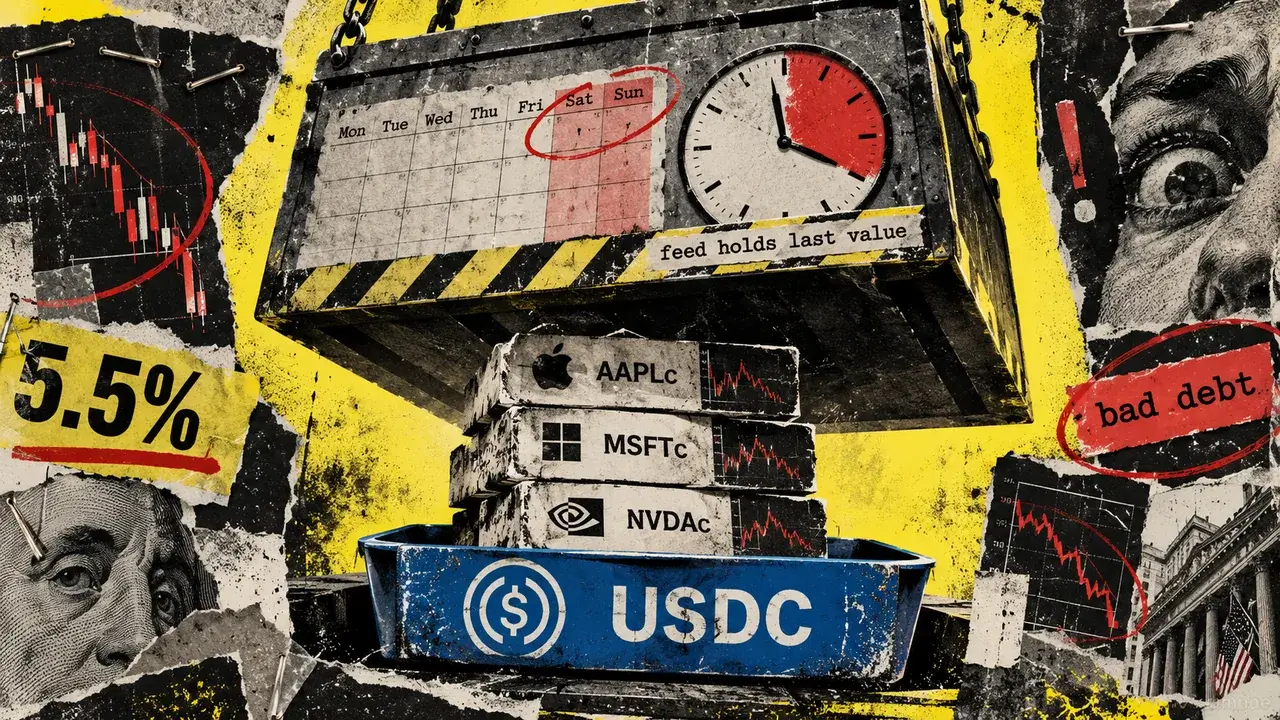
Aave's Base market has accepted seven Coinbase stock tokens as collateral for USDC loans since Sept. 25, giving the stablecoin suppliers who opt in exposure to a weekend pricing gap. Aave Labs said on Sept. 25 that its V4 Equities Hub was operational after a temporary halt was lifted. Its Mag-7 lending spoke has a $21 million USDC draw cap, a ceiling on borrowing rather than a report of loans already made.
Aave's lending system stays open while its stock-linked collateral feeds hold Friday's price until Sunday evening. A borrower can still trade a token during that gap, but a price-driven decline in the position's health may become visible to the protocol only when the feed resumes. If liquidators cannot recover enough value from seized tokens after that repricing, the opt-in USDC lending hub could be left with bad debt.
A market open while its equity feed is closedAAPLc, AMZNc, GOOGLc, METAc, MSFTc, NVDAc and TSLAc are collateral only. USDC is the sole asset that borrowers can draw from the dedicated hub. LlamaRisk, which recommended the market's initial parameters, says USDC suppliers opt into this equity-backed exposure; it does not flow into Aave's other markets.
The Chainlink equity-linked feeds combine the underlying share price with a Coinbase issuer multiplier. LlamaRisk specifies an operating window from Sunday 8 p.m. to Friday 8 p.m. Eastern time. From Friday evening to Sunday evening, and on US market holidays, the feeds hold their last value rather than publishing a new one. The Aave market itself remains open for deposits, borrowing and liquidation, and the stock tokens can still change hands onchain.
A collateral position's price-based health reading therefore cannot reflect fresh information during that closure. Interest on a USDC loan can still push a position across the liquidation threshold while the feed is frozen. A position made unsafe by a lower stock-linked price may first become liquidatable when the feed resumes on Sunday evening and incorporates that move in one update. A liquidator may then have to carry the seized exposure until deeper stock-market hours on Monday.
Related Reading Crypto stock tokens barely move over weekend, revealing markets become illiquid when Wall Street goes offlineThe original ARFC described a different approval path. Aave Labs said before execution that a Snapshot vote was binding for this activation and that the Protocol Security Council would unhalt the deployed market directly, without an AIP or Aave Governance V3 vote for the activation. Its later confirmation said the council had done so. A separate risk-steward configuration was still described as subject to an AIP.
The $21 million draw cap sits alongside a $32 million USDC add cap for the Mag-7 spoke. The latter limits how much USDC can be supplied there; neither figure establishes current deposits, borrowing or utilization. The seven stock tokens carry collateral factors from 65% to 79%. In Aave V4, LlamaRisk says, the factor sets both the borrowing limit and the liquidation threshold for each token.
Related Reading Aave V4’s Arc market is swimming in $76 million of USDC nobody is borrowingThose discounts are meant to leave room for a price decline between a position becoming liquidatable and a liquidator closing it. LlamaRisk's stress method uses historical off-hours stock moves, allows for a 0.5% gap between the published oracle value and the market, and accrues debt at the 24% annual top of the USDC borrow-rate curve across its longest market closure. It assumes liquidation is completed no later than five minutes after the next regular stock-market open. The largest observed fall and a statistical tail estimate inform the factor for each name.
That is a model of losses the parameters are designed to withstand, not a guarantee about the next closure. LlamaRisk notes that its historical record cannot describe a decline rarer than one it contains. The configured maximum liquidation bonus of 5.5% is intended to pay a liquidator for selling, redeeming or hedging the tokens after repaying USDC debt. Whether that incentive suffices depends on the price and executable liquidity available when the liquidation happens.
The exit route determines who absorbs a gapRedemption is not automatic for whoever receives a seized B20 token. LlamaRisk's technical assessment says a secondary-market acquirer initially holds an unvested position and cannot redeem until completing an issuer-controlled vesting process. A liquidator without that status can sell on Base, seek an eligible redemption counterparty, or use a hedge while waiting to close exposure. The perpetual-futures route in the risk assessment is a modeled option, not assured capacity for every liquidation.
Thin secondary depth makes the size of a forced sale consequential. LlamaRisk's table, based on Sept. 17 data before the market activated, put each token's Base sale depth at roughly $0.27 million to $1.08 million for a 2% price impact. Those figures describe a dated snapshot, not what a liquidator could sell on Sept. 27. Larger disposals may need to be split or routed to a party with redemption access.
Related Reading $1 billion in trading volume masks hidden liquidity risks for Coinbase stock token holdersA liquidation that repays the USDC debt and recovers enough value from collateral leaves no lending shortfall. If a reopening price gap is larger than the modeled buffer, or the seized tokens cannot be sold or hedged at the assumed price and speed, a position could instead leave bad debt inside the opt-in Equities Hub. Its USDC suppliers are the creditor group exposed to that shortfall; the cited risk documents describe this as a scenario rather than documenting a realized loss. The cap limits the market's maximum draw, while the actual risk at any moment depends on outstanding loans, positions and the liquidity available when the feed updates.
The post Aave’s live stock-token loans expose USDC lenders to a weekend price gap appeared first on CryptoSlate.
Why this matters
Aave is showing up inside the Stablecoins theme, so this story is worth tracking for follow-through rather than treating it as a one-off headline.
Original source
Read on CryptoSlateRelated market context

Morgan Stanley Builds Crypto Lab to Test Stablecoins, Tokenization and DeFi at Scale
Key Takeaways: Morgan Stanley has opened a Digital Asset Lab dedicated to blockchain technologies. The test is to be applied to th...
Coinbase and Marqeta Bring 24/7 Stablecoin Card Spending to Millions of Merchants
Key Takeaways: Coinbase and Marqeta are taking a stab at stablecoin-based cards. Coinbase infrastructure makes it easy for busines...

Aave’s Native Bitcoin Plan Moves Forward, But Governance Has Questions
TL;DR: Babylon Labs has advanced a proposal to bring native Bitcoin collateral to Aave V4 without requiring wrapped BTC or a centr...

Circle Reveals $819 Million USDC Payouts As Stablecoin Economics Come Under Scrutiny
TL;DR: Circle says it generated roughly $1.4 billion in first-half 2026 revenue while spending $819 million on distribution partne...
Circle defends USDC economics as stablecoin rivals court its partners with bigger cut
Coinbase, Circle’s largest USDC partner, also backs Open USD, a rival network that passes reserve income to partners after a manag...

Tokenized Stocks Reach $262 Million In DeFi, But The Growth Is Not All On Base
TL;DR: Stock-linked tokens deployed in DeFi reached an estimated $262.4 million across blockchains at the end of September, up nea...