Australia’s new crypto transfer rules to make exchange withdrawals pass through identity checks
Australia’s July 1 AML/CTF deadline has turned regulated crypto transfers into a data workflow for exchanges and other virtual asset service providers. Users can still hold and move crypto in self-custody. The friction b...
Archive context
Older archive item. Useful for background and entity history, but not a fresh market-moving signal.
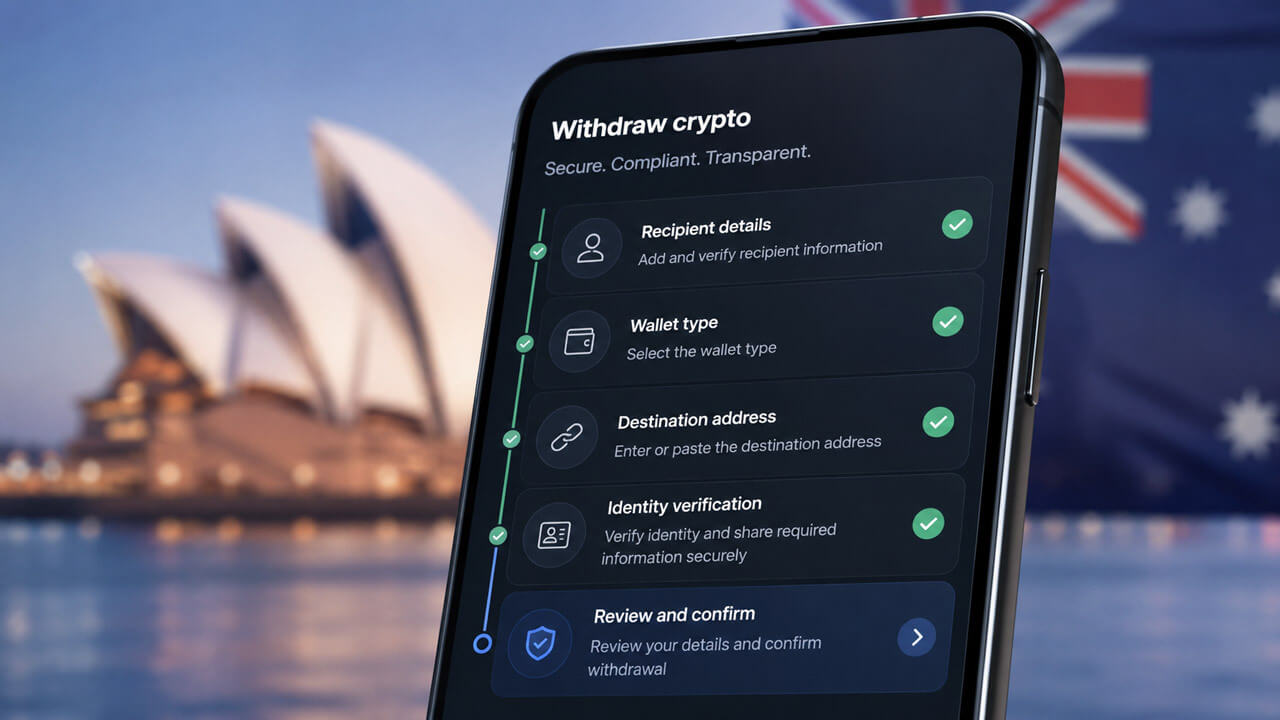
Australia’s July 1 AML/CTF deadline has turned regulated crypto transfers into a data workflow for exchanges and other virtual asset service providers.
Users can still hold and move crypto in self-custody. The friction begins when funds pass through a reporting entity, where a transfer instruction can trigger identity, wallet, counterparty, secure-messaging, and record-keeping checks before assets move or become available.
AUSTRAC’s transitional rules deferred some AML/CTF obligations for new registrable virtual asset services until July 1, 2026, including the rules covering transfers of value involving virtual assets.
The agency’s guidance says those deferred services were not required to comply with Travel Rule obligations for virtual asset transfers until that date.
That runway has now closed. For Australian exchanges and other virtual asset service providers, transfer instructions now carry more than an operational request.
They may require identity collection and verification, wallet classification, counterparty checks, secure message handling, and records linking the payer, payee, wallet, and transfer path.
How the transfer workflow changes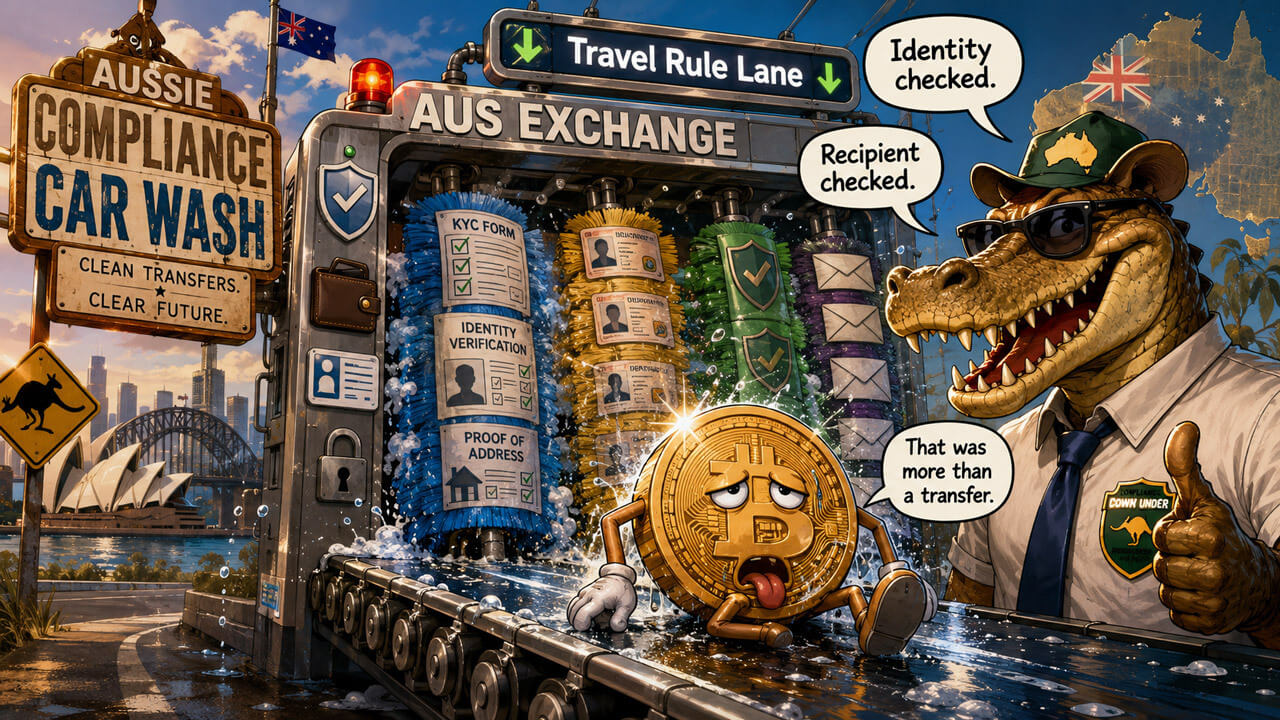
The sharpest user-facing detail is the absence of a small-transfer carve-out.
AUSTRAC’s guidance on when the Travel Rule does not apply states that there is no minimum amount for a value transfer.
The rule applies to international or domestic value transfers of any amount, unless a specific exception applies.
That turns compliance friction into a question of both transfer type and transaction size. Crypto users often associate additional checks with large withdrawals, suspicious flows, or bank-style thresholds.
Australia’s framework points to a different operating rule. The key question is whether a reporting entity is providing a covered value-transfer service.
For users, that can translate into more prompts, more required recipient or wallet information, and more delays when an exchange needs to classify a destination, resolve missing information, or decide whether the next institution in a transfer chain can receive data securely.
For exchanges, even routine transfers may require systems that consistently collect and route information, rather than relying on manual reviews only for higher-value activity.
The result is as much a privacy-and-friction story as a compliance story. A blockchain withdrawal may still settle on-chain as usual, but the regulated transfer process around it now includes a data layer that must be handled before or alongside the movement of assets.
Related Reading Australia plans clear crypto laws to boost innovation and investor safety Australia's crypto reforms will tackle debanking issues and assess tokenization laws for the country. Mar 22, 2025 · Oluwapelumi Adejumo
AUSTRAC’s Travel Rule overview describes a value transfer chain that begins whenever an institution accepts a payer's instruction to transfer value.
That chain can include an ordering institution, intermediary institutions, and a beneficiary institution.
In plain terms, the exchange that accepts a customer’s instruction may have to collect and verify payer information, collect the payee’s full name, and pass relevant transfer-message information to other businesses involved in the transfer.
A receiving institution may have to check whether information is missing or inaccurate before making the transferred value available.
This is why the July 1 date changes the experience of exchange-linked transfers. The crypto transaction itself is only one piece of the regulated workflow.
The business handling the transfer also needs to understand who is sending, who is receiving, what wallet or account is involved, and whether the information can move safely through the transfer chain.
The framework also makes repeat movements relevant. AUSTRAC says a new value transfer chain begins every time a payer instruction is accepted.
If a customer receives value into an account or custodial wallet and then instructs a separate transfer, that second movement can carry its own Travel Rule obligations.
That structure is likely to push exchanges toward more standardized withdrawal and deposit flows. Platforms need workflows that gather transfer data at the point of instruction and maintain enough information to satisfy both sending and receiving obligations.
What self-custody changes at the exchange boundaryThe most important boundary is self-custody.
AUSTRAC’s virtual-asset guidance includes a specific rule for transfers involving self-hosted wallets. A transfer to a self-hosted wallet is exempt from sending Travel Rule information to another business in the transfer chain.
But that still leaves compliance work for the regulated entity handling the transfer.
For an ordering institution sending virtual assets to a self-hosted wallet, AUSTRAC says the business must collect and verify payer information, collect payee information, and collect tracing information.
For a beneficiary institution receiving virtual assets from a self-hosted wallet, the business must obtain payer information and tracing information, and if it does not already hold it, the payee’s full name before making the assets available.
The same guidance also says businesses need policies for determining whether a transfer is to or from a custodial or self-hosted wallet, assessing whether a custodial wallet controller is licensed or registered under laws that give effect to FATF recommendations, and managing risk where a wallet is controlled by a person not required to be licensed or registered.
That is the distinction users will feel. Holding assets in a private wallet remains possible.
Moving assets between private wallets differs from sending through a reporting entity. But when funds enter or leave an exchange, the platform may need to ask more questions about the wallet and the person controlling it.
In practice, self-custody becomes less invisible at the exchange boundary. The wallet may sit outside another regulated institution, but the exchange still has to decide what kind of wallet it is dealing with, what information it needs, and whether the transfer can proceed under its AML/CTF program.
The July 1 date also falls within a regulatory perimeter broader than Australia’s older digital-currency exchange model.
AUSTRAC’s virtual asset designated services guidance covers exchanging virtual assets for money, exchanging one virtual asset for another, virtual-asset safekeeping services, and some financial services connected with the offer or sale of a virtual asset.
Related Reading Australia intensifies crypto ATM oversight to curb money laundering risks AUSTRAC task force targets non-compliant crypto ATMs to combat criminal exploitation. Dec 6, 2024 · Oluwapelumi AdejumoIts VASP overview also outlines the ordering and beneficiary institution roles for businesses that accept instructions to transfer virtual assets or make transferred virtual assets available to customers.
That framing is important because the user experience now extends beyond fiat-to-crypto onboarding. Custody, crypto-to-crypto exchange, transfer services, and issuer-linked financial services can bring businesses into the AML/CTF framework where the service has the required connection to Australia.
CryptoSlate’s Australia AML/CTF virtual-asset profile already tracks the broader reform timeline, including the March 31 commencement, the July 1 deferred-obligation date, and the July 29 registration deadline for providers beginning new registrable virtual asset services before July 1.
The live news now is the operational effect of that timeline: the obligation has moved from future compliance to being built into the transfer flow.
Why compliance tooling becomes part of the exchange productThe market consequence is straightforward: Travel Rule compliance is now product infrastructure.
AUSTRAC’s virtual-asset guidance requires businesses to determine wallet type, assess counterparty licensing or registration status, manage risks associated with self-hosted wallets, and consider whether transfer-message information can be transmitted securely and confidentially.
These legal obligations have product consequences. They require data collection, wallet intelligence, transaction monitoring, message routing, and record-keeping systems that fit inside a live exchange workflow.
Compliance firms have been positioning around that shift. Chainalysis described July 1 as a major milestone in Australia’s compressed compliance calendar, while 21 Analytics summarized the Australian threshold as applying to all transactions unless an exemption applies.
Those are vendor perspectives, but they point to the same operational reality created by the primary AUSTRAC rules.
Exchange-facing guidance is already translating the rule into user language. CoinSpot’s public support page on the Travel Rule says Australian exchanges and VASPs need to update how cryptocurrency is sent and received from July 1.
That is where the story meets users. A rule designed around information flows between institutions becomes a product-design problem: what does the platform ask for, when does it ask, how does it explain the request, and what happens when the other side of the transfer is a private wallet or a service that cannot securely receive Travel Rule data?
For users who value privacy, the change makes the trade-off more explicit. Self-custody remains available, but the regulated bridge between self-custody and exchanges is more likely to ask for information.
Related Reading Canada wants to ban crypto ATMs as fraud fears turn Bitcoin access into a political target Crypto ATMs helped bring crypto to ordinary users, but Canada now says they've have become too useful for criminals. May 2, 2026 · Andjela RadmilacFor exchanges, the competitive question becomes whether compliance can be handled without turning every transfer into a confusing support ticket.
The immediate answer for Australian crypto users is that regulated transfers can now carry more data obligations regardless of size. The immediate answer for exchanges is that July 1 turns Travel Rule readiness from a project plan into a live operating requirement.
The next signals are practical rather than philosophical. Watch whether Australian platforms add wallet-ownership checks, recipient-detail fields, longer review times, or clearer explanations around self-hosted wallet transfers.
Watch whether compliance vendors become more embedded in exchange withdrawal flows. Watch whether users respond by keeping more assets in self-custody, or by accepting more data sharing as the price of using regulated venues.
The rule preserves private crypto use in Australia while reshaping the regulated edge around it. From July 1, the simple question of where a user wants to send crypto can require an exchange to first answer a second set of questions: who is involved, what kind of wallet it is, what information must travel, and whether the transfer can proceed under AUSTRAC’s AML/CTF framework.
The post Australia’s new crypto transfer rules to make exchange withdrawals pass through identity checks appeared first on CryptoSlate.
Why this matters
Bitcoin is showing up inside the Regulation theme, so this story is worth tracking for follow-through rather than treating it as a one-off headline.
Original source
Read on CryptoSlateRelated market context
As traditional giants rush into digital dollars, USDD’s Yvonne Chia explains why 24/7 access, self-custody, and transparent yield give decentralized stablecoins an edge banks can’t replicate. 20 November – Road Town, Totorla, British Virgin Islands – Decentralized stablecoin protocol USDD is accelerating its multichain utility across TRON, Ethereum, and BNB Chain—combining automated sUSDD yield via its Smart Allocator with GasFree zero-TRX transfers—as traditional financial giants race to build competing stablecoin rails. In a recent industry interview with instant exchange partner ChangeNOW, USDD Head of Communications Yvonne Chia outlined why self-custody, 24/7 settlement, and transparent onchain reserves give decentralized digital dollars a structural advantage over bank-issued alternatives. 1. Permissionless Access vs. Gatekept Accounts For billions of people globally, opening and maintaining a traditional bank account still involves paperwork, minimum balance requirements, geographic restrictions, and approval delays. Even when banks integrate stablecoin rails behind the scenes, those services remain gated behind legacy compliance walls and intermediary control. Crypto-native stablecoins flip that model on its head. As Yvonne Chia highlighted during the interview: “Compare this to a stablecoin like USDD, where all you need is a phone, a working internet connection, you can immediately start a wallet and you have access to your funds right away.” With USDD, users can access and manage their digital dollars directly through their own wallets, without depending on traditional financial intermediaries. This represents a fundamental shift in financial access: users are no longer limited to the services, operating hours, or account structures of a single institution. Instead, they have the freedom to hold, manage, and transfer their assets on their own terms. Self-custody also gives users greater autonomy over their financial decisions. They can choose which wallets to use, where to transfer their assets, and which supported decentralized applications to interact with, without needing to route every transaction through a centralized financial institution. With USDD, users’ digital dollars can move with them across an open blockchain ecosystem, rather than remaining tied to a particular bank or service provider. 2. 24/7 Global Settlement vs. “Banking Hours” Legacy payment networks still operate on decades-old schedules: weekend cutoffs, bank holidays, and multi-day cross-border settlement delays accompanied by hefty wire fees. Blockchain networks never close. Whether it is a Sunday night or a public holiday, USDD moves globally without depending on traditional banking operating hours or settlement windows. “We are able to have transfers 24/7 and we’re not limited to any traditional banking hours. So I think that in some ways, stablecoins are not just becoming banks, but exceeding what traditional banks can offer to users.” To make everyday transfers even smoother than fintech apps, USDD introduced GasFree integration on TRON, allowing users on supported wallets to pay network fees directly in USDD without needing to hold TRX. This removes another practical barrier to stablecoin adoption: having to acquire and maintain a separate gas token just to transfer digital dollars. With GasFree, eligible users can pay approximately 0.5 USDD per transaction, compared with around 1.5 USDT for a standard USDT transfer under the referenced fee conditions. These improvements matter because the usefulness of a stablecoin is not determined by its peg alone. Low-cost transfers, straightforward wallet experiences, and around-the-clock availability are what make digital dollars practical for everyday payments and global value transfers. 3. Passing Yield Back to Users vs. Bank Spreads Perhaps the sharpest contrast between banks and decentralized stablecoins lies in how yield is distributed. In traditional banking, institutions take customer deposits, deploy them into yield-generating markets, and retain a significant portion of the returns. Everyday depositors may receive relatively low interest rates, while higher-yielding products often come with eligibility requirements, minimum deposits, or fixed maturity periods. Stablecoins introduce another way to participate in digital-dollar opportunities. Rather than keeping capital entirely within a traditional deposit account, users can access onchain yield opportunities through decentralized protocols and transparent investment mechanisms. USDD was built to return that value directly to holders. Through USDD Earn, users can deposit USDD to receive sUSDD, earning automated, competitive yield powered by our Smart Allocator system, with no fixed lock-up periods restricting access to their capital. For users, the distinction is important: USDD Earn provides access to a productive stablecoin while maintaining flexibility, rather than requiring users to commit their capital to a conventional fixed-term product. 4. Onchain Verification vs. Institutional Trust Traditional banks ask customers to trust closed-door balance sheets and periodic regulatory filings—until a crisis proves otherwise. USDD takes a different approach through its “Don’t trust, verify” ethos, emphasizing publicly accessible onchain information and independent verification. Onchain Transparency: Smart contract addresses, collateral reserves, and Smart Allocator deployments are publicly viewable, allowing users to examine relevant information directly on the blockchain. Structured Disclosures: Quarterly Treasury Reports provide additional information about reserve positions, financial performance, and operational developments. Independent Security Reviews: USDD undergoes third-party security audits to assess its smart contracts and identify potential vulnerabilities. Transparency does not eliminate financial or technical risks, but it changes how users can evaluate them. Instead of relying exclusively on an institution’s assurances, users have access to information that can be independently examined and verified. 5. Beyond a Single Network: An Open, Multichain Financial Ecosystem Financial freedom is not just about holding digital dollars. It is also about being able to use them wherever opportunities and applications exist. A stablecoin confined to a single network or limited use case cannot fully realize the potential of open blockchain finance. Following its January 2025 protocol upgrade, USDD expanded natively from TRON onto Ethereum and BNB Chain, extending its reach across multiple blockchain ecosystems. This multichain presence allows USDD to connect with different communities, liquidity environments, and decentralized applications. Its sUSDD product has also expanded into DeFi integrations, including Pendle and Morpho, giving users additional ways to access yield strategies across supported ecosystems. The bigger picture is an interconnected financial ecosystem in which users can move between holding, transferring, exchanging, and deploying their stablecoins according to their own needs. These are not isolated functions. Together, they make stablecoins more useful as everyday financial infrastructure. The Future: Interconnected, Open, and Multichain Banks will undoubtedly continue using stablecoin rails to modernize their back-end settlement. However, true financial freedom comes from open networks where assets flow freely across protocols without intermediaries. For USDD, the opportunity goes beyond offering a dollar-pegged asset. It is about making digital dollars accessible, transferable, and productive across an interconnected financial ecosystem. From self-custody and 24/7 transfers to flexible yield opportunities and multichain DeFi access, these capabilities give users more ways to put their money to work. Banks may be bringing stablecoins into traditional finance. Crypto-native protocols are showing what stablecoins can make possible beyond it.
As traditional giants rush into digital dollars, USDD’s Yvonne Chia explains why 24/7 access, self-custody, and transparent yield...
Coinbase receives $237M USDC transfer from unknown wallet
The large USDC transfer to Coinbase highlights the exchange's pivotal role in stablecoin liquidity, potentially signaling increase...

Samsung Wallet brings USDC transfers on Sui to 82 million US Galaxy devices
Samsung's integration of USDC on Sui into Galaxy devices could significantly boost stablecoin adoption and reshape digital asset t...

Thai cyber police raid Chiang Mai exchange shop tied to 2.7 million USDT wallet
The raid highlights vulnerabilities in Thailand's crypto market, emphasizing the need for stricter regulations to combat transnati...

Coinbase moves 127,745,921 USDC from institutional arm to its exchange
Coinbase's internal USDC transfers highlight the growing importance of stablecoins in liquidity management and operational efficie...
UK to ban crypto exchanges from making markets on their own platforms as Bitcoin rules change
Firms making markets in spot Bitcoin on qualifying platforms are exempt from principal-dealing permission for that activity. Separ...