Binance will hold some Brazil crypto deposits until users explain where the money came from
Binance will require Brazilian users to provide additional information for cross-border crypto transfers starting Nov. 1. The exchange said customers sending crypto abroad or receiving it from nonresidents must disclose...
Watchlist
Published in the last two hours. Multiple named entities are involved.
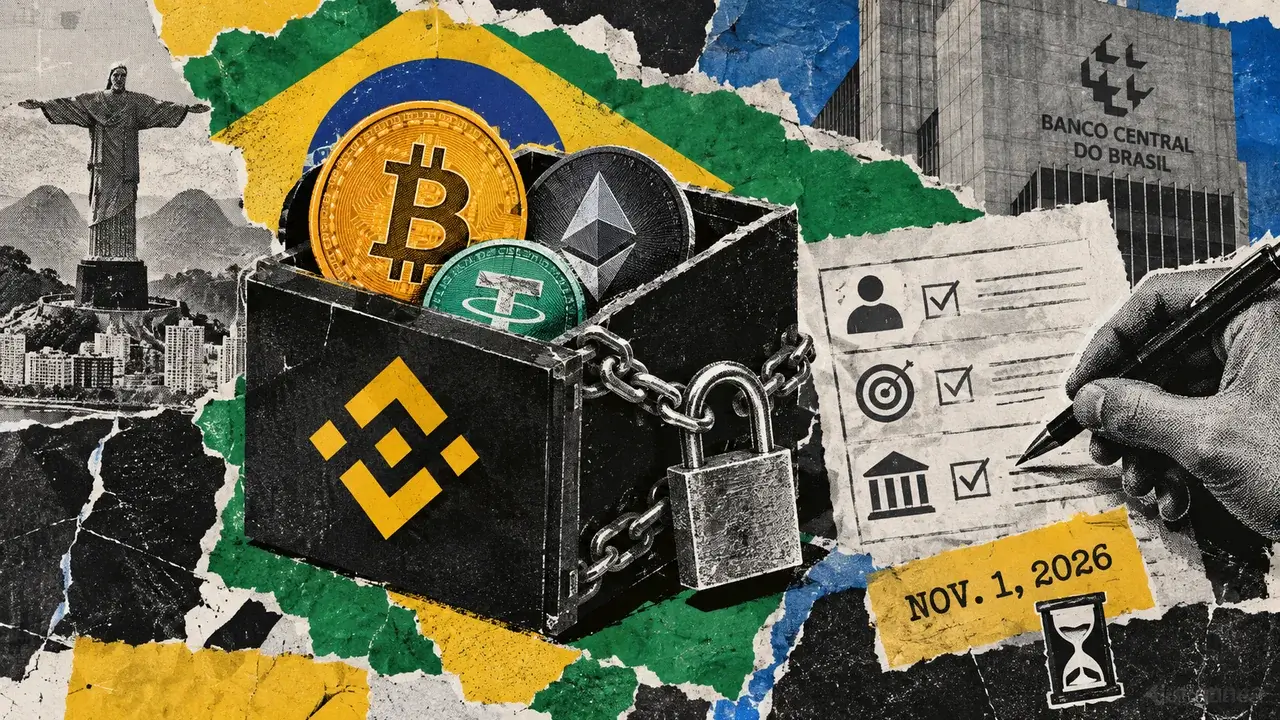
Binance will require Brazilian users to provide additional information for cross-border crypto transfers starting Nov. 1.
The exchange said customers sending crypto abroad or receiving it from nonresidents must disclose the purpose of each transfer and identify the counterparty type. Corporate accounts must also say whether the other party belongs to the same economic group.
Binance will report the transactions monthly to Brazil’s central bank under Resolution BCB No. 521/2025, which brings international virtual-asset transfers into the country’s foreign-exchange framework.
The requirement creates a new compliance checkpoint for cross-border crypto flows. Withdrawals cannot be submitted until the questionnaire is completed, while incoming deposits can remain pending and, in some cases, be returned if users fail to provide the required information.
The rules apply to individuals and companies transferring crypto to or from nonresidents, including customers moving assets to their own accounts on foreign exchanges. Transfers between Brazilian residents are unaffected.
They arrive as Brazil broadens its oversight of a crypto market that Chainalysis estimated handled $252.5 billion between July 2025 and June 2026. Brazil ranked first overall in the firm’s 2026 adoption index and second for cross-border flows, though activity contracted 1.6% during the period.
Brazil tightens oversight of crypto flowsThe Binance changes form part of a broader Brazilian push to bring crypto payments, self-custody and cross-border transfers deeper into the country’s financial-surveillance and foreign-exchange framework.
That effort already includes new reporting obligations for transactions involving self-custody wallets. Regulated institutions must report crypto transfers worth at least $10,000 to or from such wallets to Brazil’s Financial Activities Control Council, or Coaf, by the next business day, even when the transaction has not been flagged as suspicious.
Related Reading Brazil’s $252 billion crypto market gets $10,000 self-custody reporting ruleBrazil has also restricted the use of stablecoins and other virtual assets in a specific aggregated cross-border payment structure used by foreign-exchange providers. Individual international crypto transfers remain permitted, but settlement between eFX firms and overseas counterparties must now pass through licensed FX transactions or qualifying nonresident real accounts.
The restriction reaches a market where stablecoins have become deeply embedded in payments and foreign-exchange activity. Brazilian tax data showed R$1.13 trillion in declared stablecoin transactions between August 2019 and December 2025, accounting for about 72% of declared crypto activity over the period.
Binance’s new procedures extend that framework to the information collected on individual cross-border transfers. Transactions of as much as $50,000 use a simplified list of 10 purposes, while larger transfers require customers to choose from 96 classifications. Certain international transfers are capped at $100,000 when the counterparty is not authorized to operate in Brazil’s foreign-exchange market.
Customers sending crypto to their own account on a foreign exchange will have the purpose and counterparty details populated automatically and only need to confirm the declaration.
Self-hosted wallets follow a separate process. Users do not need to provide a transfer purpose but must confirm wallet ownership, and Binance will report those transactions to the central bank under a distinct category.
The exchange said the requirements are separate from Brazil’s Travel Rule, which is scheduled to take effect in phases for domestic transactions in 2027 and international transfers in 2028.
Brazil’s regulatory rollout will tighten further on Jan. 1, when Resolution BCB 584 introduces precautionary holding procedures that can delay certain outbound virtual-asset transfers while additional checks are carried out. Binance said it will provide more details before its Nov. 1 changes take effect.
The post Binance will hold some Brazil crypto deposits until users explain where the money came from appeared first on CryptoSlate.
Why this matters
Binance is showing up inside the Stablecoins theme, so this story is worth tracking for follow-through rather than treating it as a one-off headline.
Original source
Read on CryptoSlateRelated market context

XRP Price Prediction: Ripple Range-Bound at $1.50, Breakout Soon?
XRP price prediction shows Ripple entering October still trading within a broad range. XRP is currently around $1.50, with key res...

Visa Says Business Payments Now Drive 17% Of Stablecoin-Linked Card Volume
TL;DR Visa says roughly 17% of its stablecoin-linked card volume in fiscal 2026 year-to-date came from business and commercial car...

Stablecoin issuers have replaced 40% of China’s lost US Treasury demand
Stablecoin issuers are emerging as a new source of demand for US government debt as foreign official holdings lose ground. Tether...

Brazil Pits Lula’s Crypto Crackdown vs. Bolsonaro’s Wildcard Stance
The Brazilian election is right ahead, and the cryptocurrency policies of the country, which is ranked as the number one in crypto...

American Bankers Sue OCC Over Crypto Bank Charters, Challenging Coinbase and Circle
The lawsuit, filed October 2 in the U.S. District Court for the District of Columbia, puts the growing role of crypto firms within...

XRP Asia Launches With Ripple Backing to Accelerate XRPL Adoption
XRP Asia has launched with Ripple and the XRP Ledger Foundation backing to expand XRPL adoption across Asia-Pacific. The Singapore...