BitMEX shuts down without an FTX style crisis, revealing where crypto’s real danger has moved
BitMEX completed a review of its business and will close on Sept. 23, telling customers to close their positions and withdraw funds before then. The announcement came with no balance-sheet hole, withdrawal freeze, or ban...
Archive context
Older archive item. Useful for background and entity history, but not a fresh market-moving signal.
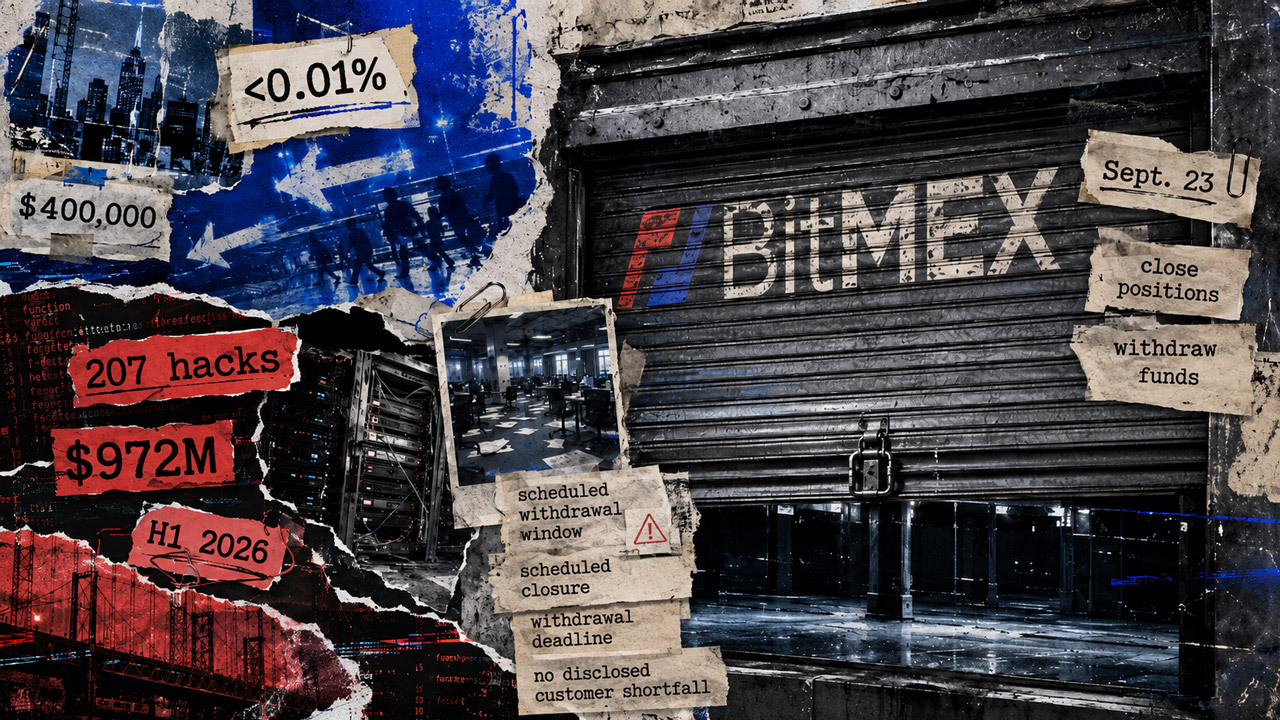
BitMEX completed a review of its business and will close on Sept. 23, telling customers to close their positions and withdraw funds before then.
The announcement came with no balance-sheet hole, withdrawal freeze, or bankruptcy filing, with Kaiko data putting BitMEX's market share below 0.01% and its daily volume near $400,000.
That combination makes BitMEX's exit a different kind of crypto headline during bear markets, one where traders migrated to deeper liquidity elsewhere, and the exchange is closing simply because its business became too small to sustain.
Related Reading BitMEX shutdown gives traders 2 months to withdraw, but active positions face an earlier deadline Reduce-only trading begins Aug. 26, with forced closes possible before exchange services end Sept. 23. Jul 23, 2026 · Liam 'Akiba' WrightA former crypto giant failing without triggering a financial crisis is a signal worth reading.
Failure type 2022 CeFi collapse 2026 BitMEX shutdown Main cause Hidden leverage, credit exposure, customer-asset misuse Loss of market share and commercial relevance Customer impact Withdrawal freezes, bankruptcy claims, trapped assets Scheduled withdrawal window Market structure Interconnected lenders and exchanges Isolated business wind-down Contagion risk High, through shared borrowers and counterparties Limited, due to tiny market share Symbolic meaning Insolvency exposed the boom’s hidden leverage Obsolescence exposed a former giant’s loss of relevance When BitMEX ruled perpetual swapsBitMEX launched XBTUSD in May 2016, a contract it described as the industry's first perpetual swap, and other exchanges spent the next decade copying and scaling that format as BitMEX itself lost ground to deeper, more liquid competitors and never got it back.
Binance, Bybit, OKX and, more recently, decentralized perpetual platforms all built some version of the same margin trading contract, spreading the format across a market BitMEX itself no longer meaningfully participates in.
The 2022 failures ran through shared borrowers, credit lines and rehypothecated collateral. Each firm's solvency depended partly on the others staying solvent, so one failure pulled the next one down.
BlockFi filed for bankruptcy within weeks of FTX's collapse, as it had relied on a $400 million FTX credit facility, and Voyager, Celsius and Genesis had already gone bankrupt or halted withdrawals once the Terra/Luna collapse hit the sector months earlier.
The Justice Department said Sam Bankman-Fried orchestrated one of the largest financial frauds in history, stealing over $8 billion in customer money that funded personal spending, investments, political contributions and loan repayments to Alameda.
BitMEX's shutdown avoids those ingredients via a scheduled closure, the product of a business review, with a withdrawal deadline and no disclosed customer shortfall.
The drawdown so farBitcoin peaked near $126,000 in October 2025, and trades around $64,884 as of July 23, a decline of roughly 48%.
Prior completed cycles fell further before finding a bottom: roughly 84.7% in 2013-2015, 83.7% in 2017-2018, and 77.1% in 2021-2022, according to Bitcoin.com's drawdown tracker.
That gap is real, and it is also incomplete information. A 50% drawdown can still deepen, and historical drawdown bands describe past cycles without predicting when this one ends.
Bitcoin’s current 48% drawdown remains well below the 77% to 85% declines recorded at the previous three cycle bottoms.Whether that disconnect holds depends on what is different this cycle. Spot Bitcoin ETFs, institutional custody arrangements, and less centralized margin debt across the market could all be dampening this cycle's swings, or the decline could have further to go before it matches prior bottoms.
BlockFills, a firm with more than 2,000 institutional clients and over $61 billion in 2025 trading volume, paused client deposits and withdrawals in February as prices fell and said it was working to restore liquidity.
TRM Labs recorded 207 crypto hacks in the first half of 2026, the highest six-month count in its data, more than double the 83 incidents in the same period last year. Losses fell to about $972 million from $2.3 billion over that same stretch.
Smart contract exploits drove most of that incident count, and infrastructure and operational compromises like KelpDAO's accounted for a disproportionate share of the dollar losses.
On Apr. 18, Chainalysis linked the roughly $292 million KelpDAO theft to North Korea's Lazarus Group and traced it to compromised internal RPC nodes, DDoS attacks on external nodes, and false data fed into a verification system.
Where the cycle goes from hereIn the bull case, Bitcoin's drawdown bottoms somewhere between 45% and 55%. Weak venues keep shutting down or getting acquired without a major exchange or lender shortfall, and exploit losses continue below 2025 levels.
That would leave this cycle's centralized failures looking structurally different from 2022's.
In the bear case, the drawdown extends toward 70% to 75%. One or more centralized lenders or custodians freeze withdrawals or restructure, DeFi losses climb as liquidity thins and governance responses slow, and the case for a less destructive cycle weakens.
Scenario Bitcoin path CeFi signal DeFi signal What it would mean Bull case Drawdown holds near 45%–55% Weak venues shut down or get acquired without customer shortfalls Exploit losses stay below 2025 levels Centralized crypto looks more mature, even if DeFi remains risky Base case Drawdown deepens but avoids prior cycle extremes More small firms wind down or restrict services Hack count stays high but losses remain contained The cycle is painful but less systemically destructive than 2022 Bear case Drawdown reaches 70%–75% A lender, custodian or exchange freezes withdrawals or restructures DeFi losses climb as liquidity thins The “better bear market” thesis weakens Black swan Drawdown exceeds prior-cycle levels A major CeFi shortfall appears A major bridge, governance or infrastructure failure compounds losses The cycle starts to resemble 2022 againCentralized exchanges are learning to close for ordinary business reasons, without a shortfall or a freeze behind the headline, a form of progress the money moving through code has not matched this cycle.
That risk moves through code, bridges, governance, and infrastructure most users have no way to check before they deposit funds. Six months, 207 hacks and $972 million in stolen funds make the point.
The post BitMEX shuts down without an FTX style crisis, revealing where crypto’s real danger has moved appeared first on CryptoSlate.
Why this matters
Bitcoin is showing up inside the Security Incidents theme, so this story is worth tracking for follow-through rather than treating it as a one-off headline.
Original source
Read on CryptoSlateRelated market context

Sui’s Hashi Launches With $500M to Turn Bitcoin Into Productive DeFi Collateral Markets
Key Takeaways: With more than $500 million in locked-in tokens, Hashi will launch its phased mainnet launch. The protocol enables...

Bitcoin Price Prediction: Can BTC USD Hold $82K Ahead of Next Week’s CPI Drop?
Bitcoin price prediction notes a brief recovery on Saturday, October 10, but the market remains poised for a weekly loss as rising...

AI Could Weaken Ethereum Security as Cryptographic Risks Grow, Vitalik Buterin Warns
Buterin urged developers to prepare for potential AI vulnerabilities in both conventional and quantum-resistant cryptography, whil...

What Is Crypto Spot Trading?
For example, a token can be up 70% and still be a terrible trade if you have no idea when to take profits. Likewise, a 30% dip can...
Ethereum open interest rose 2.3% in ETH on Binance as its dollar value fell 6.6%
Ethereum open interest in Binance’s ETHUSDT futures contract was 2.27% higher in ETH on Thursday, Oct. 8, over the last 48 hours,...

Aave MCP now connects with MetaMask Agent Wallet for AI-driven DeFi actions
AI-driven DeFi integration enhances automation and security, empowering users with greater control and developers with streamlined...