Kraken Prime and the SoFi collaboration: what best execution looks like at scale
Payward, the parent company of Kraken, and SoFi Technologies announced a strategic partnership today connecting banking, payments and digital asset markets. Payward is joining the SoFi Exchange Network’s real-time settle...
Archive context
Older archive item. Useful for background and entity history, but not a fresh market-moving signal.

Payward, the parent company of Kraken, and SoFi Technologies announced a strategic partnership today connecting banking, payments and digital asset markets.
Payward is joining the SoFi Exchange Network’s real-time settlement rails, listing its bank-issued stablecoin, SoFiUSD, on Kraken, with SoFi routing its digital asset order flow through Kraken Prime for trade execution, with qualified custody capabilities to follow as the relationship grows. Kraken Prime’s institutional and business clients will also get access to SoFi’s Big Business Banking and its SEN settlement network, giving them a regulated banking partner that settles fiat in real time, 24 hours a day.
This post is about the role Kraken Prime plays, and how prime brokerage connects to a retail-facing app.
What prime brokerage doesA prime broker is a firm that sits between an institutional or corporate client and the market, handling execution, custody and financing through one relationship. In traditional finance, that’s the model Goldman Sachs or Morgan Stanley run for hedge funds.
A fund doesn’t need a direct account with every venue it wants to trade on; the prime broker aggregates access, manages collateral, and reports on positions across venues in one place.
Crypto’s version of that model exists for a reason: without it, a trading desk looking to route flow to multiple venues has to prefund each one, reconcile balances separately, and manage counterparty exposure venue by venue. That’s a lot of operational friction to carry just to get a reasonable price.
Kraken Prime, which launched in 2025, is a good example of how a prime broker addresses this problem. It combines services like trading and custody into one platform, so institutional clients – or a partner like SoFi – can deal with just one counterparty instead of managing that fragmentation on their own.
To make this work, Kraken Prime utilizes a smart order routing system to read pricing and depth across supported venues in real time and routes each order to wherever it fills best.
Kraken Prime’s role in the collaborationMillions of SoFi members already buy and sell crypto inside the SoFi app. By collaborating with Kraken, those orders now route through Kraken Prime, which works to get the best available price across a range of venues rather than filling every order against a single order book.
This means SoFi now has access to an execution layer with considerably more liquidity than any single-venue setup. For the end customer, that shows up as better pricing on trades, without any change to how the app itself works.
That’s the mechanical answer to what “best execution” means in practice: not a single venue that’s always right, but a routing decision made order by order, across a pool of liquidity that’s deeper than any one venue could offer on its own.
It’s the difference between a prime broker and a plain exchange account: the exchange gives a client access to its own book, while the prime broker gives a client access to a market.
Part of a broader patternSince moving into the institutional space, Kraken has built relationships with some of the most established names in traditional finance: Deutsche Börse on FX and derivatives infrastructure, Nasdaq on an xStocks-powered equity token gateway, Franklin Templeton on tokenizing its ETFs, and now SoFi, a nationally chartered bank with 15.8 million members.
Each of these relationships is a different entry point into that same convergence: tokenized equities through Nasdaq, fund infrastructure through Franklin Templeton, FX and derivatives through Deutsche Börse, retail banking distribution through SoFi.
Digital asset infrastructure is increasingly running underneath products that already look and feel like traditional finance. SoFi customers buying crypto in the app they already use for their paycheck won’t see Kraken Prime at work.
What they’ll get is a better price on a trade they were already making, one small piece of a much larger shift already underway.
Explore Kraken PrimeThe post Kraken Prime and the SoFi collaboration: what best execution looks like at scale appeared first on Kraken Blog.
Why this matters
Kraken is showing up inside the Institutional Adoption theme, so this story is worth tracking for follow-through rather than treating it as a one-off headline.
Original source
Read on Kraken BlogRelated market context

SoFi Launches 4.40% APY Tokenized Deposit With FDIC Cover and 24/7 Crypto Access
Key Takeaways: SoFi launched a variable 4.40% APY tokenized bank deposit service named SOFIE. Each SOFIE signifies $1 deposited wi...
SoFi Launches Yield-Bearing Tokenized Bank Deposit With Stablecoin Conversion
TL;DR: SoFi says its new SOFIE tokenized deposit represents money held at SoFi Bank, advertises 4.40% APY subject to terms, and ca...
Chainlink And LG CNS Target South Korean Banks With Digital Asset Infrastructure Deal
TL;DR: Chainlink and LG CNS are partnering on oracle and cross-chain infrastructure aimed at South Korea’s financial institutions;...
Grayscale Tracks 580% Crypto Winner Targeting AI Computing Revenue
Grayscale is highlighting three crypto projects addressing artificial intelligence (AI) training data, hardware financing, and com...
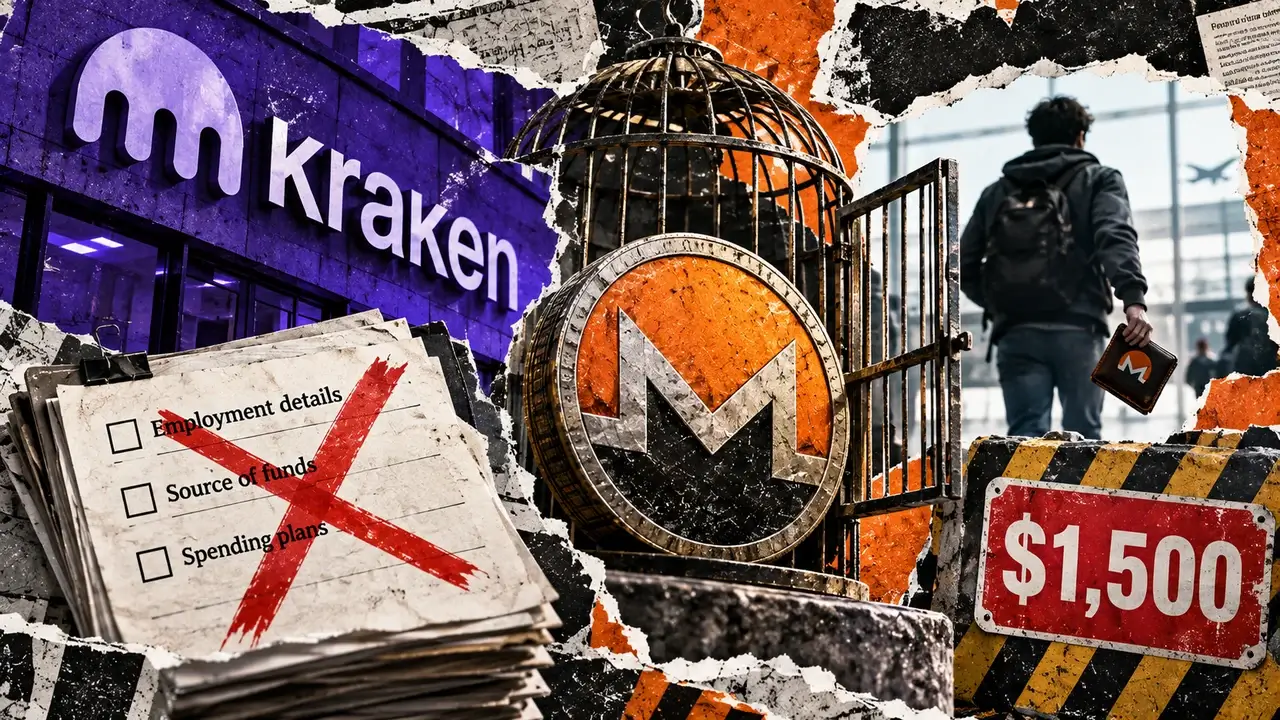
Kraken drops Monero spending questions but keeps a $1,500 rolling 30-day withdrawal cap for individuals
Crypto exchange Kraken has withdrawn intrusive compliance demands sent to Monero customers after its co-CEO admitted the requests...
SEC Puts Tokenization On Its 2027 Examination Agenda
TL;DR: The SEC has named tokenization among its fiscal 2027 examination priorities, bringing the systems behind blockchain securit...